


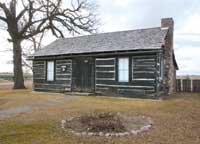
Sioux City's oldest building received a much needed face-lift this past year, enabling future generations of residents a chance to see the home of fur trader Theophile Bruguier.
"We plan to hold an open house this spring to show off the cabin," Kerry Gill, the city's parks and recreation director, said. "The city also plans to install a new sign outside the cabin."
The cabin, now located in Riverside Park, was built by French fur trader Bruguier, considered the first white settler in what became Sioux City. The Girls of '68 now operates the cabin, while the city helps pay the bills.
"Bruguier's life story is intertwined with Sioux City's history, like threads in a quilt," Marvis Hendrickson of the Girls of '68, said.
The Girls of '68 have overseen much of the renovation work through the years.
People are also reading…
Last summer, the City Council awarded a $17,687.95 contract to Terrasol Restoration & Renovation Co. of St. Peter, Minn., which specializes in historic restorations. Of that amount, $10,000 came from a grant from the Missouri River Historical Development (MRHD) Board. The city picked up the remaining $7,687,95 of the cost. In November, the council authorized an additional $6,536 bill to make repairs to the more-than-century-old cottonwood logs.
That contract came after the Girls of '68 paid Mark Johnson of Terrasol Restoration $260 to examine the cabin and make recommendations on repairs. When he started the work, he discovered that the logs had deteriorated far more than previously determined.
"He discovered that Mr. Bruguier had hewn the logs on three sides, but left the bark on the fourth side," Hendrickson said.
Gill explained that the bark has created "a sponge-like surface, which soaked up water and contributed to log deterioration."
Hendrickson added, "The chinking gave way because of the moisture, so the actual logs began to sag. Some of them are bowed."
Gill said the nails placed to hold the chinking were only put into the lower half of the joint allowing the chinking to easily separate from the upper log and funneling rain into the bark-covered joint areas.
Terrasol Restoration removed all exterior chinking, replacing it with acrylic on foam backer board. The southeast corner of the cabin has shifted due to settling since it was inspected, Gill noted. The logs had to be replaced in that section to straighten the wall.
Specifically, Terrasol did the following repairs:
-- Replaced approximately 50 linear feet of logs that are partially or fully rotten;
-- Repaired or replaced the cabin's chinking;
-- Treated the entire cabin with a preservative to prevent rot due to moisture and insects;
-- Repaired a portion of the rotted ridge beam.
Hendrickson said the Girls of '68 have obtained grants from the MRHD Board and Siouxland Foundation to replace the roof and do other repair work.
She said her research shows Bruguier built the cabin in 1849 as part of a trading post settlement near the mouth of the Big Sioux River, where it meets the Missouri River. Bruguier built another house around the cabin in 1862.
The original cabin wasn't discovered again until 1932. In the 1930s, a work crew from the Civilian Conservation Corps dismantled the cabin, log by log, and moved it to its current location in Riverside Park.
Bruguier died in 1896. He now is buried on a bluff overlooking the confluence of the Missouri and Big Sioux rivers where Chief War Eagle is buried, along with his two daughters who Bruguier married and two 4-month old baby girls.


