


In the time honored tradition of the American literary protagonist, James Calvin Schaap had to leave home to find home. So he headed west.
Schaap grew up in Oostburg, Wis., a Dutch Calvinist enclave on the western shore of Lake Michigan. It wasn't until he began looking for a college to attend after high school, 1966, that he set his compass toward Sioux County, Iowa, and the roots of his forbears. There was really no great mystery, or even yearning, involved.
"My grandpa said, 'You're going to go to Dordt,'" Schaap recalled. After all, his grandfather, John C. Schaap, reasoned, the boy's great-grandparents, C.C. and Neltje Schaap, were buried in Orange City, not far from the college's Sioux Center home. And Dordt College was aligned with Christian Reformed Church, same as the Schaap family.
Twenty-seven years later, Schaap, 56, is a professor of English at the college that introduced him to writing, the importance of story, and to his own story. Since leaving Oostburg, Schaap has written about 20 books, starting in 1979 with "Sign of a Promise, and Other Stories," a collection based on historical accounts of life on the Great Plains and written after Schaap returned to Northwest Iowa to teach. "Alex Haley's 'Roots' was big then, and it was the Bicentennial, too," Schaap said of his motivations for writing it.
People are also reading…
The subject matter was linked in many respects to Schaap's great-grandfather's emigration as a boy from Holland to South Dakota's Charles Mix County in the 1870s. The book bears a genuine family photo of that time and place on its cover, although the stories are fictional. In real life, his great-grandfather's family stayed only 10 years in South Dakota. The land could not support them. The Schaap "tribe" headed for Sioux County.
Another novel, "Touch the Sky," uses the Native American Ghost Dance as a key story element in the massacre at Wounded Knee, in the Dakota Territory. It examines the conflict between the white Dutch settlers there during the 1880s and '90s, the harshness of the land and how a man who had lost everything came to reclaim his faith through his lengthy rescue of a pregnant American Indian girl.
"I wouldn't dare to enter the Indian mind," he said. "But, as I like to tell my own students, your imagination can go anywhere. When I suddenly realized my own grandparents were close to the Rosebud Reservation, that gave me the freedom to write that story from the viewpoint of my ancestors -- I've got some DNA right there.
"I got enthralled by the Ghost Dance phenomenon," Schaap said. As he interprets it, the dance adapts Christian characters into American Indian spiritual tradition. "It's Messianic -n if they would dance it, all the right people would disappear and the buffalo would come back. Also, it made you impervious to whites' bullets."
In his research Schaap visited Little Big Horn during a big celebration. The Black Feet, Lakota and Crow tribes were represented, as well as Custer aficionados. Dancers and drummers performed.
"I thought, if my great-grandfather heard this, heard the Native singing and dancing they must have been scared out of their minds. There was nothing like it in the music of the German or Swedish Lutherans or Czech Catholics he would have been familiar with."
Schaap wants page-turners
For all the religious themes in his works, Schaap does not consider himself a "Christian" writer, and the majority of his sales are not in Christian bookstores.
"You simply want people to turn pages. I want to tell the best possible story you can. But I won't deny my Calvinist blood which says all work should be dedicated to purpose.
"I am not interested in preaching; preaching is the death of literature," Schaap said. "I think, if anything, my writing reflects my hope. At the same time, I don't engineer it to that. And I'm often surprised by what I believe."
'I was going to be a coach'
"I'm not one of those child prodigies," Schaap insists. "I spent all my time in high school in athletics. I was going to be a coach. But I had one professor -- she said, 'You're going to be a writer.'"
At Dordt, Schaap read "Winesburg, Ohio" by Sherwood Anderson, and "The Secret Place," by Frederick Manfred, a writer from Doon, Iowa, a town not far from Sioux Center and one that was very much like Oostburg.
He recognized every character. "It never dawned on me writers would write about people I know," Schaap said, as if still struck by the wonder of it. "A lot of emphasis then was on English literature, not American."
So he majored in English rather than athletics, then earned his master's degree from Arizona State University. Schaap later headed to the University of Wisconsin-Madison for his doctorate in early American literature. He also produced "Home Free," his first novel, as part of his doctoral program. It was published in 1985.
He has also written nonfiction, including a history of the Christian Reformed Church. "They wanted a storyteller, not a historian," he said.
His places, his stories
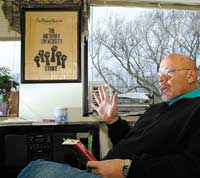
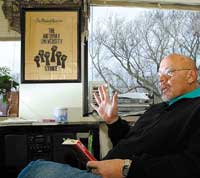
Today Schaap teaches early American literature and writing at Dordt. His office walls reflect his own story. There's a photo of his boyhood lakeshore environment -- "I grew up right over that band of trees." Of an anti-war poster he said, yeah, he protested against the war in Vietnam, but it's not as if Dordt was a hotbed of SDS activity.
And, there's a painting of a steamship engulfed in flames. It was the Phoenix, going down in 1847 near Sheboygan Harbor with more than 200 Dutch immigrants aboard, the greatest Great Lakes disaster of the 19th century. Its story appears in "Sign of A Promise." "Of course, it's quote-unquote 'my people,'" Schaap said. "You don't hear much about it. They were immigrants. If 200 immigrants die in 1847 or if they die now ... they really didn't count. They weren't 'real' Americans."
And, there is a large photo, taken by Schaap. A rosy sunset fills the sky, turning everything beneath the uninterrupted horizon dark and formless. It's an emptiness Schaap was not familiar with growing up in Wisconsin.
"I don't think people ever really fall in love with this area," he said. "You sort of learn to deal with it. And you can learn to respect it. But this is not a sweet place to live. It's beauty is in its openness. Of course, the men found this incredibly attractive. It's so awe inspiring."
It can get in a writer's blood, too.
Schaap has two books in progress. In addition to "55 and Counting," a reprise of his collection, "35 and Counting," Schaap is nearly finished with "Sioux County Folks." In it he tells the area's story through the stories of 52 of its residents, complete with photo portraits.
"It sort of changed some things about people I thought I knew," Schaap said. "Folks" is set for publication late this fall, in time for Christmas. And who knows, it might be the gift that inspires another young writer, someone who sees himself, or herself, in it.


