


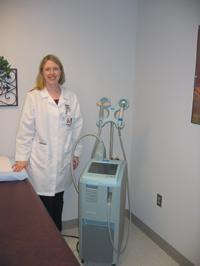
Laser treatments for unsightly skin blemishes and excess hair are now available at the new Midlands Laser Center in Dakota Dunes.
The laser treatments are administered by Dr. Michelle Daffer and laser technician Jane Olson, R.N., using a state of the art Nd:Yag laser.
Daffer, a board-certified dermatologist with Midlands Clinic, has dedicated a large amount of her time to learning about lasers. She recently completed three years of residency training in Dermatology at Texas Tech University, which focused on skin conditions, and hair and nail disorders, and included comprehensive instruction on the many types of lasers used today. Part of her training involved learning how to perfect the settings and understand the physics behind the laser.
The word "laser" stands for light amplification by stimulated emission of radiation. Lasers emit one wavelength of light, typically in the visible spectrum. They work by one wavelength of light targeting one of three substances in the body known as chromophores. These chromophores include water, brown pigment (melanin/age spots) or red pigment (blood). The laser light is absorbed by the chromophores and heated until it is destroyed.
People are also reading…
Daffer said each laser's target determines which conditions it will treat. If water is the target, it can destroy skin cells, the keratinocytes. Doing this will completely resurface the area of skin treated. This type of laser works well for acne scarring and deep wrinkles. It can also be used to destroy the skin that is infected with the wart virus. This laser requires weeks of recovery to allow the skin to heal.
If brown pigment is the target, it can treat lesions that have increased amounts of a person's natural coloration, melanin or foreign coloration, and dark tattoo dyes. Several different wavelengths of light can heat and destroy this brown pigment. These types of lasers can treat brown age spots ("liver spots") and tattoos, and can be used for hair removal. However, one type of laser cannot be used for all three, said Daffer, a fellow of the American Academy of Dermatology.
"Hair removal requires the type of laser to heat slowly, whereas tattoos require a sudden burst of intense light. Age spots improve with either form. The recovery time is quick with these types of lasers, and often only mild discomfort is experienced during the procedure," she said.
If the target is red pigment, it can treat blood vessel growths. Several different wavelengths target red blood cells. These lasers can treat spider veins on the legs, angiomas, red birthmarks and increased blood vessels on the face. The recovery time is very short for these procedures, and patients typically experience a small amount of redness and mild bruising for one to two days, she said.
The Nd:Yag laser used by Midlands Laser Center has a wavelength of 1064 nanometers (nm), and targets both brown and red pigments.
One laser can treat many different conditions by adjusting the settings. Even though the wavelength is essential to getting the target chromophore, how the chromophore is heated is also important, she said.
Daffer and Olson can adjust the size of the treated area with the laser, the strength or intensity with which the laser hits, and the length of time the laser hits an area.
These features allow the laser to act differently depending on what is being treated, she said.
"Again, if the laser is set at low intensity for a longer period of time, it will heat up hair follicles and cause hair loss, but if the same wavelength of light is stored and then fired very intensely and quickly, it will destroy tattoo pigment," she said. "These two examples are on the extreme ends of the changes in intensity and time, and most machines do not have the capability to do both hair removal and tattoos."
The Nd:Yag laser at Midlands Laser Clinic treats age spots, blood vessel growths, red birthmarks, facial blood vessels and spider veins, and removes hair. Their laser also has a feature that stimulates collagen growth to treat fine lines, wrinkles and acne scarring. It does not treat tattoos.
The number of visits required to treat a condition varies. For the majority of patients, it takes one visit for facial veins and at least two visits for leg veins. For patients seeking hair removal, it can take anywhere from five to eight visits. It depends how large the area is and how much hair must be removed, said Daffer, who also treats skin cancers, and performs cosmetic procedures such as Botox and chemical peels.
"With a normal hair cycle, not all hair shows at one time," she said. "The hair cycle has three phases, the growth, resting and falling out phases. By repeating treatments every five to six weeks, it helps get the cycle of growth that was missed last time. It ensures that you get the hair follicle at the right stage to treat it effectively."
Daffer said patients may experience a warm sensation when the laser is used, but any mild discomfort dissipates within a couple of seconds. Any redness usually goes away in a short amount of time as well. Individuals can resume their normal activities after the laser treatments, but Daffer recommends that they use sun protection and apply moisturizer to affected areas.
For more information about the laser treatments available at Midlands Laser Center, call (605) 217-5500. Midlands Laser Center is located inside of Midlands Clinic, 705 Sioux Point Road, in Dakota Dunes. The Laser Center is open 9 a.m. to 2:30 p.m. Monday and Wednesday, and other times by appointment.


