


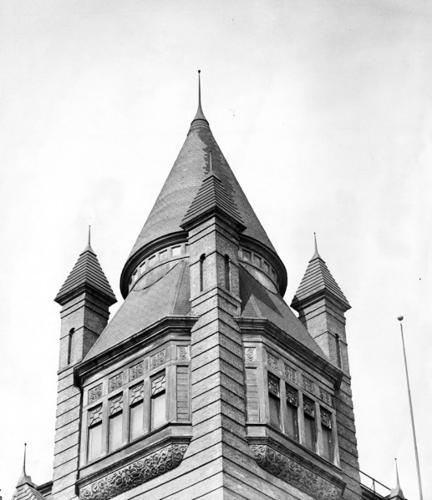
Downtown Toledo's crumbling Pythian Castle is, in some ways, a metaphor for America's declining participation in its service organizations.
Although the nation's population is larger than it was generations ago, many fraternal organizations and similar groups have declined since the 1960s.
Freemasonry membership, for example, has slipped since it peaked at 4.1 million members in America in 1959. Its latest domestic tally of 1.3 million members in 2011, the most recent figures available, hit a new low, according to figures posted online by the Masonic Service Association of North America.
Nobody has identified for certain why service-organization rolls are generally down. Some groups, such as Lions Club International, now claim a slight uptick after decades of decline.
Some theorize cultural changes brought on by Baby Boomers during the 1960s had an impact. L. Keith Stooksberry, Jr., 64, of Findlay, Ohio, supreme vice chancellor of the Knights of Pythias international brotherhood, said he believes it began earlier, with the advent of television, and has been accelerated by the number of distractions and competition for individual time since then, from a greater emphasis on school activities and sporting events to cable television, the Internet, and social media.
People are also reading…
Eighty years ago during the Pythians' peak, he said, people tended to do more things as family activities, and service organizations had greater roles in helping them socialize.
Declining participation in service organizations was a topic of the 2011 American Sociology Association's national conference. One presenter, Pamela Paxton, a sociology professor at the University of Texas at Austin, said at the time that scholars see the trend "as potentially detrimental to democracy."
The Knights of Pythias, the fraternal order that built downtown Toledo's Pythian Castle in 1890 and occupied much of the architecturally rare building for decades, most closely associates itself with Masons.
Both have ceremonial rituals steeped in longstanding customs, especially as members advance in rank. Both have reputations as "secretive" societies, although that appears -- in recent years, at least - to have been overplayed.
Stooksberry said he finds questions about secrecy amusing.
"We have a password," Stooksberry said. "But it's not like nonmembers are beating down our doors and trying to sneak in."
The Knights of Pythias, which has a female counterpart called Pythian Sisters, was founded Feb. 19, 1864, by a man named Justus H. Rathbone to promote brotherly love among the North and South during the Civil War . It became the first American fraternal organization recognized by Congress.
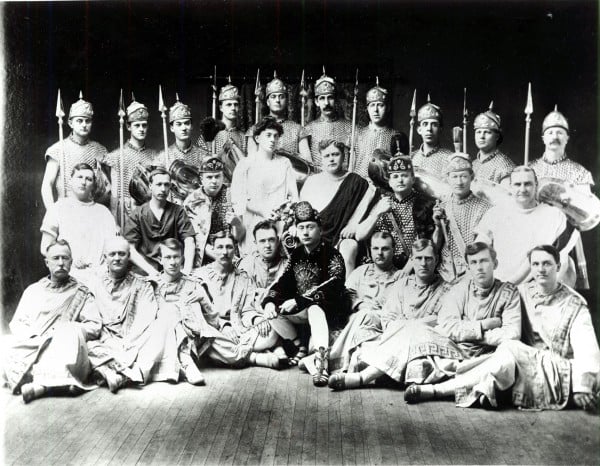
The name was derived from an 1821 play by Irish poet and playwright John Banim based on the ancient Greek story of Damon and Pythias. The two, as the story goes, were members of a school founded by Pythagoras, the Greek philosopher and mathematician. Their friendship was such a steel-like bond, each was willing to die for the other.
The Knights of Pythias does not have a religious affiliation, but requires members to believe in a supreme being. It uses the Bible as its book of law. Its purpose is to promote peace, harmony, friendship, and kindness.
"We take an obligation to pledge honor to God and country," Stooksberry said.
The group's secrecy prompted President Abraham Lincoln, in 1864, to have its original 13 members brought before him. The group claims Mr. Lincoln was so impressed by what he heard that he recommended they apply to Congress for a charter.
"If we could but bring its spirit to all our citizenry, what a wonderful thing it would be," the group quoted Lincoln as saying about the Pythians. "It breathes the spirit of friendship, charity, and benevolence."
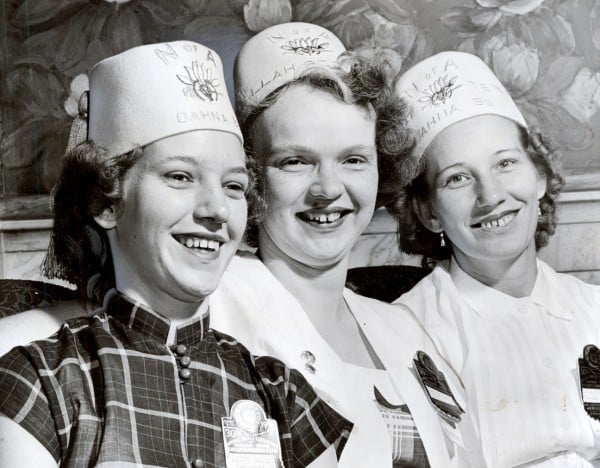
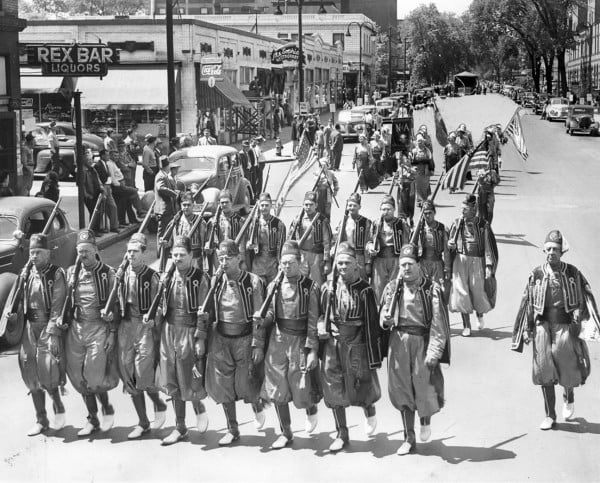
Affiliates of the Knights of Pythias and the Pythian Sisters included two known for their pageantry and playfulness, the Dramatic Order of the Knights of Khorassan, or Dokeys, and the Nomads of Avrudaka, respectively.
A popular Web site credits the national Knights of Pythias with numerous high-profile members over the years, including musicians Louis Armstrong, Sun-Ra, and Freddie Martin; former presidents Franklin D. Roosevelt, Warren Harding, and William McKinley; former vice presidents Hubert Humphrey and Nelson Rockefeller; former U.S. Sen. Robert Byrd of West Virginia; evangelist Bob Jones, Sr., and several governors and other dignitaries.
Stooksberry said the Knights of Pythias peaked in popularity with about 600,000 members during the 1920s and 1930s, but has been on the decline since. The group has fewer than 30,000 members, about a third of them in New York state, he said.
Contact Toledo Blade reporter Tom Henry at: thenry@theblade.com.


