



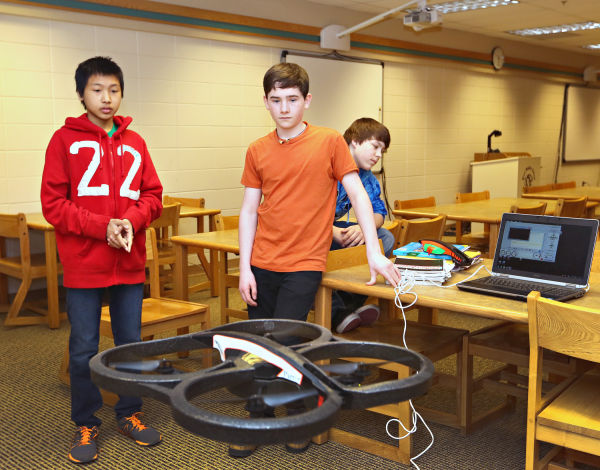
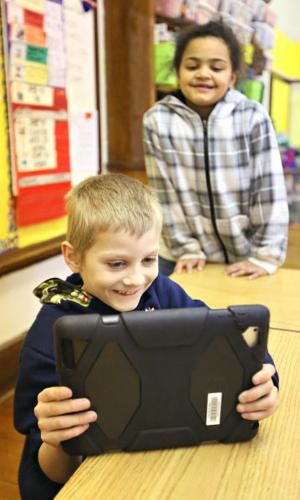
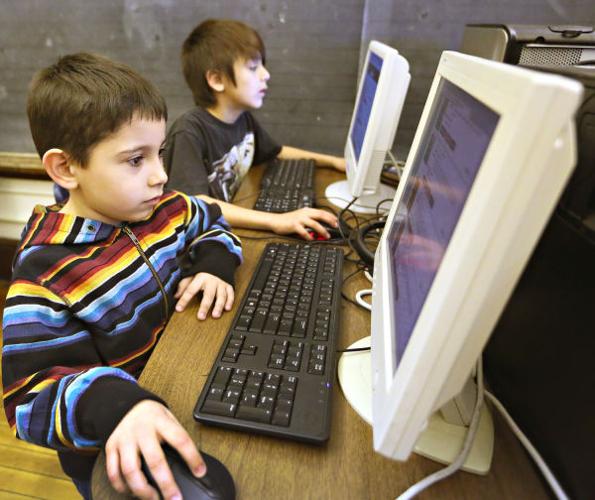
Long past are the days of blackboards and film projectors. Schools today are filled with enough up-to-date technology to impress even the most seasoned technology gurus. From large schools to small, students and teachers are more tech-savvy than ever.
Neil Schroeder, director of technology for the Sioux City school district, calls the rise in educational technology “exciting.”
“Technology offers another tool for teachers to engage students in new and interesting ways,” said Schroeder. “It doesn’t replace anything we did before, but it does augment the experience.”
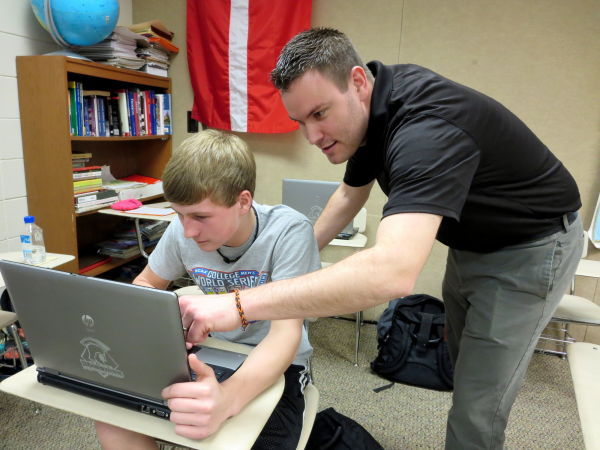
Instead of spending hours grading multiple choice and true/false tests, teachers can provide online assessments that students take on their laptops. The laptops, which the school district provides for every high school student, can then grade the tests and give the students instant feedback. This allows teachers more time to spend on complex assessments, such as essays.
People are also reading…
“In the last five years, technology went from a curiosity that you may or may not use to something that has to be there,” said Schroeder. “Students are picking up technology skills that can help them for the rest of their lives.”
Sergeant Bluff-Luton High School Principal Jason Klingensmith doesn’t describe himself as overly tech-savvy (“I can get the job done”), but it’s safe to say that his school is up to snuff.
The school boasts numerous applications of technology, from using E-textbooks to utilizing SmartMusic, a program that keeps track of any missed notes or rhythms played by a band student.
“[Technology] opens up a lot of opportunities to extend and deepen learning,” said Klingensmith.
High school students at Sergeant Bluff are also each provided laptops that contain E-textbooks for all four of their core areas (math, science, language arts and social studies), which means no more lugging around those heavy textbooks.
“We would expect homework that needed to be done on the computer and for some families that was an issue,” said Klingensmith. “We wanted all students to have equal opportunities with technology.”
Test scores have been reflecting that technology push.
“It’s hard to quantify over the last five years, but trends are up. Over 90 percent of our 11th-grade students are proficient in reading. That’s huge,” said Klingensmith. “Is it only from the technology? No, but technology is definitely a piece of the puzzle.”
Ryley McGregor, Sergeant Bluff-Luton freshman, enjoys the convenience and efficiency his laptop provides.
“You don’t have to go to a lab for class. You can just pull out your computer.”
For example, students who are learning about human biology are able to virtually and interactively explore the human body without a cadaver. Students struggling with math homework can click on tutorials and watch video lessons at any time or place.
And those old history textbooks listing George Bush Sr. as the president? Forget it. E-textbooks can be updated by certified field professionals at any time.
Matt Nelson, government, economics and psychology teacher at Sergeant Bluff-Luton High, has directly seen that benefit. The information in his subject areas updates so often that a regular textbook just can’t keep up.
“[E-textbooks] are better than an old textbook that might not even be accurate,” said Nelson. “Especially with psychology, things change so fast that if I’m teaching from a 10-year-old text, it could even be misinformation.”
However, with all great advances, there are drawbacks. Entrusting expensive equipment to students who might not be able to handle the responsibility is a risk, but both school districts say that students have been handling it fairly well. Distractions are also a concern.
“There is more value in technology than there is harm, but it does give new wrinkles to old problems,” said Schroeder. “Students might be watching YouTube instead of paying attention, but before laptops students could be throwing pencils in the ceiling. There’s always going to be some kind of distraction.”


