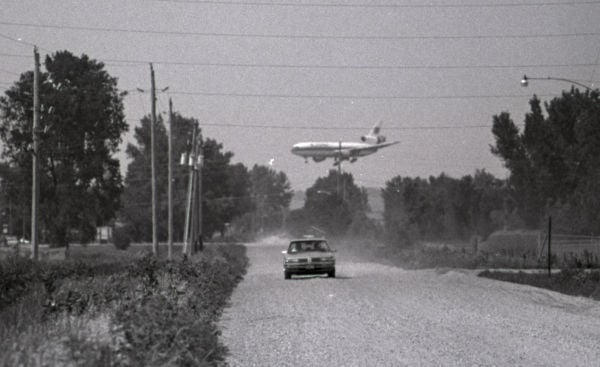
Flight 232 approaches Sioux Gateway Airport for a crash-landing on July 19, 1989. "All we had were the engines and landing gear," said pilot Capt. Al Haynes.
Gary Anderson, Sioux City Journal file
Crews transport Flight 232 victims to Marian Health Center after the crash on July 19, 1989.
As United Airlines Flight 232 headed toward Chicago, the flight crew and passengers were suddenly alarmed by a loud explosion.
"It was a very loud bang. I thought we had a bomb go off," said Al Haynes, the pilot of that July 19, 1989, flight.
Not a bomb, but something almost as damaging. The tail engine on the DC-10 airliner had exploded. Debris from the engine severed the hydraulic lines, cutting power to the flaps, rudders and all other mechanisms needed to fly an airplane.
Haynes said the crew had a good idea that the hydraulics were probably lost and the plane severely disabled once they realized how little control they had over the plane.
"We felt it right away, but we just weren't sure," Haynes said.
Able to only turn to the right, Haynes and the members of his crew worked together, using the throttles to guide the plane and descend in a slow, spiraling pattern toward Sioux City.
"All we had were the engines and landing gear," Haynes said.
Flight 232 was able to make it to Sioux Gateway Airport, and the plane broke apart upon landing. Of the 296 people on board, 112 people were killed, but 184 survived.
Crash investigators discovered the engine explosion was caused by a defective titanium disc inside the engine fan. A manufacturing defect caused the disc to crack. Over time, that crack grew until the disc broke apart and caused the explosion that cut the hydraulic lines.
It could have been worse, Haynes said. The explosion could have blown the tail off the plane, causing it to crash.
"It did the maximum damage it could do and still make the plane flyable," Haynes said.
The incident led to changes in the how planes are designed and inspected. The hydraulics system now contains a bypass valve that can prevent a complete power loss, Haynes said.
He said the manufacturing process for the titanium disc has been changed, as well as how it's inspected.
"A couple people screamed. The pilot said we had lost power -- one engine was blown. Then we started going in circles."
Flight 232 approaches Sioux Gateway Airport for a crash-landing on July 19, 1989. "All we had were the engines and landing gear," said pilot Capt. Al Haynes.