

SIOUX CITY | At Siouxland Compounding Pharmacy every gel, cream, ointment and lollipop is made from scratch with raw ingredients.
Up until the mid-1960s, when pharmaceutical manufacturing came along, it was common to see pharmacists standing behind the pharmacy counter crushing and grinding ingredients by hand with a ceramic mortar and pestle.
Today, registered pharmacist Tricia Morrical uses automated equipment to prepare patient-specific drugs that aren't commercially available in the concentration and strength needed from component ingredients in her laboratory.
Her electronic mortar and pestle resembles a milkshake machine. She uses it to mix transdermal cream for wound care patients to ensure the same concentration of active ingredients are dispersed throughout the substance.
Combining two manufactured wound care products together, Morrical explained, will result in an ointment that contains half the strength of each product. She can take the raw ingredients and produce an ointment that contains both products at full strength.
People are also reading…
"We can really customize the medication to the individual," she said. "We can customize the dosage and the dosage form."
Medications are often compounded for seniors, young children and cancer patients who have trouble swallowing. Morrical said physicians also refer patients to a compounding pharmacy when their medications are no longer available from manufacturers.
Some drugs like Bellaspas, a medication prescribed to treat symptoms of menopause, are available in Canada but have been discontinued in the United States. Lidocaine viscous, a numbing medication used to treat irritations in the mouth and throat, is currently back-ordered. If it lands on the Food & Drug Administration's short list, Morrical said she will be able to compound it.
The average cost of prescriptions compounded at the pharmacy in January, according to Morrical, was $50.
"In America we're very driven by the drug reps. Once the medication goes off brand name only status, it's obviously not profitable for the company to market it anymore," she said.
Chemist Lyneia Staber said a compounded medication isn't her patients' first option. They've often tried many other commercially available drugs without success. That's why she said it's important that she get to know her patients and ask them how their medications are working when they come in each month.
Compounded medications aren't approved by the FDA, but Morrical said all the chemicals she uses to compound medications are approved by the FDA and the U.S. Pharmacopeial Convention.
In some cases, Staber said patients may benefit from a combination of medications.
People suffering from chronic pain don't have to take several different tablets. Staber said the drugs can be compounded into a single cream that needs to be applied only once a day.
"At the end of the day we still have to have a doctor's prescription. There are going to be those doctors who are completely against it," she said. "This is just another option -- medicine is evolving. It's not a matter of you just have to take a tablet."
Many drugs contain binding agents such as gluten, a protein found in wheat and barley. A growing number of people world-wide suffer from celiac disease, an immune reaction to consuming gluten. Medications that contain casein and soy, Morrical said, also cause allergic reactions in some patients. She can compound drugs without these common binding agents.
"There are some people that are allergic to inactive ingredients such as corn byproducts that are in a lot of the commercially available products," she said. "We do have the ability to avoid all of those types of allergens."
To receive compounded drugs, patients need documentation from their doctor that states they have sensitivities and cannot take commercially available medications.
PREVENTING ERRORS
Morrical, who opened Siouxland Compounding, 4501 Southern Hills Drive, last summer, said her clientele is growing in the wake of a U.S. Food & Drug Administration crackdown on compounding pharmacies.
In October 2012, the Centers for Disease Control and Prevention traced an outbreak of fungal meningitis to the New England Compounding Center, a compounding pharmacy in Framingham, Mass. The tainted steroid injections sickened more than 700 people and claimed 48 lives.
Compounding is regulated by the state boards of pharmacy, while manufacturing is regulated by the FDA.
Morrical said pharmacies like hers have to adhere to strict sanitary regulations and be careful not to cross the line between compounding and manufacturing.
Every Wednesday morning Siouxland Compounding Pharmacy's laboratory floor is sanitized with a bleach mixture. The mixture sits on the floor until it air dries.
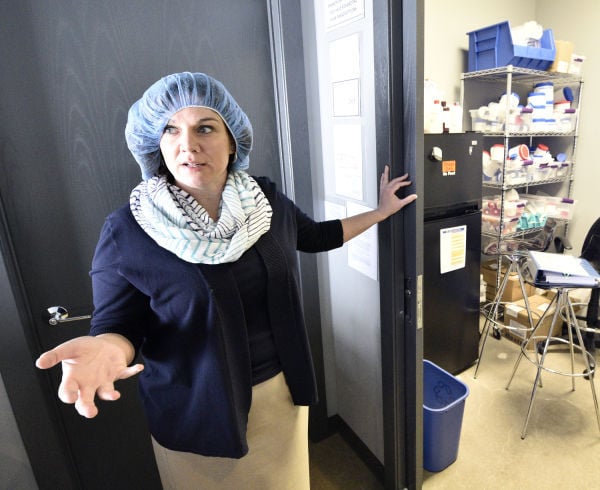
Morrical and Staber wear blue paper caps and shoes that have never been worn outside the building to keep the laboratory sterile. A clear containment hood keeps dangerous powered chemicals, such as bioidentical hormones, from traveling into the air.
"When you turn this on, it pulls the air up into a HEPA filter," Morrical said. "When we're working with the chemical, we're not being exposed to it."
Computer software adds another safety barrier.
Before Morrical and Staber compound, they consider who their patient is and the potential side effects he or she might face. They review a list of ingredients stored in the computer system for each medication. They scan a bar code on each chemical before measuring it out.
"It stops me if it's not right, so I can't go on," Morrical said of the computer. "Similarly, when we weigh it out we have a plus or minus 3 percent deviation. If it's not within that plus or minus 3 percent, the scale won't let us continue."
Automated equipment like an ointment mill, Morrical said, helps her prevent errors and produce superior products. She places cream mixed with active ingredients in the device which pulls the cream through its rollers.
"The particle size is going to be uniform no matter who's making it," she said. "This mixes the creams so that there's the same concentration of the active ingredient on the top and the middle and the bottom as opposed to if you just do it by hand."