


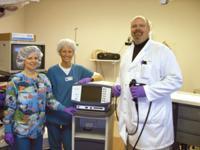
A revolutionary new procedure being performed at the Siouxland Surgery Center in Dakota Dunes, S.D., may give Siouxlanders with chronic heartburn more permanent relief from their symptoms.
The procedure, known as Stretta, is a minimally-invasive way to treat heartburn caused by gastroesophageal reflux disease, or GERD. GERD occurs when stomach contents "reflux" upward from the stomach into the esophagus through the lower esophageal sphincter (LES). Normally, the LES acts as a one-way valve, enabling food to pass downward into the stomach but not upward into the esophagus. However, chronic exposure to stomach acid, enzymes and bile causes irritation of the esophagus and can result in inflammation, ulceration and pain.
GERD causes a wide variety of symptoms including persistent heartburn, regurgitation, choking episodes at night, chest pain, difficulty or pain when swallowing, asthma, chronic sore throat, chronic cough and laryngitis. Having GERD can also increase the risk of cancer of the esophagus.
People are also reading…
In the initial stages of the disease, doctors may recommend over-the-counter medications and lifestyle modifications, such as eliminating coffee, alcohol and smoking, avoiding eating close to bedtime, sleeping with the head of the bed elevated, losing weight, and eliminating spicy foods, fatty foods, chocolate, citrus and tomato products from the diet.
If lifestyle modifications fail to relieve the symptoms, doctors will prescribe drugs such as H-2 blockers that decrease acid production, or proton pump inhibitors that completely stop stomach acid production.
Dr. Keith Vollstedt, a general surgeon with General Surgery & Diagnostics, P.C. in Dakota Dunes, said medications are effective for the vast majority of patients, but for about 15 percent of patients with bad heartburn, medications don't work and they need something extra to get relief. That's when a physician typically recommends anti-reflux surgery. Anti-reflux surgery involves wrapping the stomach around the esophagus to improve the barrier function of the lower esophageal sphincter. It takes about 2-4 hours, must be done under general anesthesia, and results in a 1-4 day hospital stay and a period of 1-3 weeks before the patient can return to work.
Vollstedt said anti-reflux surgery continues to be a very popular operation, especially since it can be done laparascopically.
"However, some people still don't want an operation, but they don't want to be on medications, either," said Vollstedt, who received his medical degree and surgical training from the University of Iowa in Iowa City and has been performing anti-reflux surgery for 10 years. "The Stretta procedure that is being tried at the Siouxland Surgery Center gives them a less invasive option."
During the Stretta procedure, the patient is placed under conscious sedation, and the physician places the Stretta catheter through the patient's mouth and into the valve between the stomach and esophagus. Then radiofrequency is delivered to the muscle of the lower esophageal sphincter and gastric cardia to create small thermal lesions. Over time, the lesions heal and the tissue contracts as it should.
The Stretta procedure takes about 45 minutes, is done on an outpatient basis, and requires a 1-2 day rest period, on average, before the patient can go back to work.
After the procedure, the patient's diet is restricted to liquid for 24 hours, followed by a soft diet for the next seven days.
Patients also continue to take their GERD medications for six to eight weeks after the procedure, and following this period, the physician may discontinue or reduce their medication if the procedure was successful in eliminating or reducing their symptoms.
Vollstedt, who has an interest in esophageal disease and bariatrics, said the FDA-approved Stretta procedure is successful about 70 percent of the time.
He performed the first Stretta procedure at the Siouxland Surgery Center the first week of September, a month after they received the Stretta equipment, and the patient has been doing well.
"She could definitely tell a change in the way she could swallow," he said.
Vollstedt said that the Stretta procedure is a great alternative for people who want a less-invasive way to take care of their GERD, but like most procedures, it isn't for everyone.
"The exception would be someone with a moderate to large hiatal hernia or a person whose esophagus contracts in an uncoordinated manner," he said.
For more information on the Stretta procedure being performed at the Siouxland Surgery Center, 600 Sioux Point Road, call 232-3332 or General Surgery and Diagnostics, P.C., 612 Sioux Point Road, at 232-6353.


