


The practices and processes of dealing with the remains of a human being are no big secret to most of us who have at least a cursory understanding of the funeral industry, its forms and functions. But what about the body parts left over from surgery, the excised appendices, spilled blood and fluids that must be dealt with daily in medical center settings?
After all, these body parts present the same sanitation and public health risks as human corpses.
And so they must be handled with equal care, precision and sterilization, according to Dr. Mike Kafka, pathologist and director of the pathology lab at St. Luke's Regional Medical Center.
"You make the assumption that anything that's blood or body fluid is potentially infectious," he said, "and you handle it as such. So that's why they go through the sterilization process before anything is sent out of here. And anything that gets red-bagged gets sterilized."
People are also reading…
There are at least three different kinds of tissues and fluids worth mentioning, he said.
First are the pathology specimens, tissues and body parts that pathologists end up examining for a doctor or surgeon after a biopsy to determine whether some organ has cancer or some other disease. Some such tissues are removed during surgery.
"They're initially placed in a fixative called formalin to preserve the tissue," Kafka said. "It's the same sort of chemical that morticians do when they embalm bodies and whatnot."
The tissue is then examined in St. Luke's histology department. Samples may be taken and turned into microscopic slides before the pathology report is issued. Once the report is finalized, the specimens are taken to a building elsewhere at the hospital where the morgue is housed. "They're locked in a secure room at the facility over there for at least a 3-week period, in the event there's a need to go back and re-examine some of these if there are questions about our report," he said.
Once the tissues are no longer needed, the formalin is poured from the Ziploc bags in which they are kept, Kafka said. It is poured with a lot of water into the sanitary drainage system. And the tissue is boxed up and hauled away by truck to Sioux Falls, S.D., on a periodic basis by a licensed medical waste handler. These tissues and lots of other medical waste from the hospital are then incinerated in Sioux Falls.
Sharps melted down
Also removed by the waste handler are those things called "sharps" - needles, glass vials, scalpel blades and other pointed things that are deposited throughout the hospital in sealed, plastic, puncture-proof containers, Kafka said.
"They also pick those up and incinerate them. So those don't go into any sort of a landfill. They're actually being melted down and burned," he said. They're hauled away with the other pathology waste by the Sioux Falls company.
Hospitals have been aggresively working to decrease the need for sharps and avoid the needle-stick injuries that could cause infections. But St. Luke's has yet to reach the needle-less atmosphere of a "Star Trek" Enterprise sick bay.
The plastic containers where the sharps are dumped, for instance, are designed so that once the lid is closed, they can't be reopened. And needle-less systems have been incorporated in IV systems, using rubberized ports to add solutions to an IV where needles were used in the past, Kafka said. You still need needles to penetrate the patient's skin, but the needles themselves are designed with more safety in mind.
"All the needles that we use in the hospital have a device on it that will, after the needle is used, you can flip up and it hides or conceals the needle. Or the needle retracts into some sort of protective container or device so that you can't re-use it and you hopefully can't stick yourself once it's fully retracted," he said.
Even scalpel designs have been changed. Now they have rounded tips so that users are less likely to poke themselves, he noted.
And changes have been made in the way scalpels and other sharp instruments are passed around in surgery. There is a specific area on a table called the Sharp Zone, where all the tools are placed. Instruments are placed on the table which is moved to within reach of the next user, so nurses and surgeons are no longer directly handing them back and forth, risking accidental punctures.
A third element of hospital waste getting special attention is anything that comes in contact with chemotherapeutic cancer and chemotherapeutic agents, he said. Because it is considered toxic, the Sioux Falls waste hauler picks it up, but this stuff is ultimately disposed of at a special licensed facility in Montana.
"So that's the general pathway the pathology samples and tissues go," Kafka said.
Exceptions to the rule
But, he said, there are two notable exceptions: Amputated limbs and tissues that come from miscarriages.
The hospital retains most amputated limbs. They are cremated by a local funeral home, then combined with other ashes that are eventually hauled away to Sioux Falls.
"We also occasionally get a request for the limbs, particularly from Native American folks," he said. "They believe that those things need to be ultimately buried with the person. So we will sometimes, on rare occasions, release those also. But that's usually a specific request from the Native American population."
As for tissues that come from miscarriages, if the pregnancy goes beyond 20 weeks, the fetus and those tissues generally go through a burial process and are released to a funeral home, Kafka said. But it the fetus is less than 20 weeks or 50 grams of weight, the hospital can do a disposal of the tissue and remains for the family. In such cases, the hospital has the remains cremated by a local funeral home. The ashes are then buried at a common cemetery plot with other fetal and miscarriage remains,
Occasionally, families will request that remains even under 20 weeks be given to them for burial, and the hospital will release them, Kafka said. "But that's usually special circumstance and (we) infrequently get a request for that," he said.
Kafka said he could think of no other exceptions.
"Ultimately, the vast majority of it ends up being incinerated - cremated and incinerated in Sioux Falls," he said.
But not every drop of blood leaves Sioux City. Large industrial sterilizers handle much of the blood and fluids that come from St. Luke's operating (and other) rooms.
"The blood and fluids, if they come over here for us to do some sort of an analysis on it, end up being disposed of the same way all the other blood samples and other stuff that we process in the lab itself," he said.
These blood samples are sterilized along with all of the other material that is considered biohazardous. Then ultimately after they are sterilized, they are compressed down and removed to the landfill.
As for much of the blood that is removed during bleeding in surgery, the operating rooms have suction devices to get the blood and stuff out if they're operating the abdomen and chest area and doctors need the blood removed in order to see what they're doing. Sterile suction devices deposit this blood in large canisters that are on stands that get moved around during surgery, Kafka said.
Blood away the Redaway
St. Luke's has a fluid waste management system called Redaway in the sterile processing area of the lab where canisters are taken after they are sealed and removed from surgery. "There's a special system that puts bleach and disinfectant in and mixes it in with the blood and the fluid, essentially inactivating in terms of any infectious waste. It gets diluted with water," he said. "And then it's sent down the sanitary drain system. It goes through this disinfection and bleaching process. Then they can re-use those canisters again up in surgery."
This system has been in use for more than 10 years, he said.
"Also, for some reason, if they don't want to run it through that system, there's another way for them to actually add a chemical that disinfects and also causes the blood to actually congeal, so it ends up being solid," Kafka said. "And then that ends up going through the sterilization process. That gets sent over and run through the big industrial sterilizers they have, compressed and then sent off to the landfill."
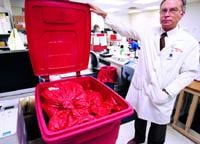
The various kinds of medical waste end up in color-coded bags in evidence throughout the hospital. All of the biohazardous material ends up being thrown into red bags.
"So we have our gray, plastic liner bags for paper and things that supposedly have come into contact or have been exposed to any blood, body fluid or anything else that's been considered infectious," he said. "And everything else goes into a red plastic bag."
The disposal process hasn't changed much over the years.
The hospital used to have its own infectious waste incinerator, but increasingly stringent code requirements involving incinerator use within city limits necessitated the closing of the hospital incinerator sometime around 2000, he said. That is when the hospital went to the industrial sterilizers and had other medical waste hauled away by specalists to the Sioux Falls incinerator.
Kafka said he isn't sure how much medical waste St. Luke's handles each year, only that it's "got to be staggering."
The medical waste haulers bring in their big truck twice a week because the hospital has only a limited amount of space for even temporary storage. It's waste in, waste out.
Body parts galore
Occasionally, patients want to preserve that boil or appendix to which they've grown attached even when it's no longer, well, attached. Hospitals discourage this, but it occasionally happens.
"We have had those occasional requests and they may want to have their tonsils or things like that," said Dr. Mike Kafka, pathologist at St. Luke's Regional Medical Center. "In those cases, the tissue will go through the additional fiormalin fixation process where they're immersed in the formalin. And then once we're finished with doing our pathology on it, they'll take those out. And we'll put it in an alcohol solution of some sort, and then that can be released to the family.
"But we try to discourage that."
More understandable body part salvage operations involve gadgets such as breast prostheses, mechanical hip joints or Pacemakers that come out of surgery, Kafka said.
A manufacturer, for example, may want the mechanical hip joint back to see if there was a failure on the part of the device. And these things usually end up being returned to the companies that made them.
"Occasionally people will ask if they've broken something, if they've had a pinning or something like that," Kafka said. "And so we will get that. We will clean it and disinfect it, and after we've examined it, those we will sometimes send out. But that isn't too frequent that we actually get a request for a body part to actually go back."


