


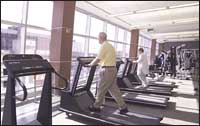
A great cardiac rehabilitation program at Mercy Medical Center-Sioux City has become even better.
Verifying the program's excellent clinical practices, the American Association of Cardiovascular and Pulmonary Rehabilita-tion (AACVPR) recently awarded the Mercy Cardiac Rehabilitation Center renewed program certification following the national board's rigorous review. The stamp of approval came just before the program moved into new, state-of-the-art facilities located on the fourth floor of the new Mercy Heart Center.
"It's a great new facility with a walking track and a terrific southern view of the city and the Missouri River," said Sue Mohning, manager of Mercy's cardiac rehabilitation program. "We have even more room with more equipment. Cardiac rehab clients also have better access to nearby parking facilities."
Designed to limit the physiological and psychological effects of cardiac illness, Mercy's cardiac rehabilitation program strives to stabilize or improve the patient's condition and enhance the patient's quality of life.
People are also reading…
From 7 a.m. to 6 p.m. each Monday, Wednesday and Friday, the Mercy Cardiac Rehab Center is fairly humming with phase two and three patients engaged in their circuit training exercises.
In fact, the center has logged more than 24,000 phase three patient visits in the past year.
For those unfamiliar with how the comprehensive program works, Mohning explained that cardiac rehab actually starts when the heart patient is still hospitalized. Hundreds of times each year, Mercy's cardiac rehab nurses, who are on duty seven days a week, help individual patients on the road to recovery after a heart attack, interventional procedure or open-heart surgery.
"During what is known as phase one inpatient cardiac rehabilitation, there is a big focus on patient education from the start," Mohning said. "We also look ahead to the patient's home activities. We typically get them started on a walking program and talk to them about the important factors that diet and exercise will play in their overall health and well-being. We also help them with their medication."
Once a heart patient is dismissed from the hospital after a cardiac event or surgery, a physician refers the patient to outpatient cardiac rehab, phase two. Heart patients are closely monitored as they begin to engage in exercise and physical activity in the cardiac rehab center. Under the watchful eye of Mohning and other registered nurses like Lynett Kayl, Joanne Jahn, Jean Wurth and Sharon Jonas, rebounding heart patients begin to walk on treadmills, ride stationary bikes, and engage in other types of fitness activities.
"After a careful start, we gradually increase the patient's physical workload until he or she has reached a level where they feel they have comfortably arrived at their maximum physical limits. Phase two typically runs four to eight weeks," Mohning said.
"Along the way, we continue to engage our patients with one-on-one and group education sessions. We talk with them about the importance of taking their medications, what to do in an emergency, watching their diet, and monitoring their risk factors. Clinical dietitians, pharmacists, and social workers work closely with the cardiac rehab staff to help patients."
Phase three cardiac rehab is essentially a maintenance program for heart patients who want to continue with their cardiac health program on a voluntary basis. Hundreds of patients, who have chosen to be part of the program, come in for hour-long fitness and wellness sessions, up to three times per week.
"Some of Mercy's cardiac rehab clients have chosen to remain part of the phase three program for many years," Mohning said. "One patient has been with the program for 15 years."
According to Mohning, cardiac rehab patients also reap the physical and psychological benefits of something else: camaraderie and peer support.
"Members of our rehab groups often become good friends. They enjoy the time they spend together. And, in some ways, it's like an extended family," Mohning added.
For more information about Mercy's Cardiac Rehab program, call (712) 279-2575.


