


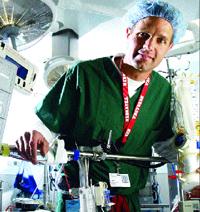
Chad Brady, chief perfusionist, Mercy Medical Center, talked with Nick Hytrek about his career and its impact.
1. What is a perfusionist?
A perfusionist is someone who specializes in operating the heart/lung machine during open-heart surgery. We operate various pieces of equipment during open-heart surgery. We're acting as the patient's heart and lungs.
2. How many people you meet know what a perfusionist is?
Not very many. I would say 1 percent of the people I meet know, and that's typically someone in a health care profession.
3. When you explain your job, how do people react?
Usually it's one of interest. Usually the first comment is "Wow, I didn't know that type of profession existed" or "I didn't know you would need this type of person."
People are also reading…
4. Do you meet with patients before and after surgery?
I typically do not. Once they enter the operating room, I might talk to them briefly. There's not a lot of face-to-face interaction with patients.
5. Do many of them know what you do?
Sometimes. Surgeons will explain it to the patient and family before the surgery.
6. How did you learn about this profession?
When I was in college, I wrote a letter to the University of Nebraska Medical Center about allied health professions. I knew I wanted to do something in that area, but I didn't know what. There was a pamphlet on perfusion and I read it. I just stumbled upon it.
7. What type of education do you need?
To get into the professional program you need to have a bachelor's degree. From there, there's the perfusion program and that's a two-year program and they award you a master's degree.
8. How many programs are there in the United States?
There are only about 20 programs in the United States. We're fortunate there's a good program in Omaha. There's one in Iowa City, too.
9. When did this profession develop?
Pretty much in the mid-1950s when they had the first open-heart surgeries. There wasn't any schooling for it then, it was just on-the-job training.
10. Is this a growing field?
I believe so. Lots of things are changing in open-heart surgery. There are other treatment options. Most of our patients here are treated with the heart/lung machine.
11. Does it bother you that people are not that aware of your profession?
It doesn't bother me. I really enjoy talking about it and informing people about the profession.
12. What's your role during surgery?
Once the surgeon is ready, that's when we're going on the heart/lung machine, draining blood from the patient, supplying it with oxygen, removing the carbon dioxide and moving it forward through the body. We're acting as the patient's heart and lungs. I'm able to control the patient's blood pressure and blood flow.
13. What types of surgeries are you involved with?
Most of our work with heart surgery is in open-heart surgery. We do operate other equipment. One is a cell saver in which we collect lost blood and we process it, wash it and give it back to the patient so instead of getting blood transfusions they're getting their own blood.
14. How involved are you during the surgery?
We are right there. Our equipment is next to the patient on the table. When we're on the heart/lung machine, we're in constant communication with the surgeon and anesthesiologist.
15. Could these surgeries be done without you?
Nope. Perfusionists are the only people trained to operate the heart/lung machine.
16. When the machine takes over the patient's functions, is it a gradual conversion or just a flip of a switch?
It's a gradual process. When we initiate the bypass process we slowly transfer blood from the patient and (near the end of surgery) slowly transfer it back into the patient. It's really not automated in the sense you turn a switch and it happens.
17. Is this done all with one big machine or several?
There's pretty much one large machine that does this.
18. What's it like at the point when you turn the functions back over to the patient's body?
It's a slow, gradual process. We slowly restrict the amount of blood we're stopping. The heart is beating at the time we're doing this.
19. How quickly does the body resume those functions?
Typically right away. The body's adjusting as we come off bypass. For a routine case, it could take an average of five to seven minutes.
20. How stressful is it for you when this process is happening?
It definitely is a stressful part of the operation where we're playing a vital role and making sure everything is just right. The patient's life is on the line.
Staff photo by Tim Hynds


