


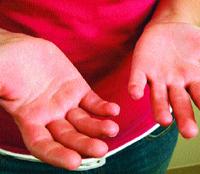
Don't ask Amanda Farley to hold a frosty glass or search for something in a freezer.
In mere minutes, her fingers could turn white, then purple, then start hurting. A lot.
"They feel like you could cut the tips off them," she says. "And, then, they may go numb."
Diagnosed with Raynaud's syndrome, the 22-year-old University of Northern Iowa student doesn't have sufficient blood flow to her hands and feet, often as a response to cold temperatures. As a result, she'll wear several pairs of gloves during the fall and winter just to make sure her fingers don't get cold.
According to Dr. Patrick Kelly, a vascular surgeon with St. Luke's Center for Heart and Vascular Health, those with Raynaud's phenomenon or Raynaud's syndrome experience intense pain because their fingers, toes and other "end organs" aren't getting sufficient blood flow. "Your body doesn't like that - it's like chest pain - your heart isn't getting blood flow and that's why you get the pain." Spasms of small arteries in the fingers and toes could last minutes or hours.
People are also reading…
Farley, a graduate of Whiting, Iowa, High School, says she first noticed something was wrong when she was in fifth grade. "My hands started turning purple and the teacher told me to go see the nurse. The nurse told me to put them under hot water."
That got the blood flowing but, she says, the pain didn't immediately disappear. Simple precautions helped her decrease the incidence of "purple fingers" (something classmates loved to see) but, by seventh grade, she sought medical help. A physician told her to do "windmill" exercises to keep blood flowing, then prescribed blood pressure medication. "That didn't really help," she says.
"Because it's a syndrome, Raynaud's doesn't have a focal problem," Kelly says. "If you look at diabetes, the problem is the pancreas. If you look at renal failure, the problem is the kidneys. But with Raynaud's we don't have a specific target."
Some physicians prescribe calcium-channel blockers which relax smooth muscles and dilate small blood vessels. Others use alpha-blockers that counteract the action of norepinephrine, a hormone that constricts blood vessels.
Nitroglycerine paste, Kelly says, is frequently used on people with poor blood flow to their legs. "We try to vasodilate them as best we can. Sometimes, however, the spasms can be so bad you have to go in with a catheter and inject medication directly into the artery to break those spasms."
When Farley begins to notice a problem, she'll try to warm her hands immediately. "I'll sit on my hands or I'll put them inside my sweatshirt." It may take 15 minutes to get them back to "normal," she says. Writing is difficult when she has a spasm; holding cold drinks is out of the question. "I like ice in my drinks but I never hold on to the cup. I move my whole body to the straw." The secondary education and Spanish major laughs. "I don't deal with anything cold at work."
A waitress at Diamond Dave's in Cedar Falls, Iowa, Farley says she has fewer attacks in the summer. Kelly says that's common.
"Are people in the Midwest more prone to it?" Kelly says. "We don't know. You're going to see more of it here and in Canada than you would in Alabama. We have the environment that will bring it out. But that doesn't mean more people here have it."
Women are more likely to get Raynaud's (between 60 and 90 percent of the cases, experts say, occur in young women). That's largely due to women's immune systems. "There's a lot of speculation why," Kelly says. "A woman's immune system is set up to carry a baby for nine months - something that's foreign - or at least half foreign - to her body. For that reason, her immune system can go a little haywire." Women also have a higher propensity for diseases like scleroderma and rheumatoid arthritis.
Smoking can prompt the spasms, Kelly says (even Nicorette, the quit-smoking gum, is a no-no). And stress is often just as bad as cold weather.
Farley knows when finals week arrives she could be more susceptible to Raynaud's. Tingling fingers are the start. "A lot of people will look and say, 'What's wrong with you?' Even people at work haven't seen anything like it. When I don't want to explain everything, I'll just say, 'I have poor circulation.'"
Frequently, Kelly says, people may think they have Raynaud's when, really, they just have circulation problems. "You'll know if you have Raynaud's. The diagnosis of Raynaud's syndrome or Raynaud's phenomenon is overused a bit. If you've got it, the pain is often excruciating. A lot of times, it's a 10 on a scale of 10." Some, he says, have described the feeling as a "rodent gnawing on your fingers...but it's different for everyone. When it comes to ischemic pain, I don't think any of us can describe it until we experience it. There are varying degrees of Raynaud's."
While Raynaud's can occur at any age, it usually starts when a patient is in his or her 20s. "You don't see a lot of real old people with it because a lot of other problems may have led to their demise," Kelly says.
Untreated, it could lead to the loss of fingers or toes. "A patient could go into severe spasms and develop gangrene."
The trick is to "learn how to work around it," Kelly says.
That's Farley's solution. "If my boyfriend and I go four-wheeling, the best thing for me is to wear snow-boarding gloves and big leather gloves over them. In the summer, I avoid air conditioning."
Raynaud's, Kelly says, isn't likely to go away. "It's something you're stuck with for the rest of your life. But nobody's exactly the same. Someone may get spasms at 29.2 degrees, others won't."
Interestingly, a stellate block - used as a diagnostic test - has worked for several of Kelly's patients. Considered a "sympathectomy" - or an interruption of sympathetic nerve pathways - it has relieved spasms.
The disease isn't necessarily genetic, either, so it is difficult to predict.
The key? "Always have gloves," Farley says. "Stay inside as much as possible. That drives my friends crazy, but I know what works for me."
That's important, Kelly says. "It's a big deal for people who live in South Dakota, Iowa or Nebraska. Interestingly, they do a lot better when they go south for the winter."
About Raynaud's
Raynaud's phenomenon - the blanket name for the problem - is classified in two ways. Primary Raynaud's, also called Raynaud's disease, occurs by itself and is the most common. Secondary Raynaud's, called Raynaud's syndrome, occurs as part of another disease such as lupus, scleroderma, rheumatoid arthritis or atherosclerosis. Other causes of secondary Raynaud's - certain medications, vibrating power tools, smoking or frostbite.
The most common trigger of an attack is exposure to cold. During an attack, the body overreacts and severely restricts the flow of blood through small vessels to the skin. An attack could last from minutes to an hour, depending on the temperature.
Raynaud's is pronounced "ray-NOHZ."
Source: WebMD


