


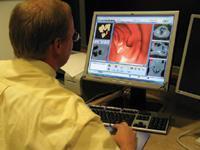
Advanced imaging techniques available through The Center for Preventive Medicine at St. Luke's Regional Medical Center now enable physicians to closely examine the colon with computer animation techniques that have never been possible before.
The new imaging test, called virtual colonoscopy, is performed with newly purchased FDA- approved virtual reality software and St.Luke's Seimens Somatom Multi-Slice CT scanner. The CT scanner takes multiple slice images of the body in the blink of an eye, scans body areas in seconds and can create three-dimensional rendering of organs and systems. The center is the only location in the tri-state area offering the FDA-approved Viatronix virtual colonoscopy procedure.
Colorectal cancer is the second leading cause of cancer death in the United States with estimates of 130,000 newly diagnosed cases and 56,600 deaths annually, says Dr. Richard Hildebrand, medical director for the Preventive Medicine program at St. Luke's. Since it takes up to 10 years for a polyp in the colon to grow to a size with a high likelihood of invasive cancer, timely and accurate patient screening with polyp removal can prevent over 90 percent of malignant colorectal cancers, says the internal medicine physician.
People are also reading…
"Currently several colon screening options are available," says Hildebrand. "They include digital rectal examination with fecal occult blood evaluation, double contrast barium enema, flexible sigmoidoscopy and the old gold standard optical colonoscopy. An emerging new screening uses CT imaging, also known as virtual colonoscopy,"
Although recommendations have been made for large scale screening programs for persons beginning at the age of 50, according to the New England Journal of Medicine, less than 30 percent of those over age 50 have been screened for colorectal cancer.
"Optical colonoscopy, performed by one of our highly qualified gastroenterologists, is one of the best methods to identify polyps at the earliest stage," says Dr. Steve Saulsbury, medical director of St. Luke's Radiology. "While optical colonoscopy is the most proven method, it is unfortunately not fully utilized for colon cancer screening.
Virtual colonoscopy offers patients another option, says Saulsbury.
"Virtual colonoscopy is a new procedure using abdominal CT images and a computer visualization system to identify polyps by navigating within a reconstructed 3-D model of the colon, using the same computer-generated techniques as the new animated films," says Saulsbury. "This process allows us to examine a computer recreation of the interior and exterior of the colon on a computer screen."
A patient must prepare for the exam by eating a light two-day diet, take a laxative, and drink an oral contrast agent which is needed to visualize abnormalities. Then the patient undergoes a CT scan of the abdomen. As in an optical colonoscopy, virtual colonoscopy requires the colon to be slightly inflated for best viewing. The procedure takes only 15 minutes and because anesthesia is not involved, there is no waiting or recovery period," says Saulsbury.
"Virtual colonoscopy is complementary to traditional optical colonoscopy," says the St. Luke's radiologist. "It's a new advanced imaging technique that provides another screening tool for colorectal cancer and clinically significant polyps while also permitting evaluation of the other organs of the abdomen and pelvis. If polyps are identified, the software generates a visual "road map" of their exact location for later removal by a gastroenterologist,.
"While the gold standard for colon cancer screening has been optical colonoscopy, some authorities believe the new gold standard is the combination of the two exams," says Hildebrand. "Some individuals either can't complete an optical colonoscopy or for other reasons prefer a less invasive procedure. That's when a virtual colonoscopy can play an important role in colon cancer detection."


