


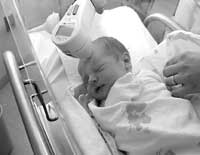
Babies tested for jaundice at St. Luke's Regional Medical Center now have a new non-invasive method to replace the long-used but painful "heel stick" blood test that can set infants howling.
St. Luke's recently purchased two hand-held bilirubin meters, or BiliCheks, which use light to measure levels of bilirubin through the skin. Bilirubin can cause jaundice, or yellowing skin, in newborns.
About the size and the shape of an ear thermometer, the BiliChek device allows babies to have their bilirubin levels checked simply and without needing to have blood drawn. Without disturbing the newborn, a phlebotomist from St. Luke's lab shines a BiliChek device on the baby's forehead. The device analyzes the reflected light, and displays results in the same units of measure as the blood test.
The test takes about a minute and is more cost-effective than the heel-stick method. The devices cost $4,405 each and were funded by St. Luke's Children's Miracle Network.
People are also reading…
Infant jaundice is a condition affecting more than 50 percent of newborns during the first week of life, says Dr. Thomas Wilson, one of two hospital-based neonatologists at St. Luke's.
A build of bilirubin causes the telltale yellowish skin tone in the tissue, which occurs after birth with the breakdown of hemoglobin or red cells.
It's a normal development because babies are born with lots of red blood cells, says Wilson. They don't need all the hemoglobin after birth and it slowly breaks down, with jaundice usually disappearing in about 10 days.
"Jaundice to a degree is perfectly normal," the St. Luke's neonatologist says. "If it's in excess it can cause potential damage. Severe infant jaundice, if left untreated, may lead to brain damage or death. It's rare, but it can happen."
BiliChek, from Respironics, can help determine when a total serum bilirubin test involving an actual blood draw is truly needed, and if the newborn should undergo phototherapy to alleviate bilirubin levels.
Treatment for high bilirubin levels calls for phototherapy for several hours in the nursery. Sometimes newborns develop jaundice after returning home and need to be hospitalized for phototherapy treatment, or be treated as outpatients at home with bilirubin lights from St. Luke's Home Medical Supply.
"The BiliChek device saves the baby from those painful heelsticks and avoids separation of mother and infant for a lab test," says Kerry Patterson, phlebotomy supervisor with St. Luke's lab. "In most instances, the babies even sleep through the procedure."


