

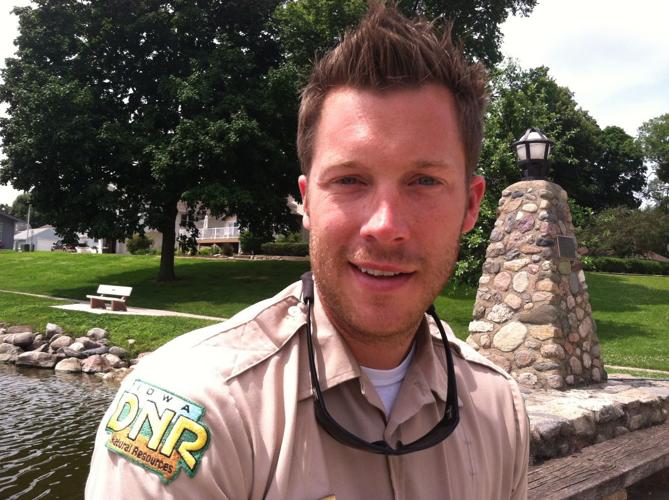
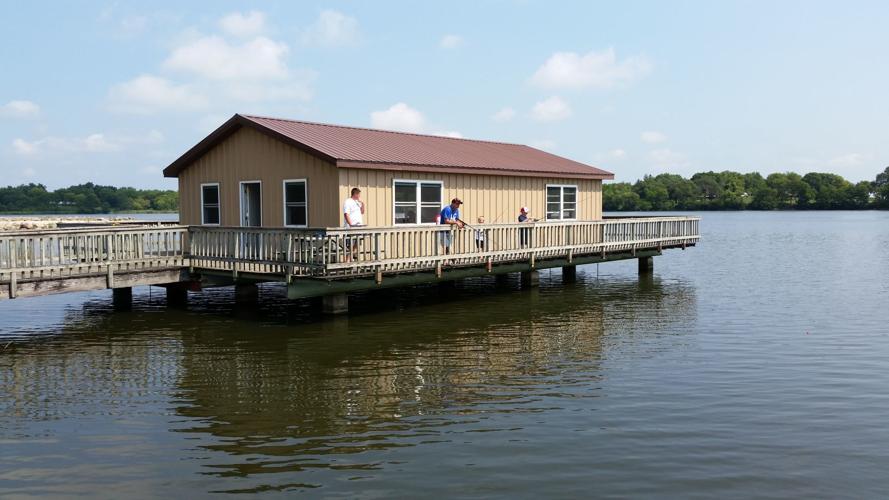
LAKE VIEW, Iowa | A 40-by-56-foot structure featuring steel, lumber and composite decking will soon grace the waters of Black Hawk Lake in Lake View, according to Ben Wallace, fisheries biologist for the Iowa Department of Natural Resources.
The agency, he reported, is letting bids for a handicap-accessible fishing pier with a shelter, allowing anglers who are in wheelchairs to enjoy the thrill of fishing on Black Hawk Lake.
"Shore fishing is a big component on Black Hawk Lake," Wallace said. "We've had anglers showing interest in something like this for years. And now we're finally pooling dollars with REAP Open Spaces funds and a local fund-raising match."
The shelter, which will connect via hard-surface trail to the approach, matches an effort completed in recent years on Swan Lake in adjacent Carroll County.
People are also reading…
"We may look at construction as early as this summer," said Wallace, noting that the structure will stand in the town bay on the west end of the lake.
The fall of 2019 may see yet another construction project for a lake that continues its resurgence since an intentional fish kill in November 2012 eradicated all rough fish from the 922-acre body of water. Wallace disclosed plans for a new fish barrier and water control structure to be installed at the bridge which separates the inlet from the main lake.
"The idea is to keep rough fish from moving from the main lake upstream into the sloughs where they spawn a lot more successfully," Wallace said. "Carp like to move into shallow waters which are warmer and those nutrient-rich waters where their offspring do very well and eventually return to the lake."
By restricting the access fish like carp have to shallow waters outside the lake, they must spawn in the main lake, in an area where predators such as bluegill have a means with which they can control their numbers.
"This structure will also allow us to pump down the inlet area which allows us to, if rough fish get in there, to drain it and kill them out without having to drain the main lake," he said. "If we can de-water on command, we can then revitalize the slough area which becomes nature's filter for water entering the lake."
This ambitious effort, which involves an earthen dike, culverts, a pump house and grate system, already has the financial support of the city of Lake View, which has pledged $300,000.
Fish numbers improve
Black Hawk Lake's 2012 intentional fish kill has paid dividends, according to Wallace, who shared data to support the contention. Going back to 1947, the largest number of bluegills harvested on Black Hawk Lake was 2,173 in 1983. In the wake of the renovation, officials stocked the lake with 280,000 bluegills in 2013. Anglers harvested an estimated 32,821 last year.
"Bluegills respond very well to water quality and habitat," Wallace said. "These numbers are a direct reflection."
Bullheads, conversely, spiral out of control when water quality dips. Wallace said bullheads used to be the most harvested species from Black Hawk Lake. More than 50,000 were taken at points in the 1980s, as surveys weren't done every year.
"In 2016, they harvested 12 bullheads out of the lake," he said. "When you get good water quality and a good predator population, you get lower bullhead density. However, the ones you get can be monsters, as the average weight for a bullhead last year was 1.7 pounds. That's a huge bullhead."'
The $27 million lake renovation began with the DNR's fish kill. It continued with a stocking program in 2013 and is now wrapping up a $2.9 million inlet dredging effort.
Additionally, the DNR continues to work with the city of Lake View, Sac County and the Black Hawk Lake Protection Association in an aquatic vegetation management program. With water quality improving, more sunlight reaches the bottom of the lake, prompting growth of more plant life. That's good for water quality, but tough on lake users.
"We do some targeted herbicide treatment and we run a vegetation harvester that cuts it out," Wallace said.
Wallace hailed the work of area farmers and landowners, the city of Lake View, the Black Hawk Lake Protection Association, the NRCS and T.J. Linn, watershed coordinator.
"Our water bodies have been impacted for more than a century," he said. "It takes time to get these lakes in a degraded state. We use the best science available and put our effort in the places we know where we can have the most bang for our buck."