


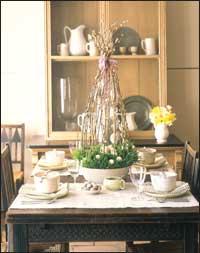
Pussy willows have an inherent allure. With their slender boughs and velvety catkins, they stand out in elegant spring arrangements. Light, supple and strong, they can easily be bent into sculptural shapes. They lend themselves to all sorts of seasonal crafts as well.
Let the ideas below inspire you with new ways to bring pussy willows into your home.
Working with willows
If you're lucky, you may have pussy willows growing in your garden right now. Give them a regular pruning to spur regeneration and for a constant supply of fresh stems. You can also purchase cut pussy willows from a florist.
Whether you get them from your garden or a store, use a pruner to cut the stem ends at an angle before you put them in water. And try to use the willows the same day they're cut, when they're most pliable. The good news is that pussy willows dry beautifully, so your creations will last for years.
People are also reading…
Spring centerpiece
Combine traditional symbols of spring (eggs, grass and pussy willows) in a sophisticated table arrangement. Gather and tie the ends of pussy-willow stems with ribbon to form a tepee above a cluster of brown eggs nestled in wheat grass.
You'll need the following materials: a 13-by-13-inch tray of wheat grass (available at health-food stores and florists), a shallow bowl (12 inches in diameter), 20 to 24 pussy-willow stems (cut to 2-foot lengths), a dozen hard-boiled brown eggs in assorted sizes, and ribbon.
To make the centerpiece, fill the bowl with a couple of inches of water. Then arrange the wheat grass in the bowl to mimic a natural bed of grass. Tuck a pussy-willow stem in the bowl, up against the side; repeat with other stems at even intervals. Gather the tops of the stems, and wrap with ribbon; finish with a bow. Nestle hard-boiled eggs in the grass.
As the willows dry, the structure will hold its shape. The wheat grass should last for up to one week.
For smaller individual place settings, cut pussy-willow 7-inch lengths, and set each across the rim of a coffee cup or soup bowl. Or bundle a few short cuttings with ribbon and set each bundle in an eggcup at each place setting.
Catkin wreath and balls
Covered in fluffy catkins (also called "pussies" because they have the feel of a silky feline), a decorative wreath and matching balls make charming spring accents. Hang the wreath from a loop of velvet ribbon; display balls inside baskets, bowls or glass containers.
For the wreath, you'll need the following materials: pussy-willow stems with catkins, a glue gun, a 9-inch Styrofoam wreath form (available at crafts stores), tweezers and ribbon.
For the balls, you'll need the same materials, but use 3- and 5-inch Styrofoam balls instead of the wreath form.
Begin by pulling all catkins off stems. Use a low-temperature glue gun to place a dab of glue on the wreath form or the foam balls, and then gently press a catkin into the glue using tweezers; repeat until the entire surface is covered.
After the glue dries on the wreath, run ribbon through the center, and tie it to form a large loop for hanging.
Willow basket
A basket made of pussy-willow stems (with a glass vase inside to give it shape and hold water) is the perfect vessel to show off vivid spring blooms. The hues of the flowers will look even more brilliant against the subdued tones of the willows.
You'll need the following materials: a glass vase, sheet moss, 26-gauge floral wire, pussy-willow stems and a clipper.
Place the vase on its side and cover one section with moss (do not cover the inside or the bottom of the vase). Stretch wire over the moss and around the vase as many times as needed to secure, at about 2-inch intervals. Twist the ends of the wire to secure.
Rotate the vase, and tuck more moss under the wire to cover the rest of the glass.
In the same manner, fasten stems atop moss with wire, letting the catkins reach beyond the vase's rim. Gently adjust stems so catkins hide the wire.
Clip stem bottoms so they're even with the base of the vase.
For the basket handle, wire together several stems to create a piece four times as long as the vase is tall; bend it to span the vase. Anchor both ends of the handle to the stems on the base with twists of wire.
Fill the vase with water and arrange blooms inside.
Questions should be addressed to Living, care of The New York Times Syndication Sales Corp., 122 E. 42nd St., New York, N.Y. 10168.


