


There is nothing like experience. As contractors, one of the lessons we learned over years is that hard work pays off. However, as you may have discovered, hard work alone doesn't always yield desired results. On the other hand, working smart - and hard - often produces superior results.
Engaging one's brain before engaging one's body (and tools) will usually make a project go more smoothly, is safer and will produce better results.
Working smart can be expressed in many ways. Some examples are having a plan before beginning a building project - whether it's big (like a remodeling project) or small (as with a craft or repair). Having the right tools and making sure that they are sharp and in good working order is another example of working smart. Aside from experience, patience, a good plan and good tools can make or break a project. And, using good, well-maintained tools can make a project much safer.
People are also reading…
Having a helping hand is another means of making a job go more smoothly. Someone on the other end of a board or at the bottom of a ladder can make a project simpler, safer and more fun. A helper is not always available and, thus, one often must fend for himself.
Our dad was an avid do-it-yourselfer. We were thrilled to be his helper whenever the need arose. However, when we were in school or otherwise occupied, Dad managed just fine thanks to an "extra set of hands" that were always available to him in his workshop - his bench vise. We were amazed how something so small could be so powerful and cause Dad to work up such a sweat.
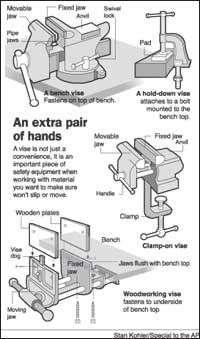
We learned that a vise can hold materials while you cut, sand, drill, solder or perform dozens of other jobs without the material slipping or moving out of place. A vise is especially helpful when you use power tools. It's not only a convenience, but an important piece of safety equipment, as well.
A vise isn't a complex tool; it consists of a fixed jaw and a moving jaw that travels on guide rods or a guide bar, and is driven by a threaded rod with a handle to turn it. The jaws have corrugated or smooth metal faces that often are replaceable. Depending upon the overall size of the vise, the jaw face size (width by depth) ranges from about 2 inches by 2 inches to 6 inches by 3 inches. The maximum opening (or vise capacity) typically ranges from 3 inches to 7 inches.
One slick feature that can really improve a vise's usefulness is an optional swivel base that will allow it to be rotated to the left or right. Equally valuable is an optional anvil, which acts as a perfect surface for hammering out material. Many vises are equipped with a secondary set of pipe jaws to hold pipes, rods, dowels, tubing and other circular material.
Dad did much plumbing work, so he had a special pipe vise that was used exclusively for plumbing pipes. Although both of his vises were mounted on his workbench in his shop, many of today's vises are as mobile as the people who use them. And whereas all vises were once made of steel, high-impact composite materials have become a favorite of do-it-yourselfers looking for a highly portable extra set of hands. Vises are now standard equipment on many portable workbenches.
A vise should be treated as any other tool purchase. Tools are an investment that can last a lifetime if properly maintained. And other than needing periodic cleaning and lubrication, a vise is virtually maintenance free. With vises, size matters. It is better to go with a vise that is slightly larger than what you believe you will need rather than struggling with one that is too small to accommodate your needs. An undersized vise also can be a safety hazard and "knuckle-buster."
If you have a workbench, we suggest that you get a steel vise with an anvil and swivel base that bolts directly to the bench top. If, on the other hand, your work surface is a traveling affair, a clamp-on vise probably will be better. Finally, if an extra set of hands for light- to medium crafts projects is what you're looking for, consider portable composite products.
For more home improvement tips and information, visit our Web site at http://www.onthehouse.com .
Readers can mail questions to: On the House, APNewsFeatures, 50 Rockefeller Plaza, New York, NY 10020, or e-mail Careybro(at)onthehouse.com. To receive a copy of On the House booklets on plumbing, painting, heating/cooling or decks/patios, send a check or money order payable to The Associated Press for $6.95 per booklet and mail to: On the House, PO Box 1562, New York, NY 10016-1562, or through these online sites: http://www.onthehouse.com or http://apbookstore.com .


