


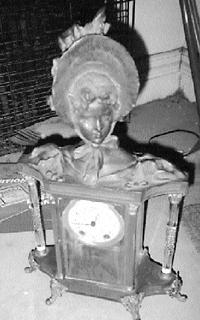
DEAR HELAINE AND JOE: I am wondering if you could tell me anything about this clock. It was my grandfather's and is a Seth Thomas. Thank you. - T. Z., Queen Creek, Ariz.
DEAR T. Z.: This is such a charming clock but would have great difficulties in making assessments because there is so much more information we need that is not provided. Specifically, we would need to know how tall this piece is, whether it is in working order, whether it has an eight-day movement like we suppose and what its back looks like. Without this information some of what we are going to say will be speculation.
We have discussed Seth Thomas before, but we will revisit the company's history briefly to refresh everyone's memory.
Seth Thomas was born on Aug. 19, 1785, and at an early age entered into an apprenticeship to become a carpenter or cabinetmaker. He went to work in either 1807 or 1808, depending on the source, for the famous Waterbury, Conn., clockmaker Eli Terry, who needed help assembling the cases for a large order of wooden clocks. At the Terry factory, Thomas worked with Silas Hoadley, and in 1810 the two men bought the plant.
People are also reading…
The partnership between Thomas and Hoadley lasted until 1813 when Thomas sold his interest and went to Plymouth Hollow, Conn. There he bought a facility and began making tall case clocks. The company prospered but Seth Thomas died in 1859 and the firm was continued by his three sons. The Seth Thomas Clock Company was bought by General Time in 1931.
The particular type of timepiece in today's question is a shelf, or perhaps more specifically, a mantel clock and it might be called a "figural" clock as well. However, most of the examples that are termed "figural" have full length representations of the human body, while this one is just the bust of a woman in an exuberant bonnet perched atop what appears to be a crystal regulator clock.
It is hard to tell in the photographs, but the glass encased clock appears to be similar to Seth Thomas' "Empire" model crystal regulators, which is a type of clock that looks a bit like a carriage clock except the flat top does not have a handle. Many crystal regulator clocks have this flat top, but some are fancier and surmounted by a final that is often urn shaped.
It is unfortunate that we do not know a lot of details about this clock because it will prevent us from valuing it with some precision. However, if this piece is working and it is approximately 14 inches (or more) tall, its insurance replacement value should surpass $1,000.
(Helaine Fendelman and Joe Rosson are the authors of the "Country Living: American Glassware - What is it? What is it Worth?" (House of Collectibles, $19.95). Questions can be mailed to them at P.O. Box 12208, Knoxville, TN 37912-0208.)


