


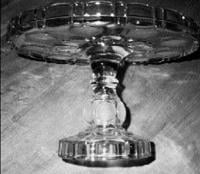
Dear Helaine and Joe: What can you tell me about this compote or cake plate that I inherited from my mother, who received it as a wedding present in 1918? It is 10 inches in diameter and 6 3/4 inches tall. The dollar and quarter sized coins are dated 1892. I have learned that this is called "coin glass" and that the government stopped its manufacture. Is it authentic?
Yours truly, R. B. R., Dover, N. H.
Dear R. B. R.: The original molds for this glass were made in 1891 at the Central Glass Co., which is located in Wheeling, W. Va.. The design was representations of various denominations of United States coins - including the dollar, the half-dollar, the quarter, the 20-cent piece (only minted between 1875 and 1878), the dime, and the half-dime (minted between 1794 and 1873).
A little later, Central Glass joined the United States Glass Company of Pittsburgh, and this became their pattern No. 15005 or "American Coin."
People are also reading…
Today, this design is usually referred to as "U. S. Coin," "Coin," "Frosted Coin" or "Silver Age." These pieces were made in clean glass with frosted coins that sometimes had a gold, platinum, amber or ruby colored stain applied to the coins. On very rare occasions, the coins were left frosted or clear and the body of the glass had a ruby stain.
"U. S. Coin" was made in a wide variety of shapes including toothpick holders spooners, pickle jars, water sets (with each set consisting of a pitcher, tumblers and a tray), ale goblets, bowls - both open and covered, champagne glasses, claret glasses, compotes (both open and covered), cruets, creamers, sugar, bowls, oil lamps, epergnes, shakers, bread platters, spoon holders, and yes, cake stands among others.
The U. S. coin pattern was produced for about six months before the U. S. government ordered the molds destroyed. As we understand it, the thinking was that the molds were reproductions of actual United States coins and therefore fell afoul of the then current counterfeiting laws.
The United States Glass Company quickly redesigned the pattern with Spanish style coins, one of which had a crown and a shield, another had an eagle and a shield, and still others had portraits of Christopher Columbus and Amerigo Vespuucci. The coins were different, but the shapes are identical to those used for "U. S. Coin."
These revamped pieces came out in 1893 as pattern No. 15005 1/2, and are now known as "Columbian Coin," "Spanish Coin" or "World's Fair."
As for whether the cake stand belonging to R.B. R. is authentic, the answer is yes - for a number of different reasons. First of all, the cake stand is not listed as a reproduced piece, and secondly, the first recorded reproduction of "U. S. Coin" was a toothpick holder that did not appear until around 1935 some 17 years after this cake stand was given as a wedding present.
Pieces of "U. S. Coin" can be relatively expensive. One of the most valuable items is the 9 inch diameter covered compote (frosted and clear), which should be valued at about $4,500. Another pricey piece is the 5 1/2 inch tall champagne stem, which retails for around $2,500.
The cake stand owned by R. B. R. is a bit less valuable, but it still has an insurance replacement value of between $600 and $650 if it is in perfect condition.
(Helaine Fendelman and Joe Rosson are the authors of the "Price It Yourself" (HarperResource, $19.95). Questions can by mailed to them at Treasures in Your Attic, 5201 Kingston Pike, Suite 6-323, Knoxville, TN. 37919)
SHNS


