
SIOUX CITY | A new era in Morningside College academics began in 2015 with the opening of the Academic Village.
The proverbial centerpiece of the three buildings, Buhler Rohlfs Hall, houses the Sharon Walker School of Education, the Nylen School of Nursing and the Regina Roth Applied Agricultural and Food Studies Program.
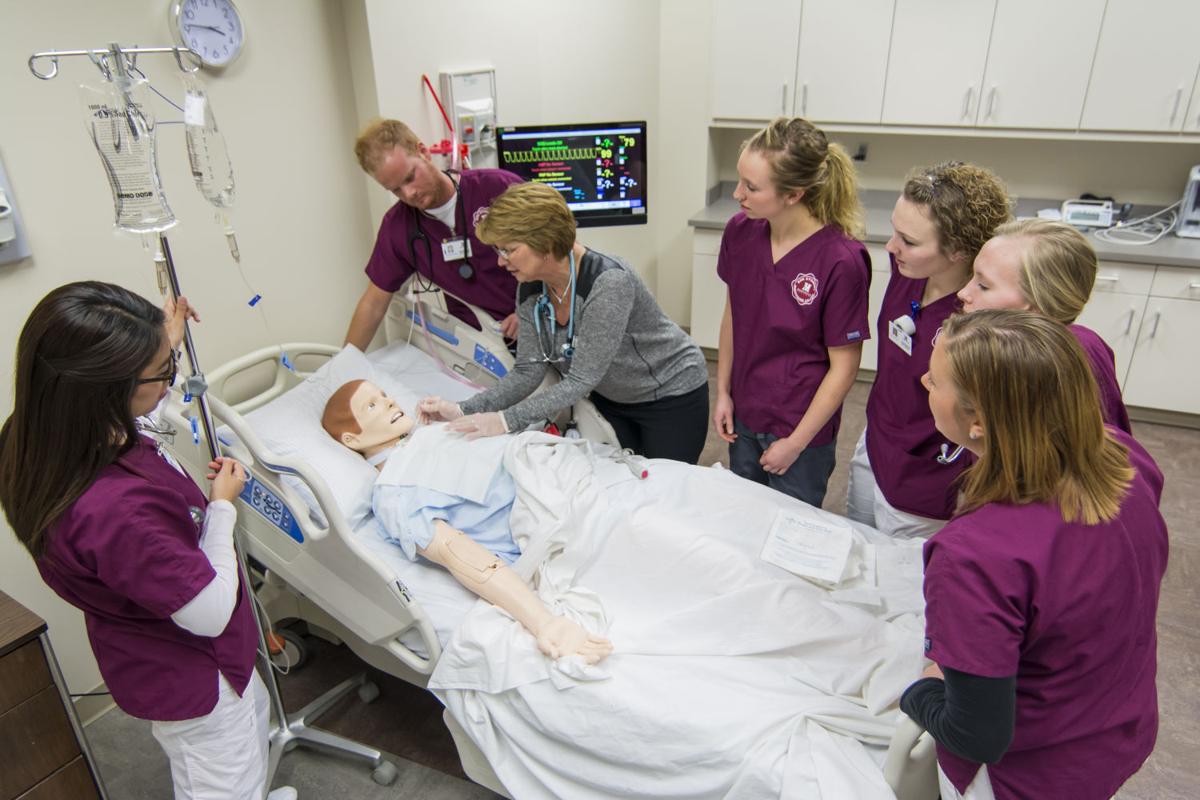
The third floor features the college of nursing, which allows students to gain hands-on experience in nursing practices, from assisting in a birth to hooking up an IV with the use of robotic patient simulators. Behind a window, a professor controls the mannequins' vital signs and can even communicate with a student through the practice "patients."
“Our area simulates a hospital setting in that we have realistic equipment and an environment for students to practice their skills,” said Mary Kovarna, professor and chair of nursing at Morningside College. “There is a nurses’ station with call lights. There is a medication cart. And throughout the day, students care for robotic patient simulators, just as if they were caring for real patients.”
People are also reading…
Kovarna said the simulators give nursing students the opportunity to learn from their mistakes so they will know what to do when working with real people.
“Several students have told me they were in the clinical setting with their teacher at one of the hospitals here in town and there was an emergency situation they had experienced prior to that in the simulation lab,” Kovarna said. “They knew exactly what to do, what was going on and what to expect as far as outcomes, so it was very obvious that they were much more prepared.”
In the real world, Kovarna said, students are stopped immediately if they are making a mistake because patient safety is the No. 1 priority.
“In simulation, if they make a mistake, we let them go with it, and then they have to figure out how to problem-solve to fix the situation,” she said. “That is a very powerful learning experience.”
After about a year in the new facilities, student reactions are very positive, according to Kovarna.
“They love it,” she said. “Course evaluations indicate they want more and more simulation. And actually the National Council of State Boards of Nursing encourages schools of nursing to use it. So it’s known to be a very effective teaching method.”
The second floor houses the Sharon Walker School of Education.
Three classrooms in the new facility contain almost every technological tool found in a modern K-12 classroom, such as interactive white boards, overhead projectors and computers.
Rooms also feature movable tables and chairs to allow students to configure seating arrangements to simulate a typical grade school classroom, a help in learning classroom management.
The ground floor features meeting and office space for the agriculture and food studies program. Chairman Anthony Kern said the floor features meeting and faculty office space.
There are no specialized classrooms, but students have a new – and larger – anatomy and physiology lab.
Kern said he was excited to see the inclusion of more lounge space in the facility to give students a place to relax, socialize and study before and after classes.
“The lounge area gives students easy and informal access to their professors. They frequently study in the lounge area, but can quickly drop by a professor's office if they have a question.”
Connected to Buhler Rohlfs Hall is the Krone Advising Center, a bean-shaped building that houses the campus' advising staff.
Lillian Lopez, vice president for advising, said the center's emphasis is to get first-year students acclimated to college life.
She said the space allows students in all grades to stop in, socialize with fellow students and staffers and seek advice on the approach to college.
"Mentoring students during their first year in college requires us to make direct connections with the students. You need to meet with them often in order to learn about their personal, academic and career goals."