

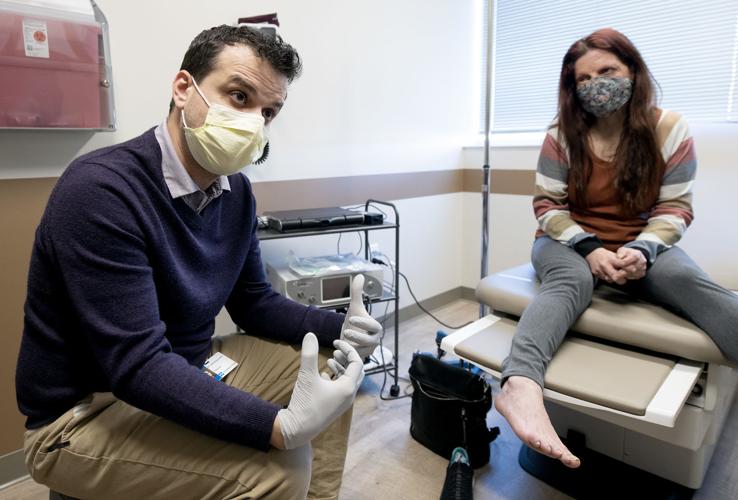

SIOUX CITY -- Using a flexible camera smaller than a pencil, Dr. Kosta Antonopoulos, a podiatrist at UnityPoint Clinic Foot and Ankle, was able to treat Tanya McPeek's painful ankle in November in a procedure room right in his office.
Rather than go back into the operating room for a second surgery, Antonopoulos suggested that McPeek have a minimally invasive procedure performed with the NanoScope, an operative arthroscopy imaging system. The Sioux City woman said it took a couple of conversations with Antonopoulos before she felt comfortable with the idea.
"It's scary when you say office instead of the operating room, but I really didn't have anything to lose. He's a great doctor. If he says he can do it, let's give it a try," said McPeek, who manages Hot Topic in Southern Hills Mall. "I work 70 hours a week and I have kids. I just didn't have that much time to put down again for operating room surgery."
People are also reading…
McPeek first injured her ankle three years ago, while interacting with her Chihuahua, Jack Russell Terrier and Norwegian Elkhound in her backyard.
"We were moving too fast with the dogs and I tripped," she recalled. "I suppose I had the injury for a good 10 days before I saw my physician and, then, she referred me to Dr. Antonopoulos."
Antonopoulos found that McPeek had a "really bad" ankle sprain, or tearing of the ligaments, and some tendonitis on the outside of her ankle, as well as some swelling within it. Antonopoulos said he tried some nonoperative treatments on McPeek, but she wasn't getting any better, so he performed surgery at that time to clean out the swelling and inflammation and stabilize McPeek's ankle, as well as repair the tendons on the outside.
"She was doing good and, then, started to have pain again. Most of the pain this time was along her tendons," Antonopoulos said. "At that point, we, once again, did physical therapy. We did bracing. We did a boot. It just was not getting better."
Antonopoulos said he has been doing procedures with the NanoScope in the operating room for several years. But, in the last year, he said it was granted in-office approval. He said the procedure room is made to be a sterile environment, just like the operating room.
"Equipment's a lot smaller. In the next year, it's going to get even smaller," Antonopoulos said of the reason why such a procedure can now be done in the office. "Patients do so much better when it's in the office. They're not having to undergo anesthesia."
Sometimes, Antonopoulos said an MRI before the procedure can be avoided to further reduce costs. That was the case for McPeek. During her procedure on Nov. 15, Antonopoulos said he was able to visualize her tendons and clean them out. Whether a patient is a candidate for an in-office procedure or not, all depends on what Antonopoulos needs to do to treat the patient.
"A lot of times, if it's just doing an ankle scope, cleaning out the ankle or a joint, or even like this tendon work, yes, they're good for the office," he said. "When I have to do other things, like stabilize the ankle, I can't do that in the office because it's different equipment."
When Antonopoulos pitches the idea of doing the procedure in the office, he said patients usually "freak out" at first and would rather be under general anesthesia in the operating room.
"What they don't realize is they do really, really well here. It's so much easier. You're not having to recover from anesthesia on top of my surgery," he said. "A lot of times, you're walking that day."
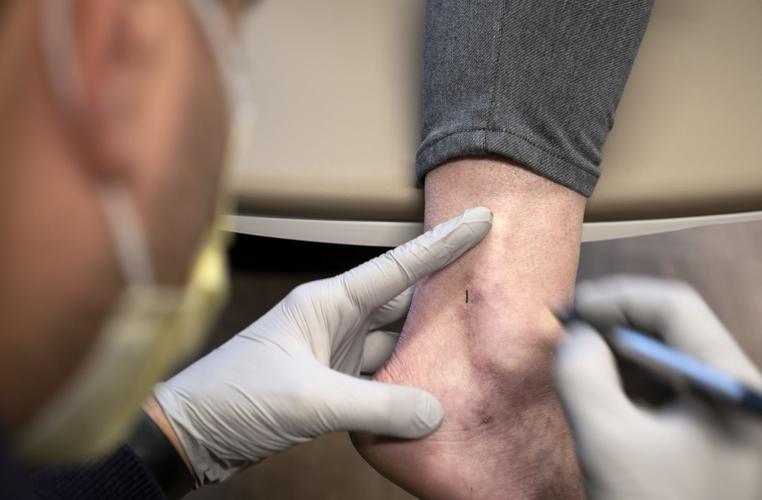
When McPeek arrived at Sunnybrook Medical Plaza for the procedure, she was given medication to calm her and reduce pain. Then, Antonopoulos numbed up her ankle twice, before making four total tiny incisions in her ankle -- two on the front and two on the right side.
"It's a little incision in the front of the ankle and then another incision on the other side in the front of the ankle. Then, I stick the camera in and I look at the ankle," he said. "A lot of times, we have synovitis (an inflammation of the tissues that line a joint) within the ankle, so I fully clean out the ankle. Anybody who has problems on the outside of their ankle, 92% of them, according to the literature, have problems within the ankle, too."
McPeek described her recovery from her first surgery as "very rough." She didn't walk for 51 days. She said the in-office procedure, which took between 30 and 45 minutes, was "a piece of cake." She wore a boot for about a week after the procedure, before transitioning into shoes.
"With my first surgery, my foot had to be elevated. I couldn't put my foot anywhere close to the floor for a couple of weeks. With this one, if I'm honest, I went back to work two days later," she said. "I was back the next week for