


Posted from 03/11/06:
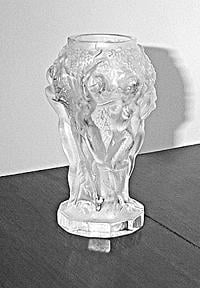
Question: I recently bought the frosted glass vase seen in this photo at an antiques shop for $100. It stands 5 inches tall and is decorated with dancing nude females and bunches of grapes. The bottom is ground, unmarked, and the sides of the vase have visible mold marks. The dealer said it could be an unmarked Lalique.
Is there any way to tell if it is an authentic Lalique vase?
Answer: If the dancing nudes could talk, they would be singing, "Fake, fake!"
As a rule, Lalique glassware was signed, but obvious mold seams are a clear indication your vase is not an authentic piece.
Although most Lalique glass was pressed, the mold marks are virtually impossible to detect.
People are also reading…
The quality of the glass is another way to spot a fake. If there are any flaws, lack of crispness in the design, or if it is not pristine, it's a knockoff. Many similar fakes are made in the Czech Republic and some even have forged Lalique marks.
The dancing nudes are ancient Bacchantes, young women devotees of Bacchus, the god of wine. Lalique produced several versions of Bacchantes vases.
Original Lalique Bacchantes range in values from $2,000 to $35,000. Your vase was made in the mid- to late 20th century and would probably be worth $50 to $125.
Question: This mark is on the bottom of a porcelain vase that I have. The vase stands 9 inches tall and is decorated with a white rose against a cream background. The top and the base are dark pink and there are ornate gold handles on each side.
Could you please tell me who made it, how old it is, and if it has any value?
Answer: Your vase is a nice example of R.S. Prussia porcelain and was made by Erdmann Schlegelmilch in Germany. They used the "Royal Saxe" mark from around 1890 to 1900.
Your vase would probably be worth $325 to $425.
Question: What can you tell me about a circa 1940 stock ticker that I have? It stands about 49 inches tall and is in very good condition. There is a brass plate on the machine that reads "Dow Jones Wall Street Journal." I also have the original felt-backed clipboard that accompanies the ticker. It, too, is marked with a Dow Jones and Co. plate.
Answer: There is limited collector interest in stock ticker machines, but to the right person, it would probably be worth $2,000 to $3,000.
Question: I have a pottery pitcher that is decorated with an apple and leaves that are shaded from a dark to a lighter green, all against a warm cream background. It stands 8 inches tall, was made by Watt Pottery, and is marked "17 USA." What can you tell me about its history and value?
Answer: Watt Pottery Co. was located in Crooksville, Ohio, from 1922 until about 1965. They introduced their Apple Series in 1952 and the line was in production until 1962. Bowls, mugs, pitchers, plates, baking dishes and teapots are just some of the pieces included in the line. Although there are several variations of the pattern, any Apple Series piece is highly collectible. Some pieces were offered as premiums at hardware and grocery stores. The number "17" is the design number.
Your pitcher would probably be worth $275 to $300.
Address your questions to Anne McCollam, P.O. Box 247, Notre Dame, IN 46556. For a personal response, include picture(s), a detailed description, a stamped, self-addressed envelope and $15 per item (one item at a time).
Visit Copley News Service at http://www.copleynews.com.


