


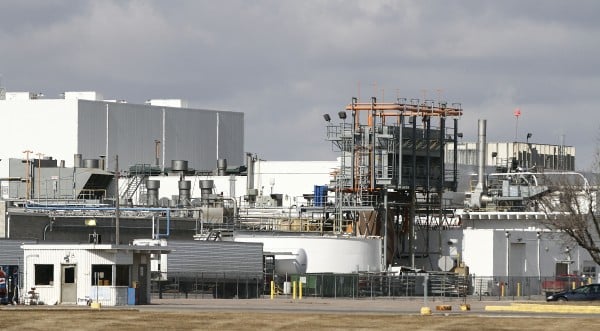

DAKOTA CITY | The world's largest beef plant is about to get even bigger.
Construction continues on a major expansion of Tyson Fresh Meats' sprawling complex in Dakota City.
The $90 million project, scheduled for completion this fall, includes replacing the aging slaughter floor with a larger, more efficient line.
More beef is packed in boxes at Dakota City than at any other plant. The expanded kill floor will allow the complex to match its slaughter and processing numbers.
Dakota City currently receives a supplemental supply of beef carcasses from a satellite plant in Denison, Iowa.
Tyson said the Denison plant, which employs about 400, would most likely close unless the company finds another use for it.
About 200 production jobs would be added at the expanded Dakota City plant. With nearly 4,000 workers, the complex is already the largest employer in metro Sioux City, providing an annual payroll of more than $140 million.
People are also reading…
Hiring for the new Dakota City jobs will begin shortly after the project is completed, said Tyson spokesman Gary Mickelson.
As part of an $80 million project six years ago, Tyson completely rebuilt the original processing areas of the 1966 plant. The latest construction project is replacing or updating other areas more than 50 years old.
The new modern slaughter floor will include the latest sanitation and production systems. Ergonomics changes will strengthen worker safety, helping to make certain jobs less physically demanding.
The beef carcass cooler, rendering and box handling operations also are being updated. Changes to the plant's box handling system will involve the installation of additional conveyors and other equipment that will allow the plant to more efficiently handle products.
"We continue to make progress on improvements designed to ensure the Dakota City plant continues to be a state-of-the-art facility, with a product quality and cost structure that will keep it competitive for many years to come," Mickelson said.
As many as 200 construction workers should been on site during the construction project, which began in the spring of 2012. Mickelson said the company has used outside contractors and suppliers, including several tri-state subcontractors. That's helped pump additional dollars into the local economy.
The Dakota City plant produces fresh vacuum packed, boxed beef for sale to wholesalers, retailers, hotels, restaurants and institutions. Bone, fat, trimmings and hides are recovered and used in the making of various foods, pharmaceuticals, cosmetics and clothing.
In fiscal 2011, the Dakota City plant bought more than $1.7 billion worth of cattle.
Most of the producers who supply cattle live within a 100-mile radius of the plant, but some comes from as far away as 400 miles, according to the company.
Of the eight beef plants Tyson operates in six states, Denison is the sole slaughter-only site. A majority of cattle harvested there are purchased from independent cattle producers that actually live closer to Dakota City, according to the company. The two cities are about 80 miles apart.
The Denison plant, which opened in 1961, was the birthplace of Iowa Beef Packers, later known as IBP Inc., which grew into the world's largest beef and pork supplier.
Springdale, Ark.-based Tyson Foods acquired Dakota Dunes-based IBP in October 2001 for $3.2 billion, creating the world's largest processor and marketer of chicken, beef and pork, and the second-biggest food production company.
"It's difficult to consider the possibility of closing our Denison plant, given the impact on our people, the plant's long history in the meat industry and the tremendous support we've received from the community over the years," said Noel White, senior group vice president of Tyson Fresh Meats, a subsidiary of Tyson Foods, in a statement last year. "However, unless area cattle supplies increase significantly or we find an alternative use for the facility, it may make economic sense to discontinue operations there ..."
IBP also built the Dakota City plant, where the company began to revolutionize the industry with its boxed beef concept, in which meat was cut into smaller portions for shipment in sturdy boxes, replacing the traditional shipments of carcasses to major cities.


