


SIOUX CITY -- MercyOne Siouxland Medical Center is now offering innovative care for patients with new minimally invasive interventional radiology and heart procedures that previously were unavailable in the tri-state area.
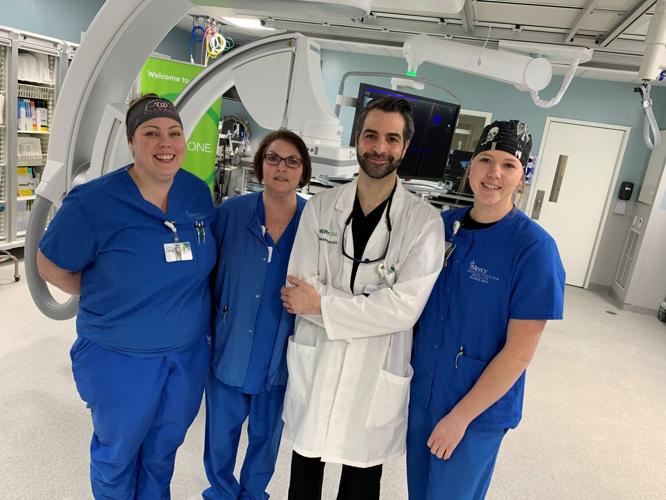
A new Interventional Radiology (IR) suite debuted at MercyOne in January. The suite features complex machines that have the ability to move from head to toe around the patient in several dimensions.
The equipment allows patients to be more comfortable, gives the physician the ability to see from several angles and perform the procedure greater safety and ease. The new machines feature software that allows 3D mapping of vessels, 3D reconstructions of images, and even allow overlay of older scans/images onto the live shot.
Dr. Neal Khurana, medical director of Interventional Radiology, provides patients with alternative options that were previously unavailable in Siouxland, including nonsurgical options for spine compression fractures, pulmonary embolism and deep vein thrombosis, portal hypertension and cirrhosis, uterine fibroids and prostate hypertrophy. In addition, his interventional oncology expertise includes catheter directed chemo-embolization/ radioembolization and thermal ablation.
People are also reading…
"The best thing about IR is the limitless possibilities with today’s imaging technology along with the types of catheters and devices that are available to us; all while providing quicker recovery, increased safety, and lower cost," Khurana said.
HEART SURGERY
MercyOne Siouxland Heart and Vascular surgeons have increased the number of patients served by 350 percent in the last year. Innovative procedures, such as sutureless aortic valve replacement procedures, became an option for Siouxland patients in 2019.
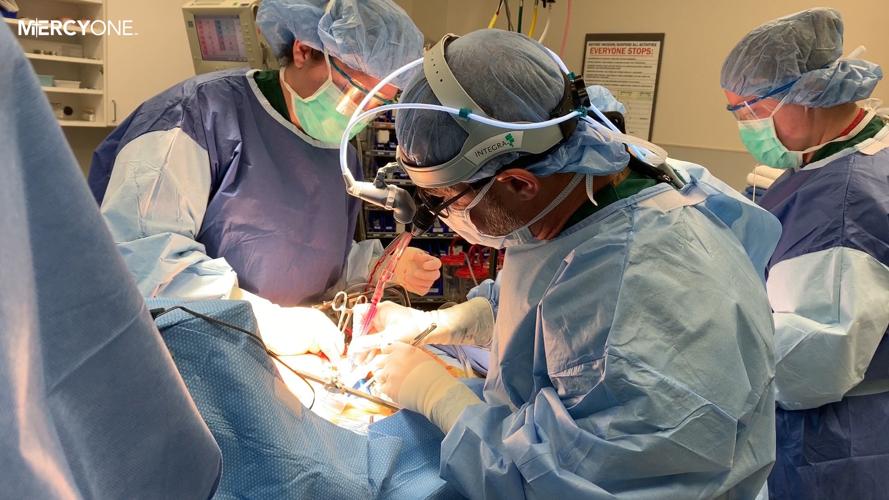
Dr. Giovanni Ciuffo, medical director for Cardiovascular and Thoracic Surgery, performed the alternative, minimally-invasive technique for the first time in Siouxland with the assistance of Dr. Stilianos Efstratiadis, medical director of cardiology.
Ciuffo says the new valve sutureless system "allows you to deploy the valve in the aorta in the position where it needs to be, without having to use stitches. It sort of grabs the portion of the heart where it has to stay and it becomes a part of it."
Ciuffo says the minimally invasive surgery and sutureless valve was a perfect option for one his patients, Mollianne Heikes. Since her surgery, Heikes is up and back to her active lifestyle.
"The medical staff was just great. I have nothing but good to say about this new procedure," Heikes says.
Ciuffo offers patients a minimally invasive heart surgery option. He is able to make a small incision between the ribs to get a look at the heart and is able perform the procedure without breaking the breastbone. The process allows for a quicker recovery for the patient, minimal pain and often no need for a transfusion.
"We've been offering this surgery to the region and beyond. We're here to offer a world-class service. We do advance techniques. We do complex surgery. We do minimally invasive surgery," he says.
The bloodless surgical option appeals to the Jehovah’s Witness community in particular, who seek out physicians and surgeons who understand the need for their members to not share blood. Ciuffo, who has patients from across the United States seeking his surgical talents, performed heart surgeries on Jehovah’s Witness patients who traveled from Naples, Florida and Australia in 2019.
TAVR
MercyOne Siouxland has the tri-state area’s only transcatheter aortic valve replacement (TAVR) program and is one of only three programs in Iowa.
TAVR, the treatment for severe aortic stenosis, offers patients a less invasive procedure than traditional open-heart surgery or even the newer minimally invasive aortic valve replacement surgery. TAVR is most often done through the artery in the leg, much like a cardiac catherization. The new valve is placed on a balloon and positioned across the patient's native valve. The balloon is inflated, expanding a stent with the new valve, which begins functioning immediately on deployment.
The MercyOne Siouxland physician TAVR team includes Efstratiadis, Ciuffo and Drs. Glynne Edwards and James Spann.
The recovery time from TAVR is minimal, as most patients have short hospital stay and often do not require the use of long-term blood thinners.
“This is a historic moment, since even low risk patients with severe aortic stenosis can be treated safely and be better off with TAVR,” Efstratiadis says.
He said Dr. Alan Zajarias, a pioneer of the TAVR procedure and director of Structural Heart Program at Washington University in St. Louis, one of the top U.S. programs, will be a "close collaborator in building the program to amazing quality heights."
The addition of a transcatheter aortic valve replacement program will lay the groundwork for more advanced cardiac surgical care, including mitral valve procedures and alternate treatment options for atrial fibrillation.
Over the past year, MercyOne Siouxland Heart and Vascular Center physicians have grown the number of local patients served through cardiac catheterization lab procedures. Efstratiadis and Edwards have performed 1,000 more catheterization procedures in 2019 than the previous year, an increase of more than 80 percent.
LOOKING TO THE FUTURE
MercyOne is currently raising funds for a $3-million-dollar Hybrid Operating Room, where specialized cardiac, vascular and trauma surgeons will be equipped with advanced medical imaging devices to perform world-class minimally invasive techniques. The techniques will minimize incisions and reduce the patient’s recovery time, saving time, money and lives.
The Hybrid OR will be used for patients with arterial blockages, aneurysm repairs, valve replacements and for the new TAVR procedures. In addition, the new room will provide enhanced imaging and equipment for cutting-edge repair of organs and arteries for trauma patients coming to MercyOne, the region's only Level II Trauma Center.


