


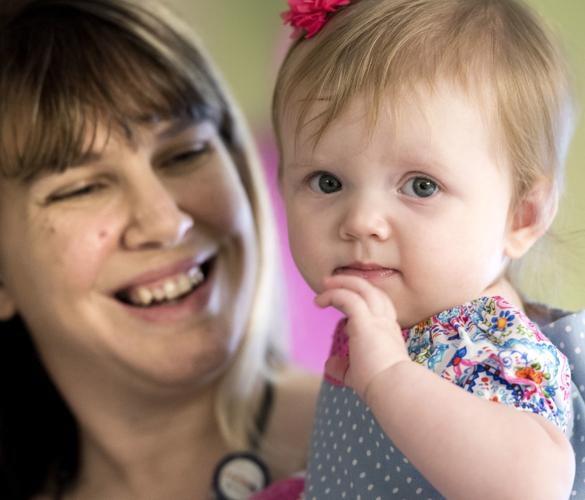
SIOUX CITY -- Francine Paul said the care and attention Jeremy Granger, a pediatric hospitalist, gave her 7-month-old daughter, Mia, "put her heart at ease."
Mia was hospitalized at UnityPoint Health -- St. Luke's for three days last February with respiratory syncytial virus (RSV), a potentially dangerous virus that causes moderate to severe cold-like symptoms in children and babies. RSV can progress to a severe lung infection and cause serious breathing problems.
Granger, who worked as a pediatrician in a local clinic before coming to St. Luke's, coordinates care for and treats children who are admitted through the emergency room or referred for hospitalization by other physicians. He assesses a child's condition throughout their hospital stay, treats them, gives updates to the child's doctors and provides information and reassurance to worried parents.
People are also reading…
"If they have a patient in their clinic who they feel is sick enough to be in the hospital, they call us directly, give us the story and we have them send the patient to the hospital. That happens periodically throughout the day," Granger said.
St. Luke's, a Children's Miracle Network hospital, cares for more than 21,000 Siouxland kids each year, including children with diabetes, cancer, pneumonia and other illnesses, as well as babies who are born prematurely.
Anne Holmes, St. Luke's Children's Miracle Network director, said a growing number of children were being transferred from St. Luke's to hospitals more than an hour's drive from Sioux City. She said the pediatric hospitalist program will help keep more sick children closer to home, thereby making a trying time easier on families.
"Mom and dad don't have to take quite as many days off as they do when they travel to another city. They don't have to worry about what they'll do for child care with any remaining siblings who may be at home," said Holmes, who said a second pediatric hospitalist will join the program in May. "When you can have that care in your own backyard with physicians that you can establish relationships with for years to come, it creates a much better bonding experience for the family and the patient."
Before Granger came on board, some young patients with lung and respiratory tract infections, like Mia, were transferred from St. Luke's to hospitals in Omaha or Sioux Falls in anticipation that their conditions would worsen, only to be discharged from those facilities the very next day. Other times, when pediatricians were unable to get to the hospital until they had finished seeing patients in clinic, Granger said the safest and easiest thing to do was transfer those sick children out of Sioux City to a hospital that could provide a higher level of pediatric care.
"When you're in clinic and your patients are in the hospital in the afternoon, you're just not able to come up here. You can't either be fully in the hospital or fully in clinic. Your attention is divided between the two," Granger explained. "Because I'm here all the time, I'm more often able to keep (children) who are a little bit more sick. I can take them a little bit farther down that course with some other respiratory support methods that we have. That's already kept a handful here that otherwise would've been sent out."
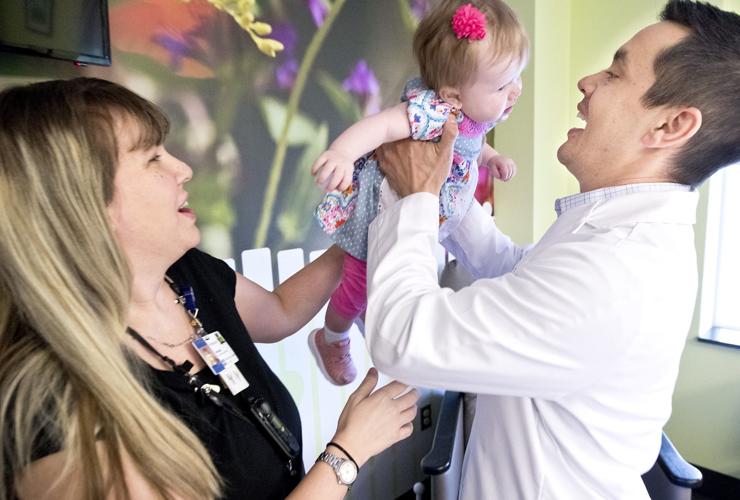
Paul said Mia's hospital admission was a "scary" experience until they met Granger in St. Luke's pediatric unit. Granger isn't afraid to engage in baby talk, make funny faces or play with his young patients. In fact, he approaches the child first when entering a room. After interacting with the child, he talks to the parents and begins the exam.
"I've got to gain their comfort and trust," he said. "If I interact with them and play for a little bit, then that opens the door for them to relax. Their heart rate goes down and they're not going to be screaming when I listen to them. Kids can't always tell us what's wrong, so we rely heavily on the ability to have a good physical exam."
Mia was dehydrated and having trouble breathing. Granger ordered IV fluids and oxygen treatments. By evaluating Mia several times, Granger was able to provide her mother with frequent updates and avoid unnecessary testing and medications.
"With her I was able to listen a few times before and after some breathing treatments. I realized she didn't need a couple of medicines that are sometimes given," he said.
Besides the care and attention Granger gave her daughter in the pediatric unit, Paul said she also appreciated the calls she received when Granger was away.
"He would come in before he'd leave for the day. Then he would call and say, 'Is she OK? How are her vitals?' It wasn't like he up and left and you wouldn't hear from him," she said. "Even though he's not their normal doctor, he still treats (patients) like his own children, which is great."
Copyright 2019 The Sioux City Journal. All rights reserved. This material may not be published, broadcast, rewritten or redistributed.
Dolly A. Butz
City Government & Features Reporter


