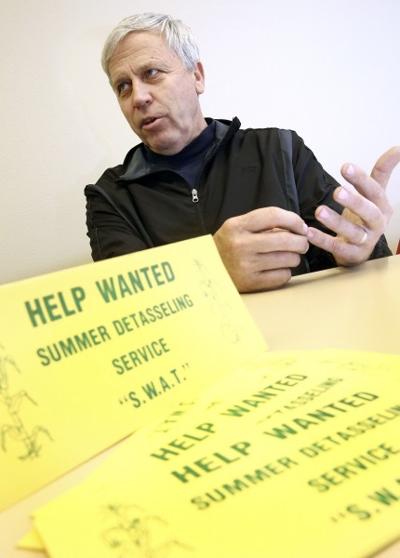

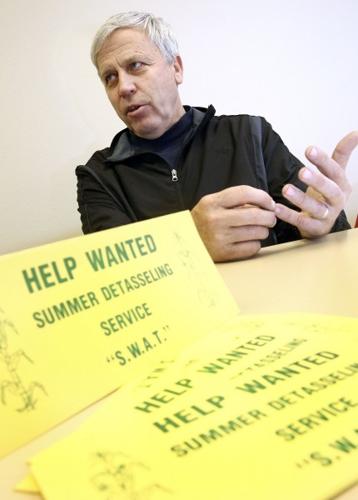
The S.W.A.T. team has had its last mission.
That is if S.W.A.T. stands for "Schermerhorn's Weapons Against Tassels."
"Yeah, that's what the kids called my summertime detasseling business," George Schermerhorn admitted. "Our S.W.A.T. team attacked tassels (pollen-producing flowers) that grew on the tops of corn plants and weeds that grew around soybeans."
But the retired Bishop Heelan Catholic School math instructor gave up his seasonal S.W.A.T. team more than 15 summers ago.
Schermerhorn said it was common at the time for teachers to get involved with farm work during their summers away from school.
"There's a bunch of reasons why I stopped," he contends. "First, it was tough hiring students every summer and then, the seasons got so short that it stopped being worth the time or effort to teach a new crop of kids."
People are also reading…
"Mostly, technology changed," he added, "and there were fertilizers that would get rid of weeds faster and cheaper than any human could."
That, in a nutshell, is what bean walking meant. People would walk through soybean fields, pulling or cutting weeds that could hinder the growth of crops.
When fertilizers containing glyposate -- a broad-spectrum systemic herbicide used to kill weeds and grasses that would compete with commercial crops -- became available in the 1970s, bean walking stopped being a necessity to some farmers, according to Joel DeJong, a crop field agronomist with Iowa State University's Extension Office from Plymouth County.
"Certainly in the past 15-18 years, (bean walking) has become a lot less common," he said, noting that a glyposate-based herbicide called Roundup effectively keeps the weeds away.
Still, walking beans and killing weeds with shovels, spades and machetes represented a first job for many generations of Midwestern kids.
This was true of DeJong, who grew up on a farm in rural Sioux County.
"Bean walking and detasseling were often the only job that rural kids could do near home," he said, adding that small farms would use family members for the job while larger corporate farms recruited teams of short-term employees.
For more than 20 years, Schermerhorn represented the latter approach, hiring teenagers for an average of 13-15 days worth of work.
During the boom years of his business, Schermerhorn supervised up to 140 summertime workers, who split up into several teams.
In most recent years, that number would decrease to one team of four or five workers.
"Better herbicides decreased the window of time we needed to cut weeds," Schermerhorn observed. "So, what was a 15-day job could be accomplished in less than a week."
Which made a hard farm job like bean walking less desirable for teens wanting money.
"It became easier for teens to find other jobs," DeJong said. "After all, walking beans or detasseling corn during a hot summer was never easy."
Today, bean walking is often accomplished by migrant workers seeking short-term employment.
Still, Schermerhorn misses having his old S.W.A.T. team with him.
"When an older child graduated, a younger brother or sister would come in to take his place," he said. "It's a rite of passage that's been lost."