


Invite a flock of birds into your backyard this fall with eco-friendly bird feeders you've made yourself. These projects use organic or recycled materials and are easy enough to put together in an afternoon.
Fall is a great time to begin a bird-feeding program that will last until spring: As the temperature begins to drop, the natural food supply dwindles, forcing birds to look for alternative sources to get them through the winter months. Put out your feeders now, fill them with nutritional delicacies on a regular basis, and you'll have a variety of feathered guests all winter long.
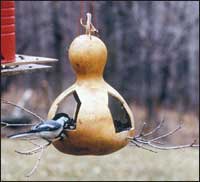
Gourd shelter
Small birds, such as finches and pine siskins, will appreciate the protection from predators that this feeder offers.
For this project you will need a 9- to 15-inch dried bottle gourd (available from gourd farms or farmer's markets), a pencil, paper, a craft
People are also reading…
saw, a drill with a 3/8-inch bit, four sturdy twigs, waxed twine and an upholstery needle.
Start by slapping the gourd with your palm to loosen the dried gourd seeds inside. Draw the shape of a window opening on paper and cut it out.
Trace the shape onto the gourd's surface at equally spaced spots.
Use a craft saw to cut along the tracings; remove windows. Shake out the gourd seeds.
Drill a hole beneath each opening, and find a twig that will fit snugly inside each. (The twigs will extend out horizontally from the gourd to make a perch.) Insert the twigs.
Drill two holes a few inches from the top of the gourd, one on either side of the gourd's neck.
Thread twine through the holes with an upholstery needle, tie the ends together to form a knot, and loop it over a tree branch. Fill with peanuts, cracked corn, black-oil sunflower seeds or other treats.
Suet servers
Many birds enjoy eating suet (beef fat), especially when it is mixed with other tasty ingredients. You can purchase suet mixtures at garden stores or make your own: Melt 3 cups of suet (available at supermarkets) and 1 cup of peanut butter in a saucepan, then stir in 1 cup of cornmeal.
To make a container for the suet, you will need a coconut, a chisel, a hammer, a drill with a 3/8-inch bit, waxed twine and an upholstery needle.
Position the chisel at the coconut's midpoint, and tap it with the hammer to create a hole. Pour out the coconut milk. Repeat this step around the coconut's circumference until it breaks in half.
Drill three holes at equidistant points around the edge of one coconut half, about 1 inch from the edge. Insert a piece of twine into each hole using an upholstery needle and knot the pieces together so the coconut may be hung from a tree branch.
Fill the coconut with melted suet mixture and freeze it until itcongeals.
Hanging-log feeder
Birds that hover (starlings, chickadees) or cling (woodpeckers, flickers) while they eat will favor this feeder.
For this project you will need a dry log (about 1 1/2 feet long and 3 inches in diameter), 2 C-clamps, a drill with a 1-inch bit, 2 eye hooks, peanut butter, cornmeal, waxed twine and a pinecone.
Secure the log to a work surface with C-clamps. Drill eight holes through the log at various points. Screw in one eye hook at either end of the log.
Mix three parts peanut butter with one part cornmeal and press the mixture into the holes. Wrap twine around a pinecone. Roll the pinecone in the peanut butter-cornmeal mixture, and tie it to an eye hook. Thread a piece of twine through the other eye hook, and then hang the feeder.
Strung-up snacks
Treating birds to a meal of peanuts or fresh fruit slices couldn't be easier: All you need to do is hang them on a string.
For these projects you will need peanuts (in the shell), fresh fruit (green grapes, slices of banana and apple, wedges of orange), waxed twine, a tapestry needle, Popsicle sticks and a drill with a 1/8-inch bit.
To make a string of peanuts, use a needle threaded with waxed twine to pierce each peanut shell in the spot between the two nuts. When you have a full string of nuts, knot the ends to secure.
To make a fruit string with a Popsicle perch, drill holes through the centers of 2 Popsicle sticks. Lay one stick on top of the other, forming an X and lining up the holes. Pull a needle threaded with waxed twine through the holes, knotting the twine underneath the sticks to anchor them. String pieces of fruits onto the twine.
Hang both the peanut and fruit strings by looping the top of the twine around a branch.
Questions should be addressed to Martha Stewart, care of The New York Times Syndication Sales Corp., 122 E. 42nd St., New York, N.Y. 10168.
Questions may also be sent to Stewart by electronic mail. Her address is: mstewart(at)marthastewart.com. The (at) represents the symbol on your keyboard. Please include your name and daytime telephone number. Questions of general interest will be answered in this column; Martha Stewart regrets that unpublished letters cannot be answered individually. For more information on the topics covered in the askMartha column, visit www.marthastewart.com.
Dear Jim: I am planning to build a house on a sloping lot. I thought about using an all weather wood foundation instead of concrete blocks or poured concrete. Will this be an energy efficient construction method? - Rich L.
Dear Rich: You are lucky to find a sloped building site because it allows you to have the living space on the lower level partially sheltered by the ground. This allows you to take advantage of the nearly constant ground temperature and its protection without the problems of an underground home.
All weather wood foundations are called permanent wood foundations (PWF) today. PWF is an ideal foundation construction method for your sloped building site or for flat building sites. It produces one of the most energy efficient foundations and offers many advantages for your home.
A PWF is basically a standard insulated framed wall used for the foundation. It differs from a typical above-ground wall in that it uses pressure-treated lumber, is stronger and is designed to be water resistant.
PWF's have been used for decades and they hold up very well. Several companies produce complete PWF panels made to your building plans.


