


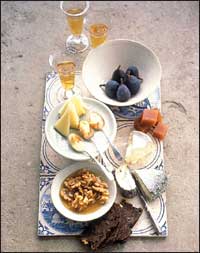
If you'd like to serve a cheese course at your next party and find the endless selection a bit intimidating, you're not alone.
But there's no need to be nervous. A plate of cheese doesn't have to be anything elaborate. In fact, a platter with just three or four cheeses is ideal. Even a single cheese with the proper accompaniments -- a nice Stilton, say, with sliced pears, toasted walnuts and a glass of sherry --is better than an overwhelming number of varieties. And you don't need to be a cheese expert to pull it off.
You can't really make a mistake when assembling a cheese course, but some combinations work better than others. If you've never served a cheese course before, you might want to start with familiar cheeses that you enjoy and expand your repertoire one cheese at a time.
The staff of your local cheese shop or gourmet shop can help inform you and introduce you to new varieties. Then let your palate guide you.
People are also reading…
Here are some things to keep in mind:
Choosing cheeses
The cheese should reflect the menu. A simply prepared dish, such as grilled meat or fish, is ideally followed by complex, aromatic cheeses.
Mild cheeses are an excellent counterpoint to spicy or elaborate entrees.
Serve an assortment with different flavors, colors, textures and rinds.
Young cheeses generally have a mild flavor, a soft, moist paste, and no rind. With age, a skin or rind forms, flavor intensifies and the paste becomes denser. Soft chevre, for example, is a young cheese, while firm Parmigiano-Reggiano is older.
To develop particular flavors, cheesemakers use herbs and benign bacteria, which also cause the paste to vary from the bright white of fresh cheeses to ivory, orange and blue-veined.
Serving cheeses
The timing of when to serve a cheese course varies culturally. The British serve theirs after dessert, while the French present the cheeses just before it. A great advantage to serving cheeses before dessert is that guests can pair the wine that accompanied the entree with less pungent cheeses, before moving on to blue cheeses, which work well with the sweet and fortified wines that go with dessert.
(Cheeses are usually eaten starting with the mildest and progressing gradually to the strongest, to prevent the flavor of milder cheeses from being overwhelmed by those that are more intense.)
Before serving your cheeses, let them rest for an hour or so at room temperature (larger ones should be cut to a manageable size just before putting them out so they don't become dry). Allow about 3 1/2 ounces of cheese per guest.
You can arrange the cheeses on a wooden board or a platter and allow guests to slice their own portions. Or, just before serving, you can arrange individual slices on plates.
Serve with crusty rustic bread, sweet items (fresh or dried fruits, chutney, honey) and savory tidbits (olives, nuts).
Delicious combinations
Try composing a cheese plate based on a theme, whether by region, type of milk or age. Here are some wonderful combinations:
American cheese course
We've traditionally viewed European cheeses as superior, but American varieties now compete with those made abroad. Some of the best: Point Reyes blue from California, Vermont Shepherd aged sheep's-milk cheese, Sally Jackson sheep's-milk cheese from Washington state, a Camembert from New York's Old Chatham Sheepherding Co., a Vermont Bonne-Bouche ash-ripened goat's-milk cheese, and Winchester's aged California Gouda.
Serve with apples, pears and hard cider.
French cheese course
French cheeses are one of that nation's gastronomic glories. To acquaint yourself, try a luscious Edel de Cleron, a classic Roquefort, a bright-orange Mimolette, a Camembert, an aged Ossau-Iraty from the Pyrenees, or a lemony Brillat-Savarin.
Serve with raisin bread, slices of honeydew melon, toasted almonds and prune plums.
Goat cheese course
Goat cheeses are milder in aroma and flavor than many of their aged sheep's-milk or cow's-milk cousins. Offer a few of the following: a peppercorn-studded Coach Farm wedge, a fresh California chevre, a creamy French Bucheron, a French Pave au Poivre, a nutty Spanish Garrotxa or a French blue.
Serve with Concord grapes and slices of rustic bread.
Dessert cheese course
When cheese is going to stand in for dessert, serve a spectrum of sweet and savory flavors. For a decadent platter, pair slices of manchego, creamy Explorateur, and a rich Mont Briac with sweet fresh figs, Spanish membrillo (quince jelly), and dark bread with walnuts and honey.
Questions should be addressed to Martha Stewart, care of The New York Times Syndication Sales Corp., 122 E. 42nd St., New York, N.Y. 10168.
Questions may also be sent to Stewart by electronic mail. Her address is: mstewart(at)marthastewart.com. The (at) represents the symbol on your keyboard. Please include your name and daytime telephone number. Questions of general interest will be answered in this column; Martha Stewart regrets that unpublished letters cannot be answered individually. For more information on the topics covered in the askMartha column, visit http://www.marthastewart.com .


