



PHILADELPHIA - Edgar Allen Poe is probably best known for his gothic tales of horror but in fact he was also a literary critic, poet and is credited with inventing the modern detective story. Although Poe is probably more associated with Baltimore since he's buried there, he also lived in Philadelphia and wrote many of his most famous stories there. Poe lived in several houses while in Philadelphia but only one still remains and is owned by the National Park Service and open to the public. Poe lived in the house in 1843 before moving to New York City.
Poe was born in Boston on Jan. 19, 1809, to David and Elizabeth Poe. Shortly after his birth his mother separated from her husband and took her three children with her. She died in 1811 when Edgar was just 2 years old. After her death the three children were divided up among friends and relatives and Edgar went to live with Mr. and Mrs. John Allan. John Allan was a successful merchant and Edgar grew up in a somewhat privileged household and went to good schools. When he was 6 he was sent to school in England to study Latin and French as well as math and history. After five years he returned to America to continue his education. At 17 he enrolled at the University of Virginia but began to drink heavily and was soon in debt. He quit school less than a year later.
People are also reading…
His adoptive father shunned him and with no money or job skills Poe enlisted in the U.S. Army in 1827. He did well in the military and obtained the highest enlisted rank of Sergeant Major. When Mrs. Allan died in 1829 John Allan tried to mend the differences between himself and Edgar by signing Edgar's application to West Point. While waiting for his first term to start at the military academy Poe stayed with his grandmother, aunt, his brother and his young cousin Virginia. In 1830 Edgar became a cadet at West Point but was soon asked to leave. It's believed Poe ignored his duties and regulations in order to get dismissed because John Allan refused to send him money.
A year later Poe went to New York City and had some success getting his poetry published. In spite of that he was soon broke and in debt. He wrote to John Allan for help but was refused. Allan died in 1834 and left his adopted son out of his will.
In 1835 Poe got a job as editor of the Southern Literary Messenger in Richmond, VA and with his new found success sent for his aunt and cousin Virginia. In 1836 Edgar Allan Poe married his cousin. Poe was 27. Virginia Clemm was 13.
Poe increased the paper's circulation from 500 to 3,500 but left in 1836 saying his salary wasn't high enough. Edgar continued to write and gain some success and in 1840 he became editor of Graham's Magazine in Philadelphia. While there he wrote and published "The Murders in the Rue Morgue" which has been called the first detective story in American literature.
He continued to have limited success with his writing but was seemingly always broke and in debt. Virginia developed tuberculosis at a young age and in 1847 died from the disease. Edgar was devastated by her death and collapsed from stress at the loss of his beloved wife. Although he eventually recovered from his loss Poe was never the same.
Like many of the stories and books he wrote Poe's death is a mystery. What's known of his final days is that he left New York in June 1849 and went to Philadelphia to visit his friend John Sartain. The next month he went to Richmond, Va., where he joined "The Sons of Temperance" in an effort to stop drinking. He renewed a boyhood romance with Sarah Royster Shelton and made plans for an October wedding. On Sept. 27 Poe went to Philadelphia and stayed with his friend James P. Moss. He left Philadelphia on Sept. 30 intending to go to New York but apparently took the wrong train and ended up in Baltimore. On October 3 Poe was found unconscious at Gunner's Hall, a public house in Baltimore and was taken to the hospital. He never fully regained consciousness and couldn't explain what had happened to him. Edgar Allan Poe died in the hospital on Oct. 7, 1849.
Researchers have proposed many theories about Poe's death including being mugged, acute alcoholism and even rabies but the exact cause remains a mystery today.
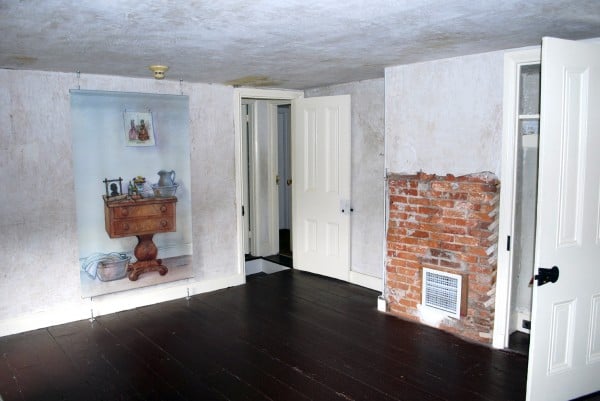
The Edgar Allan Poe National Historic Site in Philadelphia was Poe's residence in 1843. The red brick building has 6 rooms on two floors and a basement. Visitors entering the front door are greeted by National Park Rangers who are available for guided tours. Those wanting to tour the home on their own can get a self-guided map and brochure. The front part of the Poe house has an exhibit room, a theater showing an eight-minute film about Poe, a reading room and gift shop.
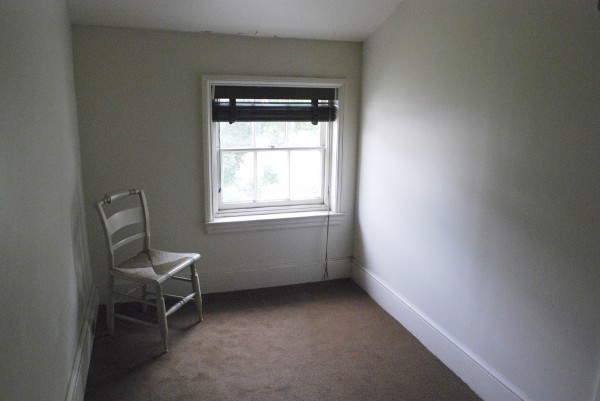
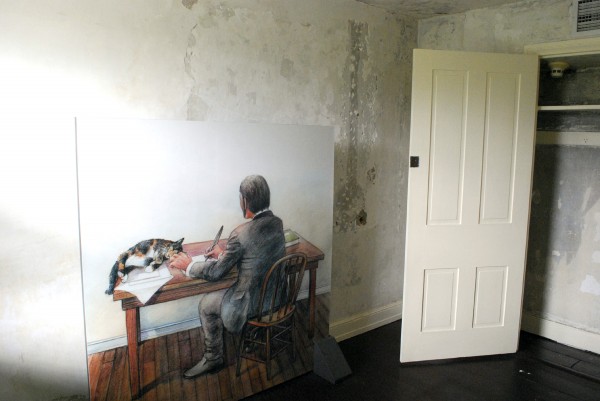
The rooms in the home are sparsely decorated which probably reflects the way the house looked when Poe and his family lived there.
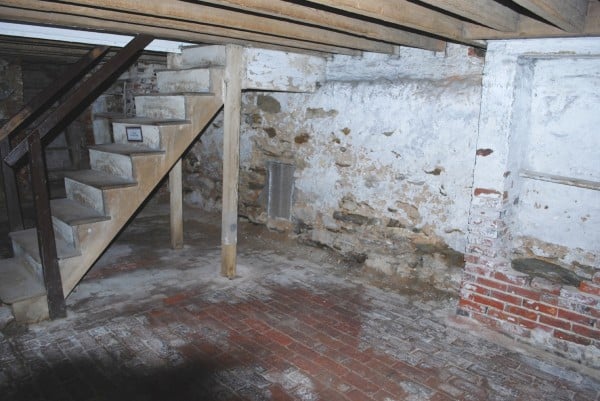
Those brave enough can venture into the dank and dismal basement of the Poe house. A basement many believe served as the location for Edgar Allan Poe's story, "The Black Cat". Park rangers tell of visitors who went into the dimly lit basement only to see a cat watching them through the window. Others have reported getting an eerie feeling while in the crypt-like basement. One park ranger when asked if there were any ghosts in the basement replied, "I don't know but if you see one, don't tell me."


