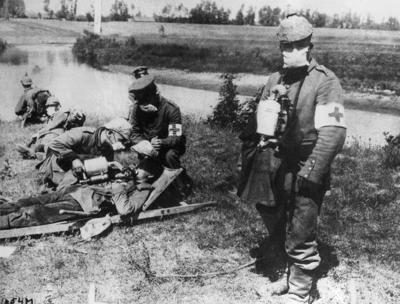

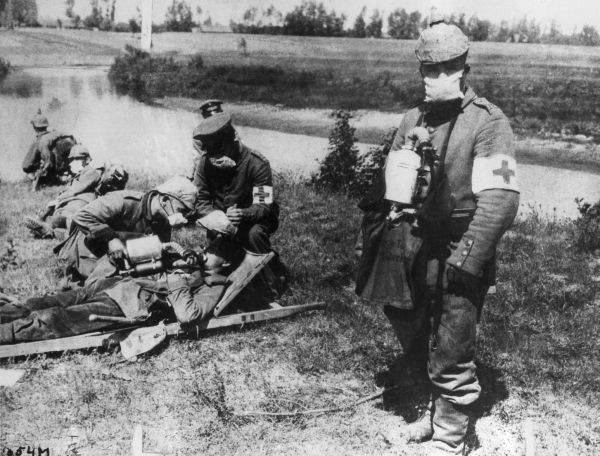
This year marks the 100th anniversary of the start of World War I.
The war began July 28, 1914, when Austria-Hungary declared war on Serbia following the assassination of Arch Duke Ferdinand by Serbian nationalist Gavrilo Princip. Then it seems everyone decided to declare war on their neighbors. Just a few days later, on Aug. 1, Germany declared war on Russia, and on Aug. 3 Germany also declared war on France. The next day, Britain declared war on Germany after Germany invaded Belgium. Not to be outdone, Austria-Hungary declared war on Russia, and on the same day Serbia declared war on Germany. Apparently nobody could get along with anyone. Not a whole lot has changed over the past 100 years.
And where was the United States in all this mess? On Aug. 19, President Woodrow Wilson announced the U.S. would remain neutral while the rest of the world dukes it out. But on April 6, 1917 the U.S. declared war on Germany.
People are also reading…
There were several reasons why the U.S. entered WWI after remaining on the sidelines for three years. The most commonly accepted answer is the sinking of the British passenger ship Lusitania by a German submarine. Many Americans passengers lost their lives on the Lusitania. Added to that was the sinking of seven U.S. merchant ships by German subs.
Another reason for entering the war was the so-called Zimmerman Telegram. The telegram was sent by German foreign secretary Arthur Zimmerman to the German ambassador in Mexico instructing him to approach the Mexican government and form an alliance if America was to enter the war. The message was intercepted and decoded by British intelligence and passed on to the U.S.
The Russian Revolution also contributed to the decision for America to enter the war since the Russians were busy with their own internal problems they couldn't spend time fighting the Germans.
So the U.S. entered the war on April 6, 1917. To boost the military's numbers, Congress passed the Selective Service Act on May 18, 1917, allowing the government to draft young men into the Army. One of those men was Charles Turner, who many years later would become my father. I don't know a lot about his military service because his records along with thousands of others were destroyed in a fire at the National Archives in St. Louis in 1973. And because he died when I was 8, I never had the chance to ask him about his service.
I do know he was sent to Fort Riley, Kan., for training and sometime later shipped out and was headed for France. Fortunately for him and the rest of my family, he never made it out of the U.S. The fighting ended in 1918 with an armistice on the 11th hour of the 11th day of the 11th month. But the official end to the war didn't happen until The Treaty of Versailles on June 28, 1919.
In 1914, what we call World War I was known as the "Great War" or "The War to End All Wars." It was called that because nobody would be dumb enough to start another one. Unfortunately for all of us that turned out not to be true. So maybe it's good to take time to look back 100 years to WWI and realize war is not the solution to any problem.
Terry Turner is a Prime writer and can be reached at turnert185@outlook.com