
You do not want to be behind John Walsh at an airport or at the courthouse or even at Wal-Mart.
Why?
Because the computer chip implanted in Walsh's brain and the neurostimulator implanted in his collarbone used to stop tremors always causes even the most advanced metal detectors to go off.
"There's plenty of beeping whenever I go shopping," he said, jokingly.
But it's a small price to pay for the Anthon, Iowa, man who had been suffering from debilitating Parkinson's disease for nearly 20 years.
Less than a year ago, Walsh became one of the more than 80,000 patients worldwide to receive deep brain stimulation (DBS).
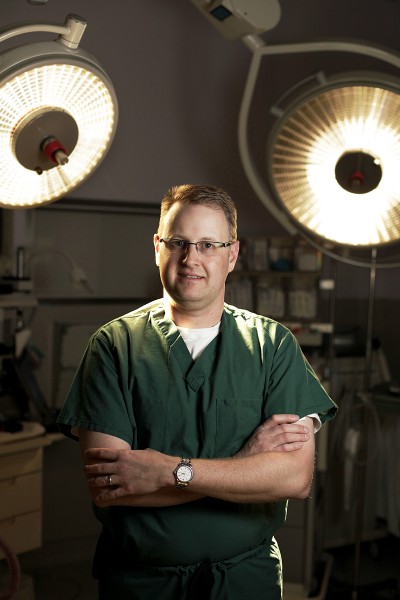
"Think of deep brain stimulation as a cardiac pacemaker," CNOS neurosurgeon Matt Johnson, who performed Walsh's procedure, explained. "Instead of helping the heart, DBS helps the brain."
People are also reading…
In the past year, Johnson said he has performed the procedure on five other Parkinson's patients.
DBS uses a surgically implanted medical device to deliver carefully controlled electrical stimulation -- controlling things like movement and muscle functions -- to the brain.
These devices are connected to one (or more) neurostimulators implanted near the collarbone. Containing a small battery and computer chip that are programmed to send electrical pulses to control symptoms, the neurostimulator can be adjusted non-invasively by Johnson, to maximize control and minimize any side effects.
This has made life easier for Walsh, a 50-year-old former security guard.
"My Parkinson's had gotten so bad, I could hardy walk because of my tremors," he said inside his kitchen. "Now, I can get around so much better."
Johnson implanted an electrode by drilling a hole into Walsh's skull at Mercy Medical Center -- Sioux City while the patient was under local anesthesia.
"I can remember my arm was shaking when the doctor drilled a hole in my skull," Walsh recalled. "Gradually, the tremor slowed down. And then it stopped entirely."
Although he cautions DBS will not cure Parkinson's, Johnson said DBS will allow patients like Walsh to "turn the clock back a few years."
Which is fine by Walsh, who has plenty of gardening to do in the meantime.
"Last year, I could only dream about working in my garden," he said. "Now, I can do it anytime that I want."
As he looks out into his yard on a sunny spring day, Walsh smiles.
"Although I get a bit stiff at times and I tire easily, I feel like I have more control," he said. "DBS has made living with Parkinson's a lot less debilitating for me."