
SIOUX CITY -- Some of the artifacts at the Sioux City Public Museum say a lot about the pocketbooks of the people who owned them.
The well-to-do rode in closed carriages and lit their homes with gas. Half a century later, the less well-to-do joined the Civilian Conservation Corps, and farmers used proto-wind turbines to power their radios because the electric company refused to run power lines to their homes.
For the Victorians (lovers of the ornate and fussy, who crowded their homes with decorations) and people of the early 20th century, household objects were a marker of status, in a society where social distinctions carried some weight. Even a person's dishes signified whether theirs was a family of means.
Tom Munson, archives manager at the Sioux City Public Museum, sat down recently to provide insight into some of the museum's most interesting household objects, some of which are in storage and seldom seen by the public.
People are also reading…
1. Pelletier pitcher, 1904
Not on display

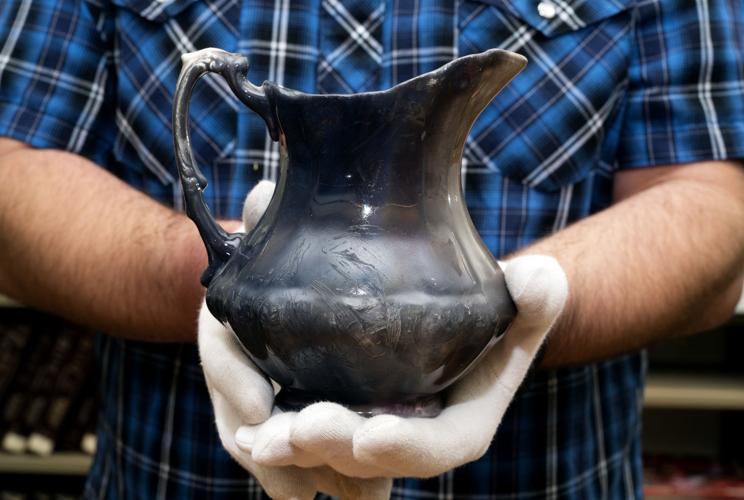
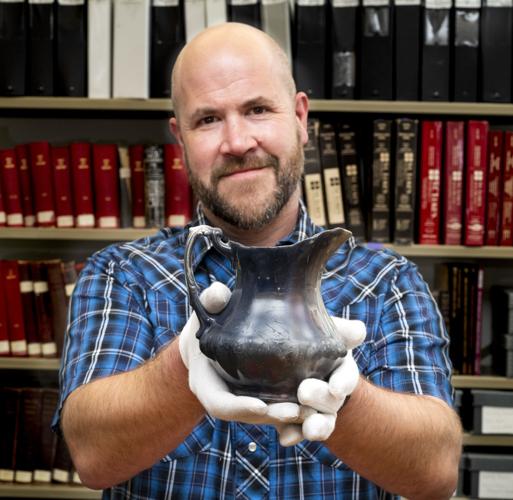
Tom Munson, Sioux City Public Museum archives manager, holds a pitcher that survived the 1904 Pelletier Department Store fire.

Tom Munson, Sioux City Public Museum archives manager, holds a pitcher that survived the 1904 Pelletier Department Store fire.
Shortly before Christmas, 1904, the Pelletier Department Store burned down after a mishap involving highly flammable cotton and paper Christmas décor.
A small pitcher of English manufacture, maybe five or six inches tall -- likely intended for a dinner service, probably as a cream pitcher -- apparently survived the fire, and was donated to the museum six years ago. Its dainty coloring, probably pink and white originally, was scorched to an unusual grayish, quasi-iridescent hue, and some of the glaze melted, though it remains intact.
Munson said that the little pitcher, had it been sold rather than burned, probably would have belonged to an upper-middle class family. It's somewhat nicer -- or, at least, more decorative -- than the plainer, more practical wares used by people of modest means.
Fine dishware was, at that time, one of many status symbols. You knew you'd made it when you had a large, attractive dinner-service from a reputable manufacturer, often imported from Europe.
"This kind of china, this kind of service-ware -- most likely, you're talking about somebody who was upper middle-class or upper class," Munson said.
2. Gas and electric chandelier, circa 1890
Not on display

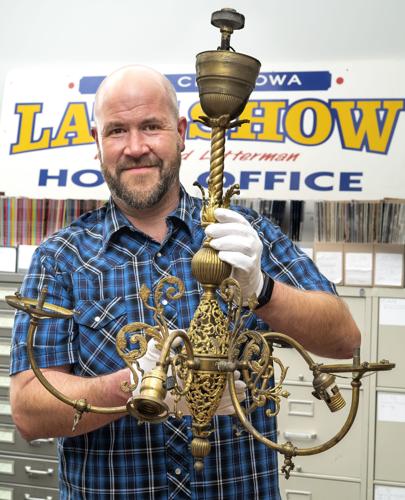
Tom Munson, Sioux City Public Museum archives manager, holds a a chandelier from about 1890 that operates with either electricity or gas.
During the 19th century, people of limited means had limited options for nighttime lighting: kerosene or oil lamps, or candles. Going to bed after sunset was also an option, particularly for people with lean budgets.
Middle-class and wealthier people of that era, by contrast, could control the light in their homes by the turn of a knob. Gas lighting, powered by coal gas, became a fixture in newer houses and other buildings by the middle part of the century.
The inexhaustible dance of a gas flame was at least slightly more convenient than candles or kerosene lamps, and it was a sort of status symbol -- especially when the light came from an elegant, showy fixture.
"Manufactured gas, or coal gas, would have been the common lighting source here, through the mid- to late-19th century," Munson said.
In 1884, Sioux City's earliest power plant began operation, only a few years after Thomas Edison demonstrated his lightbulb. "Sioux City in the 1880s and the 1890s was really a very modern city," Munson said. "This was our era of big growth, so it was easy to put this kind of technology, this kind of infrastructure, in place."
The gradual electrification of America starting in the late 19th century put manufacturers of light fixtures in a tough spot -- newly-built homes could as easily have electric wiring as gas piping. Illuminating a home by burning coal gas was not without its drawbacks, though the electrical grid of that era was somewhat unreliable, and most cities and homes were yet-to-be electrified.
The industry's response was combination gas-and-electric fixtures. The Sioux City Public Museum's ornate gas and electric chandelier is an example of this, with upturned nozzles for gas lighting and downturned sockets for lightbulbs. It would've had glass globes originally, but these are long gone.
The fixture, along with two identical ones in the museum's collection, may have come from the Peirce Mansion, though its exact provenance is unclear.
3. Fur coat and fur cape, circa 1970s
On display

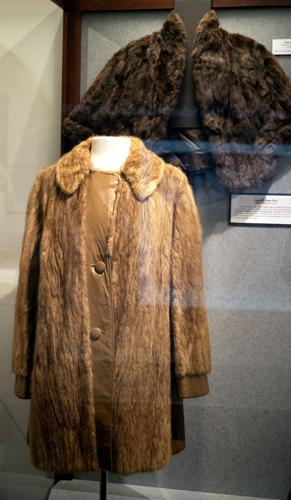
A circa 1970 fur coat and cape.
As late as the 1970s, it was relatively common for women, both wealthy and middle-class, to wear mink for its warmth and glossy style. Men occasionally sported fur during the 20th century, often in the form of coats with fur lapels or rakish fur coats, though the latter had fallen out of style before midcentury.
"Every woman of a certain age or a certain income had a fur coat. A fur coat was absolutely a status symbol," Munson said. "It's not something we see very often -- you hardly see anybody wearing fur coats."
Furs had been widely used in outerwear for centuries, but for several reasons -- notably the rise of animal-welfare concerns and increased demand for inexpensive, ordinary, easy-to-care-for clothing -- genuine fur has almost vanished from fashion in recent decades. Faux fur is still somewhat common.
"I certainly never considered my family wealthy, but I remember my great-grandma had a fur coat," Munson said.
Sioux City had several mink farms during the fur industry's good years, Munson said, and was home to "quite an active furrier business." The Strange Bros. Hide Company, a fur and pelt processor, was in business in Sioux City from the 1870s to at least the 1970s.
The museum has on display a women's mink coat and a mink cape from the 1970s, when the sun was setting on fur as a fashion mainstay. Both the cape and coat came from Sioux City furriers.
4. CCC jacket, circa 1940
On display

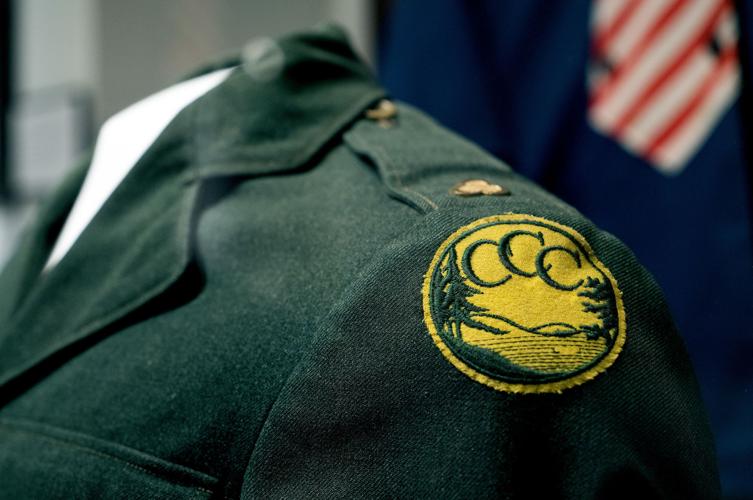
A circa 1940 Civilian Conservation Corps jacket.
On the wall opposite the fur coats is a piece of outerwear rather their opposite -- a uniform jacket from the Civilian Conservation Corps.
The United States tumbled into the Great Depression in the years following the stock market crash of 1929. Beginning in 1933, the administration of Franklin D. Roosevelt launched the New Deal series of federal programs intended to alleviate the hardships of the Depression.
One of these programs was the Civilian Conservation Corps, or CCC, a work relief program for young men in their late teens and 20s who needed a job. They were paid $1 a day, most of which was earmarked for their families.
In Sioux City, the CCC was responsible for the improvements at Stone State Park.
This jacket, on display at the museum, would probably have been used for the CCC's dressier occasions, like parades. Contemporary photos of CCC workers at project sites normally show them either shirtless or dressed in T-shirts, tank tops, plain work shirts, overalls or denim coats.
A casual glance at the jacket (which originally belonged to a CCC worker outside Sioux City) reveals its working-class origins: one of the buttons doesn't quite match the others, a likely replacement after the original fell off.
5. Gordon Badgerow's carriage, circa 1890
On display

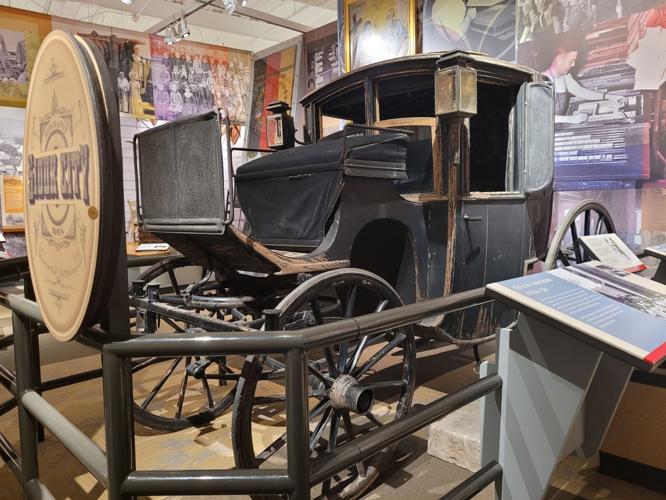
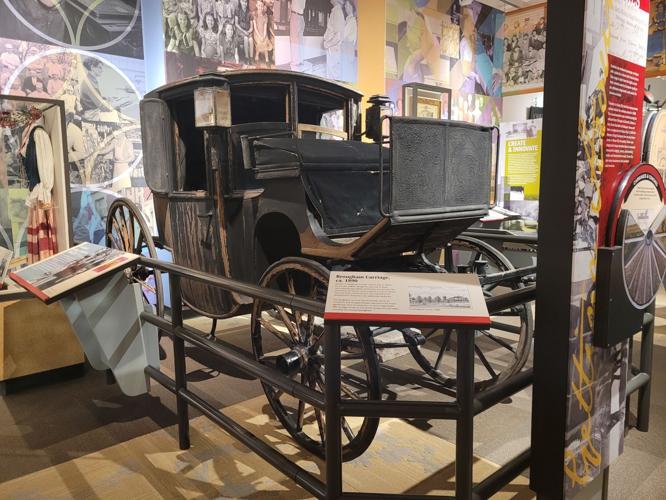
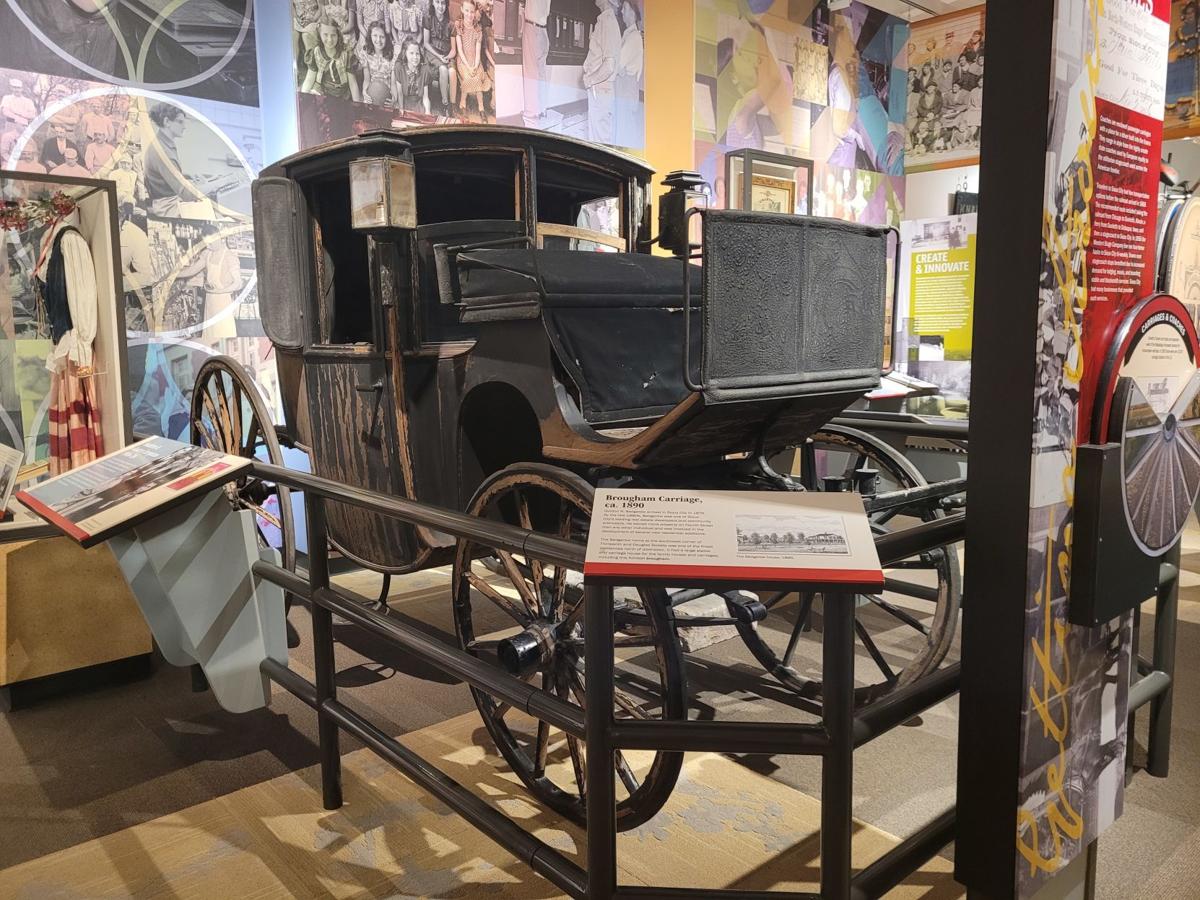
Gordon Badgerow's Brougham-style carriage, circa 1890, is shown at the Sioux City Public Museum.
Only the affluent rode around town like this.
This elegant Brougham-style carriage, which has been in the museum's collection for decades, was originally owned by Gordon Badgerow, whose children later gave their name to Sioux City's legendary Badgerow Building.
Gordon Badgerow was a Sioux City postmaster, businessman and real estate developer, known for speculating in Fourth Street properties. When he died during a visit to Tacoma, Washington, in 1916, Badgerow left behind an estate worth more than $1 million -- the equivalent of over $25 million today.
Like others of its type, this carriage has a roof to protect the passengers from inclement weather or harsh sun, while the driver (employed by the carriage owner) was seated in the unenclosed front, exposed to the elements.
Some of the earliest luxury automobiles maintained this design concept, with the chauffer seated outside and the passengers inside -- despite the fact that the driver of a car really didn't need to be outside.
6. Wincharger components, circa 1930s
Not on display (replicas are on display)

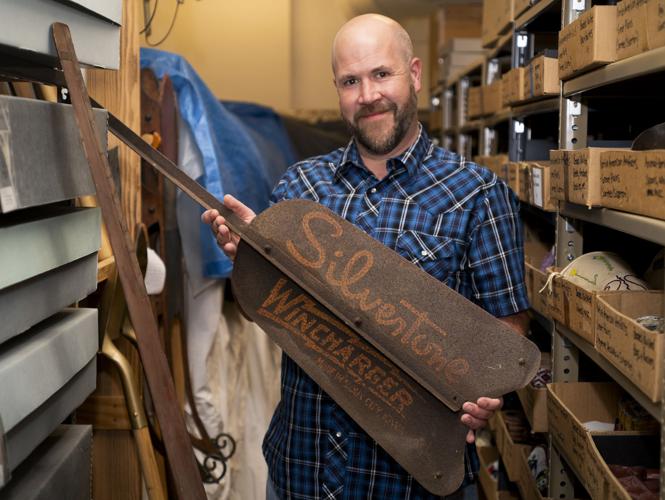
Tom Munson, Sioux City Public Museum archives manager, holds a piece of a Wincharger power-generating apparatus, made in Sioux City circa the 1930s.
Prior to the passage of the Rural Electrification Act in 1936, most farmers were on their own when it came to electricity.
Due to the prohibitive cost and technical limitations of the electrical grid during the early 1930s, power companies did not offer service to rural farmhouses. Electricity was thus a luxury afforded only to city-dwellers or those who lived in the vicinity of a town.
Still, farmers wanted electric lights and radios. So they turned to wind power.
Wincharger, formed in Cherokee, Iowa, in the 1920s before moving to Sioux City, built electricity-generating windpump-like devices that farmers could use to generate their own electricity. The machines built up a charge in lead-plate batteries, which in turn powered the house.
While they were relatively affordable and widespread prior to electrification, Munson said Winchargers had limited capacity. One of their more-powerful models, the 32 volt, was enough to run a radio and, maybe, a few lightbulbs.
Wincharger was acquired by the radio-manufacturer Zenith in the 1930s -- farmers who bought Zenith radios were reportedly given a generous discount on a Wincharger, according to one version of the company's history.
Demand for the original Wincharger equipment began to wane during the 1940s, as more farms were connected to the grid, though the firm stayed in business for decades; Wincharger's products (which later evolved into tractor-powered generators under the name Winco) retained their appeal primarily because of the ever-present threat of power outages.