


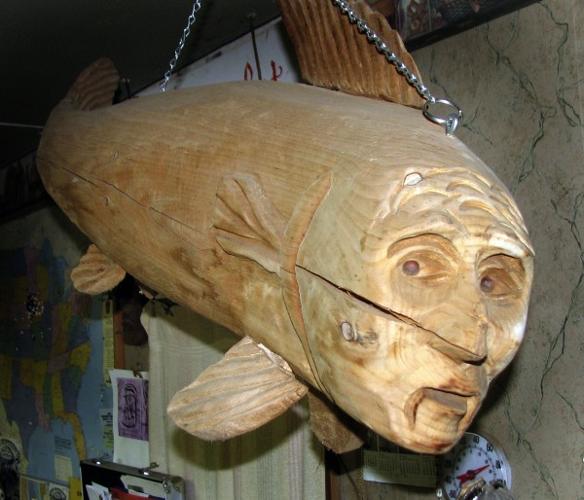
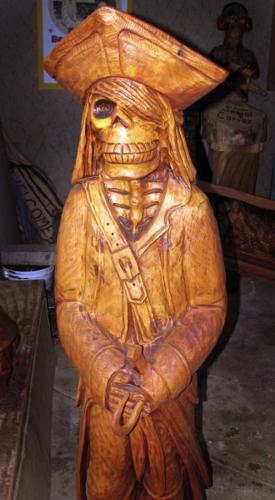
Chainsaws and county fairs are a match made in heaven, artistically speaking.
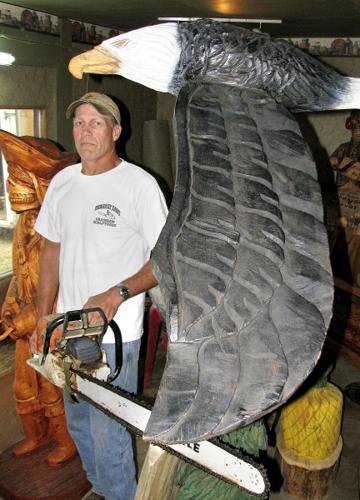
When the sweeps of a chainsaw artist's blade turn a big, boring log into a scary skeletal pirate, the fair crowd is mesmerized. Then the fairgoers await and applaud the carver's next creation, an eagle or maybe an elf. It's a common occurrence at county fairs throughout Siouxland and beyond. Which brings us to Jeff Klatt, a chainsaw sculptor from Storm Lake, Iowa, whose own viewing experience in 1990 propelled him into the business.
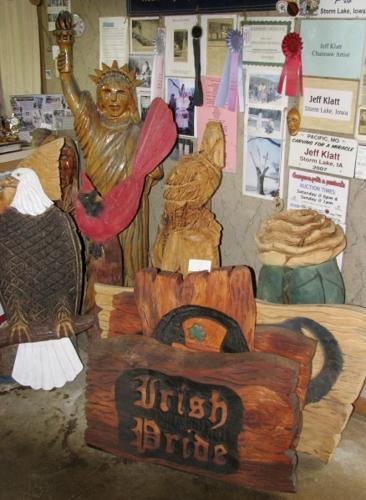
Klatt's Runaway Saws ("Art at Full Throttle") is a 20-year fixture in Storm Lake and his creations, sculpted from tree stumps up to 18 feet high, are scattered throughout the community, easily located through maps available at the Storm Lake Chamber of Commerce.
"I was a welder at Ranco Fertiservice in Sioux Rapids building fertilizer equipment," he said. "Then one day, a fellow who worked next to me said there was going to be a chainsaw artist up at the lake, and he asked me if I wanted to ride along. And I said, sure.
People are also reading…
"Then, I watched the guy and I thought, that's pretty neat. He's doing what he wants and when he wants and where he wants. And I thought, I want to do that when I grow up. I was probably about 34 then."
So Jeff grew up fast. Never having touched a chainsaw in his life, Klatt trade in an old 750 Honda motorcycle to a guy at work for a used John Deere chainsaw and just went out and started playing with it.
"I was learning chainsaws and carving all at the same time. Just practice practice, practice," he said. "When I first started this, I told myself I was going to carve my way out of Ranco, and it actually happened."
Sitting in the corner of his office is his first piece, an "ugly head with ball bearing eyes" that took six or seven hours to carve, a crazy long time, he admitted. Today, Klatt could knock off a piece like that in half an hour to 45 minutes, and it would look a lot better, he said.
If you caught his act during Storm Lake's Fourth of July Parade, you know how accurate that claim is. He starts carving a log on a car trailer being pulled by his wife early in the parade. By the time he reaches the end of the route, his creation is done. So he heads back to the starting point, and rides through a second time to show what he has accomplished, this in a parade that lasts maybe a little more than an hour.
The work can be dangerous, especially in a moving vehicle, but he has the experience now to tune everything out but the work at hand. And the chainsaw chaps he wears, kevlar protected, help keep him safe.
It took Klatt a while to get established in this business. Ranco let him slip out for a month during the slow summers, without pay, to do the county fairs, the first one in 2002. And it wasn't too long after that he was making enough money to leave Ranco.
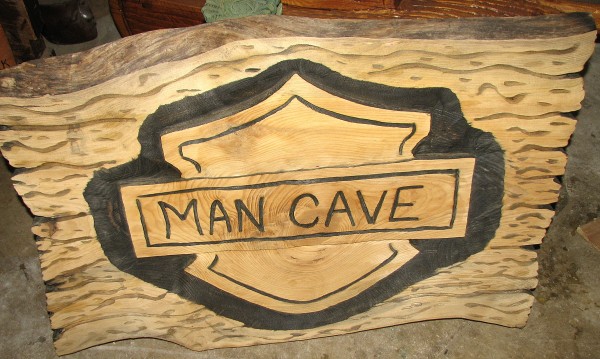
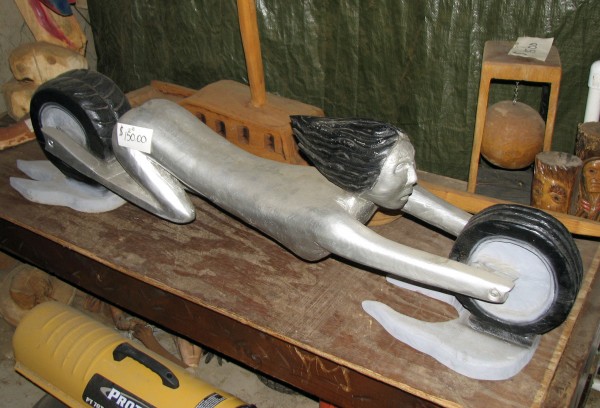
The work has always involved three parts, fairs, shop sales and going on site, what he calls "stump jobs."
"Most of it now is stump jobs and fairs," he said.
Every summer, he works somewhere between six and 10 county fairs, from the Mississippi Valley Fair in Davenport to Westfair in Council Bluffs and the Clay County Fair in Spencer.
"I've been doing fairs for about 10 years now, but that was hectic that first year," he said. "I was just nervous. The wife and one kid went with me, and I'm surprised they were still speaking to me when we got home. It was nerve-wracking. That first year, I probably shouldn't have been out there."
But even when the economy was at its worst, business never slowed down. While chainsaw artists in some regions complain they have nothing to do, many of them tend to do the same stuff over and over and are in a bit of a rut. Others, he noted, are just hobbyists, not interested in working that much.
"Some of them don't have a shop and some of them don't go out and do stump jobs," he said.
One recent stump job at Ayrshire, Iowa, had him crafting a 14-foot family totem, working four days in the baking sun to craft a 10-foot ear of corn, with branches showing a little schoolhouse (complete with flagpole) and a football on the husks to display the family's big interests, with the family initial etched in the kernels, their names and some musical notes in the base.
It was the kind of creative challenge he enjoys. Something different.
Working a county fair is hard, physical work, he noted.
'You get there and they start early in the morning, and usually by the time you're done, it's 8 or 9 o'clock at night anyway, by the time you're getting ready for the next day," he said. "You've got to get there and get your stuff out and set up and do four carvings that day, no matter how hot or cold it is. They supply the wood. And my fee lately has been $850 a day and motels. And there's got to be a minimum of three days at that. if it's under that, my fee goes up."
But he still loves the opportunity to make something new, even if he seldom has the time to relax and do some art on his own, like the skeletal pirate that sits in his shop.
Klatt uses nothing but steel chainsaws. They're good and dependable, but he can attach smaller carving bars on them, the size of a dime, for detail work. And when all is done, each of his creations is 98-99 percent chainsaw-carved, with just a little bit of sanding and grinding to polish them off.
And the work still takes him to interesting places, like the time he carved a large tree in the middle of the state prison at Rockwell City, Iowa, as commissioned by the inmates for the Lions Club and its leader dog program, which involves the inmates in the early training stages.


