

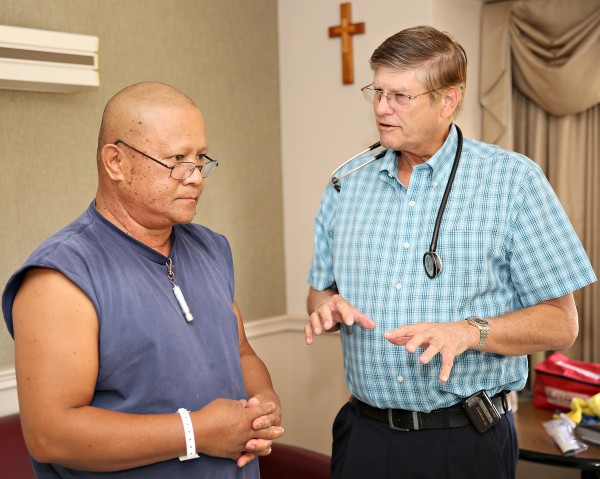


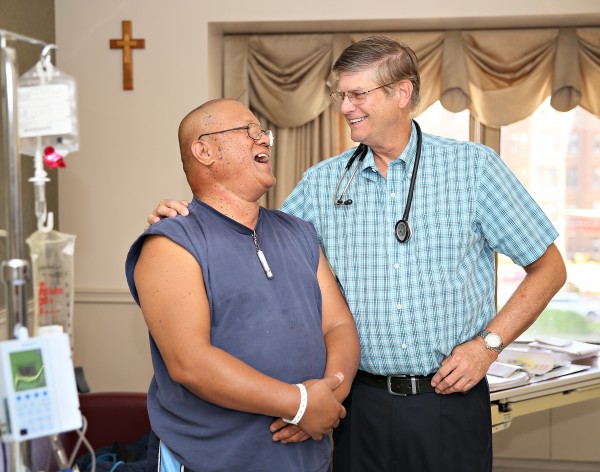
Oncologist John Michalak jokes that patient Nick Kaaihue could put a stethoscope around his neck and make the rounds for him at Mercy Medical Center.
Kaaihue, of Walthill, Neb., was pouring over information about his condition and upcoming treatments while receiving chemotherapy at the hospital on a July morning. Since last August, the 62-year-old has been battling acute leukemia, a cancer of the blood and bone marrow. He's set to undergo a stem cell transplant at Mayo Clinic in Rochester, Minn.
"My part is to tough it out, put away the handkerchief and don't cry about it," Kaaihue says, as he stands in his room hooked up to an IV line that is delivering chemo to his body. Binders and files full of papers cover a table near his window.
As Michalak converses with his patient, he rests his hand on Kaaihue's shoulder. The two share a laugh.
People are also reading…
"He's a trooper," Michalak says. "We've given him everything but the kitchen sink."
Other than a single, hour-long lesson, Michalak says he received virtually no training in medical school to help him break bad news to patients.
"Do you hand someone a box of Kleenex? How do you respond? Do you just sit there? Everything was just the scientific side of medicine," he explains.
Michalak says post-op patients on IV drips and epidurals want to know what kind of tumor they have, where it is and what options are available to treat it. He says he puts off the "big discussion" until he meets with his patients at the June E. Nylen Cancer Center, where he serves as medical director. When the shock of the diagnosis wears off, Michalak says his patients return to the clinic to view a video about their condition and discuss treatment.
"Most people do want to see their CAT scans. Sometimes it's a benefit," he says. "They were told they have a huge tumor, but when they actually see it, they say, 'Well, it's not that big is it?' Sometimes it's a positive experience for them."
When a tumor progresses, Michalak says he tries to point out something positive to the patient -- the tumor hasn't spread to the liver or the lungs. He might tell a patient whose quality of life has worsened that they should discontinue chemotherapy. Reactions vary. He says patients who believe in an afterlife tend to cope better.
"That's always a tough conversation because the family doesn't want to give up," he says. "I'll say, 'We have hope to keep your dad comfortable in his own home for whatever that time is.' We try to always push something that's positive, but it also has to be 100 percent true. I wouldn't want to give somebody false hope."
Terminal cancer patients are living longer, according to Michalak, thanks to advancements in treatment. The average life-span for metastatic lung cancer he says, used to be six months, now it's two to three years. Patients whose colon tumors spread to their livers are living three to four years longer on average than they used to.
"Treatment or no treatment, as somebody gets older it's like a poker game," he says. "The average patient will be an 82-year-old. Some families will want everything done, and other families want comfort measures."
Dealing with death and dying on a daily basis, Michalak says is the toughest aspect of his job. He often makes connections with his patients, who address him on a first-name basis, over a favorite sports team or hobby. Kaaihue and Michalak share the common bond of military service. Kaaihue, a native of Hawaii, spent time in the Air Force, while Michalak was drafted into the Army during the Vietnam War. He was stationed at Fitzsimons Army Medical Center in Denver, Colo., where he completed his internship, residency and a fellowship.
"It takes a tremendous toll, because nobody can really distance themselves from patients. They become your friends," he says. "You see them on a regular basis. You know what their kids are doing. You know their likes or dislikes."
On a particularly bad day, Michalak distracts himself by hitting golf balls or zoning out on a TV program. He said he also shares "bad news" with the physicians and nurses he works with.
"They become close to the patients, too," he said. "It's really a team effort. As long as you practice that way, you get a lot of support and patients get more support, too."
Sometimes, Michalak said he encounters a "miracle" case like that of a man in his 30s whose melanoma had spread to his lungs. He thought the man had just six months left to live, but he responded well to treatment. The man is now married with a young son.
"Isn't it great I was wrong!" he said. "Those things are minor miracles. Thank God they happen once in a while."