
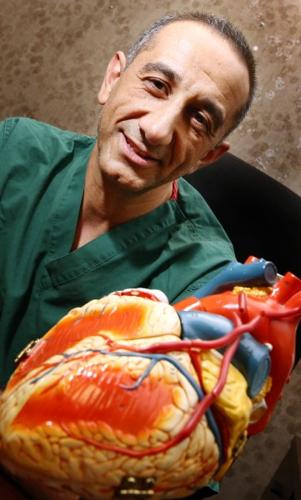
You won't hear any music emanating from the operating room at Mercy Medical Center when Tayfun Gurbuz is performing heart surgery.
The cardiac surgeon who started working at the hospital in February, knows there is very little room for error. Coronary artery bypass surgery, he said, has some 2,800 steps to it.
The procedure involves removing a vein from the leg and grafting it to the coronary artery to bypass blockage.
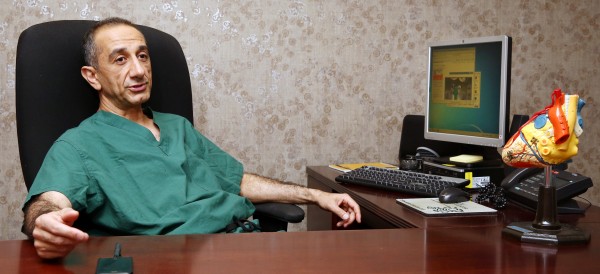
"You have to be on constant alert," the 47-year-old, dressed in a pair of dark green scrubs, said as he slouched in a high-back chair behind an oblong desk. "You go ahead and take the clamps off and they didn't hear you, and all of sudden it just becomes a disaster. There's lots of checks and balances."
Gurbuz, a native of Turkey, was among the first surgeons practicing beating heart bypass surgery in the state of Arizona. He trained a number of surgeons from the United States and abroad in off-pump coronary artery bypass surgery.
People are also reading…
He also worked at a Johns Hopkins-affiliated hospital on the outskirts of Istanbul, Turkey, where he performed nearly 1,100 open heart surgeries in just three years.
Gurbuz had just finished coronary artery bypass grafting with mitral value repair before sitting down for this interview.
The patient's heart was stopped for about two hours with a special potassium solution delivered directly into the arteries. The substance is also used during execution by lethal injection.
The moments spent waiting for a patient's heart to start working after such a procedure, Gurbuz said, are "very stressful."
"You never know if the heart's going to start. Most of the time it does," he said. "Sometimes it starts, but it doesn't come back as you want. Sometimes you have to pace it."
LONG DAYS
Gurbuz's day begins at 4:30 a.m. He sits down for a quick bowl of cereal before heading to Mercy to begin rounds.
When he was younger, Gurbuz might have guzzled some coffee in the morning. Now, he said he opts for a cup of green tea.
After rounds, he reviews his surgical patient's angiogram and echo cardiogram with a cardiologist. Then he makes a final surgery plan complete with alternative options in case problems arise. The nurses, surgical technicians and anesthesiologists who will be in the operating room are all aware of Gurbuz's strategy.
"Our job is not a one-man band. We just don't go in there and do something and come out," he said. "Heart surgery is a team surgery. Every member of the team is just as important if not more important than the surgeon."
By 6:45 a.m. an anesthesiologist is putting Gurbuz's surgical patient to sleep.
"You start at 7 in the morning and you're there until 6 p.m. on your feet," he said. "You can't move. You can't leave the room. You can't take a break. You can't do anything."
Gurbuz once spent 16 hours performing heart surgery. The elderly patient needed valves repaired, along with bypass surgery.
"The surgery doesn't take that long, it's afterwards," he said. "They either bleed, or their heart's not working very well because their heart's so sick or we discover other things that we need to do."
When Gurbuz emerges from the operating room, he said he's usually greeted with a "thank you" and a hug.
"Imagine one of your relatives has open heart surgery and you're there for 6 hours and you have no idea what's going on inside," he said. "It's stressful for us. It's stressful for the families. It's obviously very stressful for the patients."
HEART DISEASE IS PREVALENT
Annually, more than 300,000 people in the United States have coronary artery bypass surgery. That's more than the number that have appendectomies, according to Gurbuz.
"It goes with our lifestyle and everything else that comes with it. And more awareness of coronary artery disease," he said. "It used to be that people dropped dead in the street and nobody knew what happened to them. Now, they're finding those people beforehand."
Valve surgeries, Gurbuz said are also increasing due to an aging population. Cardiac surgeries involving older people, he said, are more complex because the patients are often suffering from lung disease, kidney disease, they've had a stroke or have other medical complications.
While the number of cardiac surgeries is on the rise, Gurbuz said the number of cardiac surgeons available to perform them is declining.
"Our job is pretty much being available all of the time," he said.