

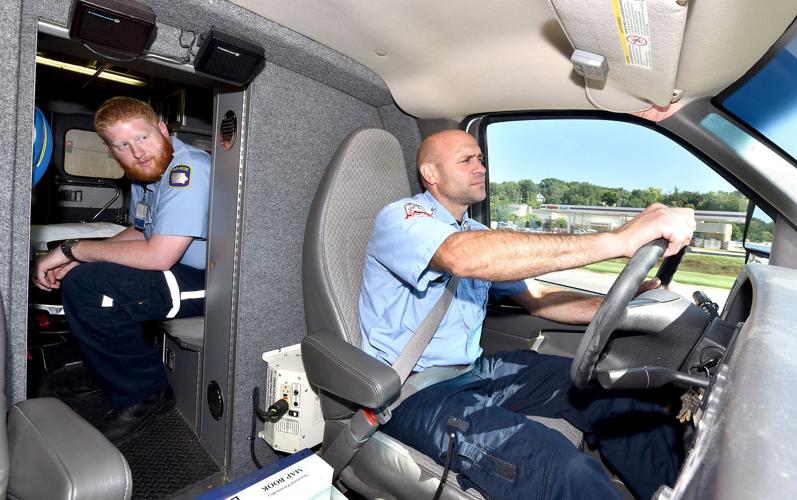
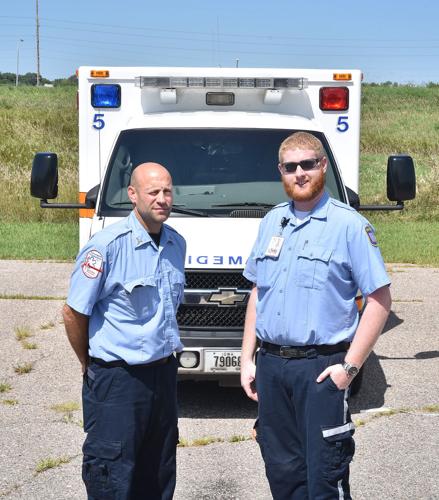
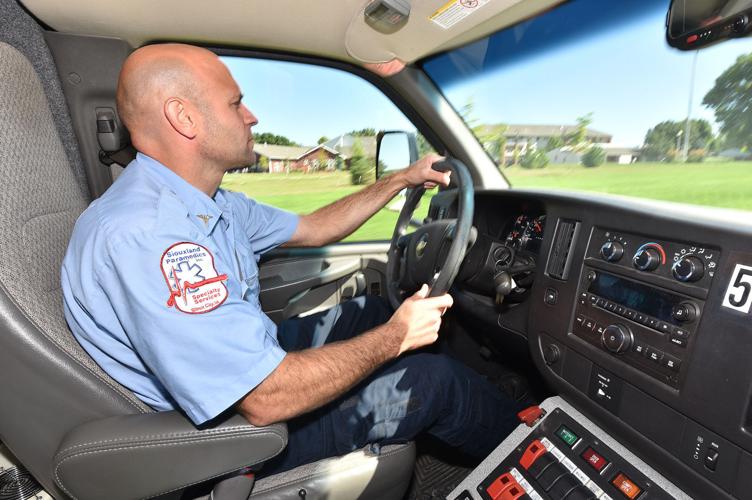
SIOUX CITY | With lights flashing and sirens blaring, Brandon Pollema flies down South Fairmount Street from Siouxland Paramedics headquarters on Seventh Street, en route to Sunrise Retirement Community to transfer a woman suspected of having a stroke to UnityPoint Health-St. Luke's.
Most cars pull over to the right, letting Medic 5 pass on the left, but the driver of a red Lexus decides to race the ambulance, which is traveling at 50 miles an hour, as it approaches the intersection of Gordon Drive and South Fairmount Street just after 11 a.m. on a Tuesday.
"He's allowed to go 15 miles over the posted speed limit if conditions are OK," Jared Drotzman, a paramedic of six years, says of his partner as he sits on a bench seat in the back. The ambulance jostles back and forth. Potholes in the road, Drotzman says, magnify the bumpiness.
Road construction, traffic and winter weather can make navigating Sioux City streets difficult for paramedics. This time of year, Drotzman says they avoid taking Interstate 29 when they can. He says they try to arrive at their desired location within 8 minutes, but response time to the mall and the airport, he says will be delayed.
People are also reading…
"At 5 p.m. on a Friday we have to haul down to the truck stop; we're not going to be able to take the interstate with road work," he says.
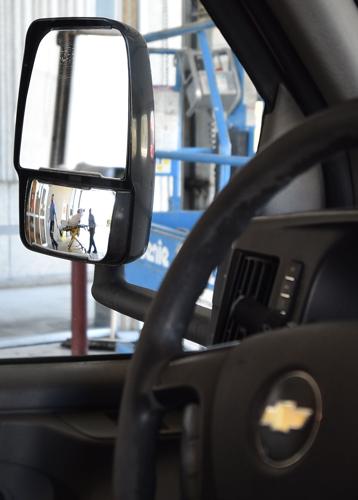
Once at Sunrise, Pollema and Drotzman pull a gurney from the back and slam the steel doors. Rock music radiates from the stereo.
A few minutes later, they return with their patient.
"I'm going to put this on your arm and check your blood pressure. Relax your arm. You're gonna feel a squeeze," Drotzman says to the woman.
Wearing bright purple gloves, Pollema warns her he's going to poke her arm to start an IV.
"Sorry ma'am," he says as he threads the catheter.
Imagine having to start an IV when the ambulance is flying down the highway at 80 miles per hour.
In a true emergency, Drotzman and Pollema have to be moving as soon as the patient is placed in the truck. Drotzman explains there's what's known as the "golden hour" in emergency medicine. It's the time period lasting an hour or less following a traumatic injury during which there is the highest likelihood that prompt medical attention will prevent death.
Drotzman asks the woman if she is cold. He switches off the air conditioning in the back. He asks her if she'd like to see what's going on outside the back window, then props the gurney up. He reports his patient's condition over a two-way radio to medical staff at St. Luke's.
After handing off the patient, Drotzman gets behind the wheel of the ambulance. Pollema, who has been a paramedic for a decade, hops in the back.
"I wanted to do it because I wanted to help people that needed help," Pollema says as he holds a Styrofoam cup of coffee.
Securing a trauma patient's airway, he says, is one of the more intense aspects of the job. Transporting sick children is difficult too. Pollema says you can't be scared to talk to people in this line of work.
He reaches up into an overhead compartment and pulls out a Beanie Baby black bear. He comments about Medic 5's stuffed animal stash being low.
"We always make sure we have something in here because there's times we transport kids without their parents," he says. "Sometimes that can be hard and intense when you have a really sick kiddo. You want them to trust you. We kinda try to make them feel a little bit more comfortable."
Some patient transports can be long. Siouxland Paramedics takes patients to Rochester, Minnesota, Omaha, Nebraska, and Iowa City and Des Moines, Iowa.
"Weather is an issue when you have a critical patient," he says. "That's why we love summer and sun shinning."
Pollema recalls driving a patient to Iowa City during a snowstorm. The trip, which usually takes 10 or 11 hours to complete, took 16 hours.
Hearing the words, "Thank you," after helping save a patient's life, Pollema says, are rare. He estimates maybe one out of every 10 patients he encounters says, "Thank you."
Drotzman no more than pulls into the driveway at Siouxland Paramedics headquarters when another call comes over the radio about a sick party at a fast food restaurant on Singing Hills Boulevard. Pollema and Drotzman are speeding down the road again, lights flashing and sirens blaring.