

SIOUX CITY -- There aren't all that many 10- or 15-minute outpatient procedures that completely and permanently correct a medical condition. Rarer still is the quick procedure that vanquishes more than one problem, all in one fell swoop.
Cataract surgery is one such procedure.
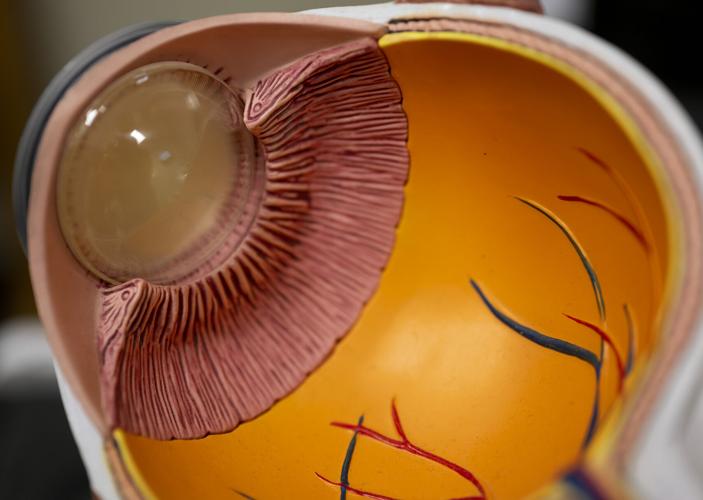
Cataracts are a sort of a cloudiness that develops in the natural lens of the eye. The lens starts out clear at birth; clouding becomes increasingly prevalent once the lenses have seen seven or eight decades of daily use.
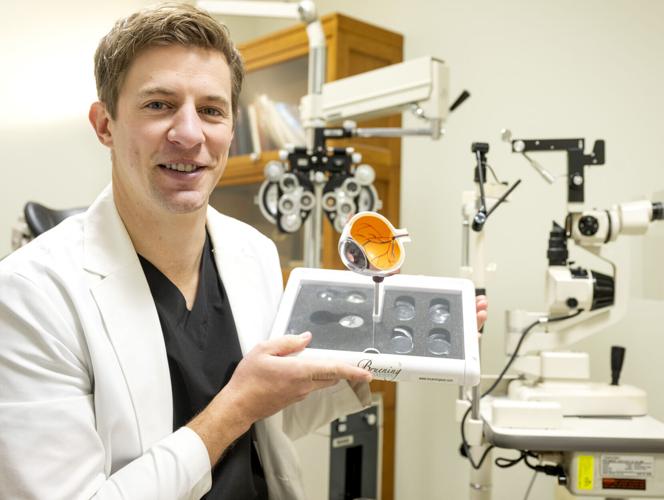
"Most people, by the time they get to their 60s or 70s, have at least some cataract development," said Dr. Justin Kuiper, an ophthalmologist with Bruening Eye Specialists.
"It is just kind of a normal degradation of the quality of the clear lens. It essentially goes from this kind of clear, to a yellowish or a brownish color, which blocks the light coming into the eye and affects the clarity of the vision," Kuiper said.
People are also reading…
Cataracts can also develop in conjunction with certain health conditions or as a result of certain medicines, like steroid medications. "So there's some certain situations where you might get it at a younger age," Kuiper said.
Pets get them, too
The condition can also affect animals other than humans -- cataracts in older dogs are often plainly visible to the naked eye. In a dog blinded by cataracts, the eyes typically have a clouded and opaque appearance, at times almost whitish-gray, due to light hitting the eye and being reflected right back out. That reflected light, in a healthy eye, would have gone into the retina to be processed as clear eyesight. But if that light is visible to an observer, the dog can probably see very little.
It's quite similar to what happens in human eyes. But elderly dogs don't need their eyes to read, drive or watch television, and they usually don't live in blindness for another 20 or 30 years after cataracts develop.
"It starts to affect vision, causing nighttime glare from car headlights or difficulty with reading in dim light," Kuiper said. "And as it progresses, it blocks more of the light entering the eye, and can cause, ultimately, pretty profound vision loss. Unless it's treated."
Surgery's the way
There are are only two treatment paths for cataract patients: surgery or nothing. There aren't any solutions that don't involve a knife. "At this point, there's really no other treatment for cataracts," Kuiper said.
Cataract surgery -- which was attempted in ancient times, to unknowable degrees of success -- has made major progress during the past century.
"The big advancement was, they used to take the cataract, or the lens of the eye, out in one piece, which required a pretty big incision and was kind of a long recovery. Now it's more like laparoscopic surgery, sort of, where we have these very small incisions, small enough they don't require any stitches actually, and we can remove the cataract in pieces. So it's all done through these two small incisions. And that's how we've been doing cataract surgery for several years now."
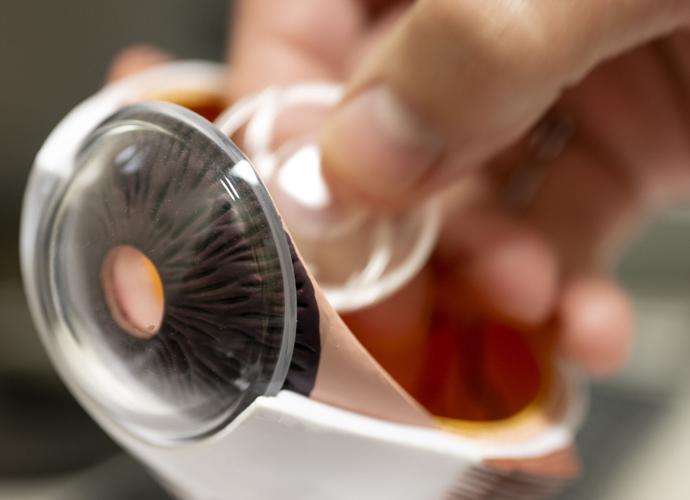
The failing lens is swapped with a synthetic acrylic or silicone replacement, which Kuiper said are inert, durable and inevitably "outlive the patient." Lens technology has progressed to the point where the new lens is not only perfectly clear, but in some cases functions better than the old lens did when it was new.
"We're doing more of what we call 'refractive cataract surgery,' where the goal is not just, get that cloudy lens out, get a clear lens in, it's -- let's do that, plus try to correct any refractive error that you have," Kuiper said. "So patients are seeing really well, without glasses."
Like LASIK
The end result is similar to LASIK eye surgery, but unlike LASIK, cataract surgery kills two birds with one stone.
"People get LASIK to get out of glasses when they're younger, but when you're older, for some patients it's actually better to do what's called a clear lens exchange, which is basically cataract surgery on somebody that doesn't yet have a visually significant cataract," Kuiper said. "Because of these lenses that we have now, we can correct your vision for distance, we can correct it for computer distance, we can correct it up close. So they make lenses that are called 'trifocal lenses.' They basically do everything your glasses do, but it's inside your eye."
Cataract surgery is usually a 10- or 15-minute outpatient procedure done "with minimal sedation," Kuiper said.
A topical anesthetic and some lidocaine inside the eye is about all the anesthetic that's needed; the eye, as organs go, is relatively insensitive to pain. "The only part of the eye that really has much sensation actually is the cornea, which is the clear front part of the eye. And if you put some numbing eye drops in the cornea, people do great with surgery," he said. "Most patients sail through surgery without any discomfort."
But that reality is at odds with a natural anxiety that results from having a sharp object so very close to the eye. Talking with the patients during the procedure can keep them at ease. A mild sedative can also be employed. "Pretty much across the board, once people get done with surgery, they'll say, 'I'm not sure what I was so nervous about. It was no big deal,'" Kuiper said.
"Patients are awake. Sometimes we give them medicine to keep them comfortable, or almost in like the twilight state, just to get them through the procedure," he said.
Afterward, patients may experience "a little bit of discomfort, mild irritation," Kuiper said. "But that's about it."
Complications are relatively uncommon, with a 1 to 2% chance of inflammation or swelling, or high eye pressure, all of which can be treated with eye drops. Serious issues like infection or retinal detachment are quite rare, Kuiper said, and those issues are generally treatable.
"And usually the vision's pretty good shortly after surgery. So people notice the improvement pretty quickly," he said.
Commonly performed
Tens of millions of satisfied patients can't be wrong -- cataract surgery is easily among the most commonly performed surgeries in the United States, with ophthalmologists like Kuiper performing the procedure several million times each year.
The typical end result is a marked quality-of-life improvement for the patient.
"Not only improving the vision because the cataract's out of there, but just reducing that dependence on glasses, particularly for people that are really nearsighted or really farsighted, I mean they need glasses for everything," Kuiper said. "Those are some of the happiest patients after cataract surgery."