


There's nothing left of the old World War II POW camp that brought German and Italian prisoners of war to Onawa, Iowa, nearly 70 years ago.
It's been years even since the former POWs as tourists visited the town and campsite, which was located on government-owned land west of Onawa on the banks of the Missouri River, just a mile north of the bridge to Decatur, Neb. A decrepit road leads to the site which after the war was converted to a government engineers material yard, said Fred Wonder, former editor of The Onawa Democrat newspaper
One barracks building was deconstructed and used as a garage for the keelboat at Lewis and Clark Park, he noted. A second building, believed to be a guard shack, stood behind the John Deere dealership for years, used as a garage/storage building until it was eventually torn down.
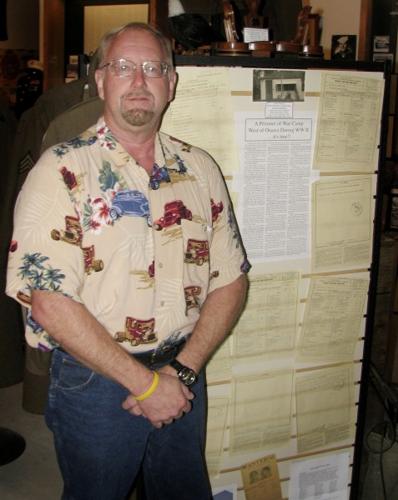
But Wonder and his son William, the current newspaper editor, are doing what they can to preserve the camp's history through an exhibit at the Monona County Veterans Memorial Museum in Onawa. William is the curator, Fred the co-curator in charge of special tours.
People are also reading…
What Onawa has left is memories of a lost time, a chapter in history that serves as a constant revelation to museum visitors, both young and old, who didn't know it existed. Some GIs were not even aware of the camps, busy as they were fighting the Germans at that time.
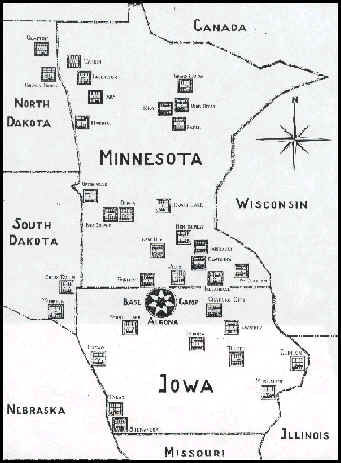
The POW camp, "Hub of the Empire," was established in Algona, Iowa, from 1943 to 1946. The Hub had 34 branch camps in four states that included camps in Onawa, Storm Lake, Iowa, and Yankton, S.D. The other states were North Dakota and Minnesota.
Algona, the largest camp, processed more than 9,000 German and 1,335 Italian POWs, dispensing them through other transfer camps like Onawa's Branch Camp 25.
Fred was a boy of 11 when the Chicago Northwestern Railroad troop trains carrying POWs from Chicago stopped in Onawa to drop off the prisoners for transport to the POW camp west of town on a special line built for that purpose.
"I was growing up down by the railroad tracks, and they let us go over," Fred said. "The MPs, they put up a snow fence and let them out to recreate themselves, get stretched out and stuff like that. And some of the prisoners still had their official uniforms on, but they had been stripped of all rank insignias. Everything had been taken off the uniform. And some of the other prisoners had jumpsuits on them, with a great big POW on the back of them."
Fred said it was a big deal for the kids to go over and talk over the wire barrier to the prisoners, though not much talking really occurred because of an even tougher barrier, the language one.
"But it brought the war to Onawa. It brought it closer to us," he said. "It was a real oddity to see them. I mean you see that on the news reels, war, but when it's four feet away from you and a soldier's standing there and he's in a German uniform or an Italian uniform..."
The citizens of Onawa had little contact with the POWs. Sightseers, in fact, were turned back 2-3 miles from the camp by armed guards, Fred said
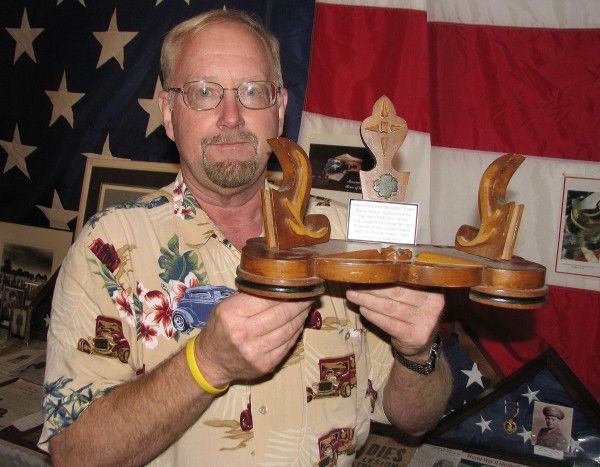
But some farm families had regular contact with the POWS who worked their fields. They worekd alongside them, sharing food with them, William noted. He then showed a wooden piece on display at the museum which was hand-carved by a German POW named Eric and given to a young farm woman whose father had given the soldier an old apple crate which he used to carve his gift.
The POWs also did a lot of river rechannelization work for the U.S. Engineering Department.
"They did a lot of river pilings and things like that on the river. They did a lot of farm work because all the guys around here were in the war. So they needed them for agricultural purposes," he said.
"Everything I've heard from the families whose farms they worked was that they had it better here than they ever had it (back in Europe), and that they enjoyed their time here. They had their own orchestras at this prisoner of war camp, and they were well fed. And aside from the work they had to do, it was better than being the war and being shot up, I would assume," Bill said.
But that doesn't mean there were no problems at the camp.
'They did have an uprising out there at one time," Fred said. "I heard that they burned one of the barracks out there. But they were reprimanded for that."
Fred said he heard of no escape attempts. While escape was probably possible, they were more than 1,000 miles from either coast. Where were they going to go?
Some of the POWs emigrated to the United States after the war, though none seem to have opted for the Onawa area, the Wonders men said.
They did come to visit, though.
"They came back with their families," Fred said. "The prisoners wanted to shows their families, after they went back to Germany or Italy, where they had been kept. And there is a few families in Nebraska that did stay put. They came back after the war and settled here.
"Like William said, they weren't going to escape from here because they were well fed and well treated."
Fred never really got acquainted with a German POW at the time; but later during an eight-year stint in the Air Force, he got real friendly with a German girl when he was stationed in Germany during the Korean War. He met and married her, William's mother.
Though not a veteran himself, William's decision to push the Onawa City Council to build a veterans memorial led to a fund-raising campaign launched by his newspaper in 1997 to build the museum. "It was a little over $100,000 to build this 42-by-60 building, and on Memorial Day 2000, we dedicated it back to the city," he said.
A later fundraiser raised $90,000 and led to a 40-by-40-foot addition to the museum, providing for a multi-media room and meeting space for the local American Legion post.
And, of course, it left some space for the story of Branch Camp 25.


