

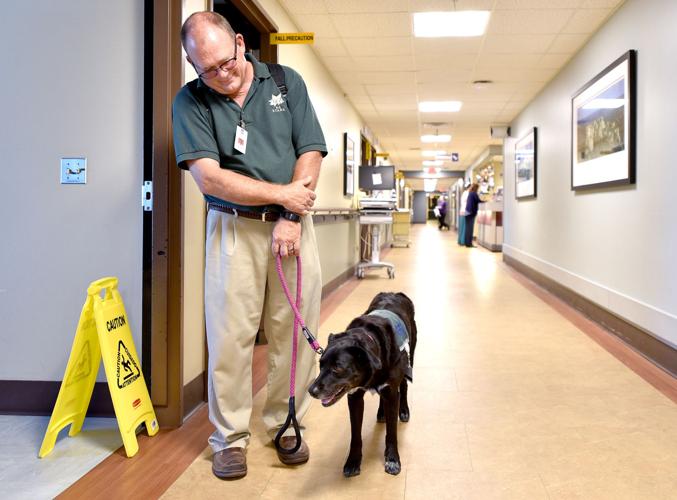
SIOUX CITY | Gracie, a 7-year-old border collie and golden retriever mix, trots through the sliding glass doors into UnityPoint Health-St. Luke's lobby with her human, Ran Newberg, on a Wednesday afternoon.
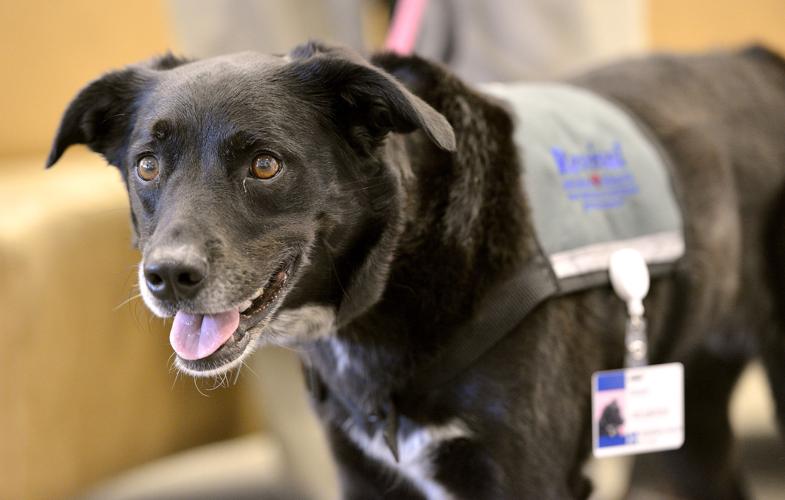
The pooch with a soft, shiny black coat and slightly graying muzzle calmly stands at Newberg's side wearing a green vest and hospital credentials. Her mouth is open in a slight smile. Her brown eyes beam with happiness as she waits for the elevator.
"This is her hospital mood," Newberg says. "I let her be a dog until we come in here."
On the hospital's fifth floor, Gracie meets a blond-haired toddler who offers her a piece of candy. Newberg politely declines on her behalf. There's no time to be distracted by food. Gracie, a therapy dog with K-9 S.T.A.R.S., has work to do.
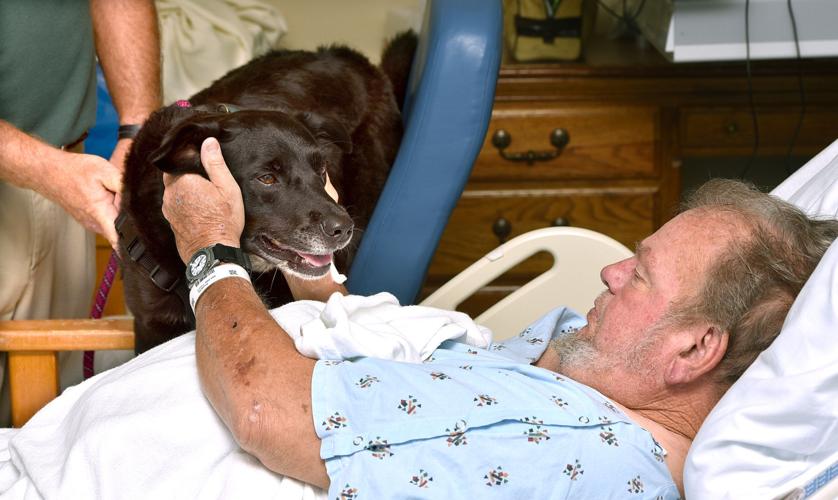
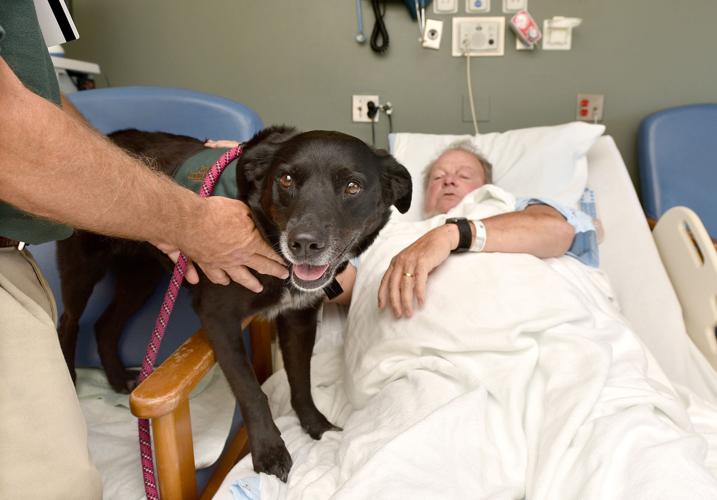
"You're almost too calm," Newberg says to Gracie before entering a patient room where they find Ron Kommers lying in a hospital bed. Gracie hops up onto a chair and then places her front paws over the wooden arm onto the bed. She sniffs Kommers' hand.
People are also reading…
"You look like my Bella," the Oakland, Nebraska, man says. "You're a pretty girl."
Therapy dogs are frequently called upon to provide comfort in times of stress.
A dozen therapy dogs traveled to Orlando, Florida, in the wake of a nightclub shooting that killed 49 people and wounded 53 others, to provide affection, warmth and reassurance to survivors, family members and first responders.
Studies have shown that petting an animal causes a patient's blood pressure and heart rate to drop. The act also alleviates muscle tension.
A survey conducted by the Human-Animal Bond Research Initiative Foundation, a nonprofit research and education organization, found that 69 percent of physicians have successfully worked with animals in a hospital, medical center or medical practice to assist patient therapy or treatment. They report interactions with animals improve patients' physical and mental health, as well as their mood and relationships with medical staff.
During one K-9 S.T.A.R.S. visit, Newberg says therapy dogs sat in bed with a patient after surgery. The man hadn't yet woken up from the anesthesia. The volunteers took the man's hand and started petting the dogs with it.
"The guy's eyes started fluttering. His fingers started moving," Newberg says. "That's why we do what we do. You see those kinds of reactions all the time."
Newberg says various dog breeds have become therapy dogs, including German shepherds, Rottweilers, Great Danes, English bulldogs and fox terriers. Two rounds of obedience classes are required, as well as Canine Good Citizen certification. The dogs undergo further instruction at the nurses training facility across the street from the hospital, where they practice riding an elevator and learning how to approach patients in walkers and wheelchairs.
"You can tell by the dog when you're doing the training how much additional training you're going to need just by their temperament," says Newberg, who trained Gracie alongside his late golden retriever, Lucky.
Newberg adopted Lucky when she was 8 years old and got her involved in the K-9 S.T.A.R.S. program shortly after that. His wife, Kathy, worked at a pediatric therapy facility alongside K-9 S.T.A.R.S. program coordinator Jean Gill.
"She saw Jean bringing her dogs to work every day and thought that was pretty cool. Jean and Kathy were talking about our dog Lucky and that's how we got Lucky into the program," he says.
When Gracie came home at 12 weeks of age, Newberg says he didn't know if she would be a good therapy dog. But given the fact that golden retrievers are generally docile in nature and border collies are highly intelligent, the odds were in her favor.
"It took years of patience. We tested when she was 18 months old, which is the youngest the dogs can be," he says. "We didn't visit with her a lot at first, because we didn't want her to fail. At 18 months old they're a lot more puppy than they are dog."
Gracie, who enjoys playing ball and Frisbee and swimming when she's not hanging out with her four-legged friends at doggie day care, visits with patients at St. Luke's three or four times a month. She also sits with children as they read books to her during the Read-to-Me Story Dogs program at the Wilbur Aalf's Public Library.
Gracie laps up the attention from Kommers, who pets her head and rubs her ears. He motions to a plate of food covered with a plastic lid sitting on a table at the side of his bed. "There's a cheeseburger under here if you want it," he says.
Kommers, who was looking forward to being discharged from the hospital later that day, tells Newberg about his nine dogs back at home. Newberg informs Kommers that he and Gracie will be at the hospital on Saturday visiting the fifth floor and the pediatric and intensive care units. With a chuckle, he says they don't like seeing patients twice.
On the way out the door, the border collie in Gracie comes out. She takes the leash in her mouth and leads Newberg down the hall.