

SPIRIT LAKE, Iowa | A few years ago, a single live zebra mussel was discovered in Upper Gar Lake. Then two dead mussel shells were found on a hoist pulled from East Okoboji Lake.
The population of this invasive species, which compete with native fish and mussels, clog pipes and cut swimmers' feet, exploded in East Okoboji Lake last year.
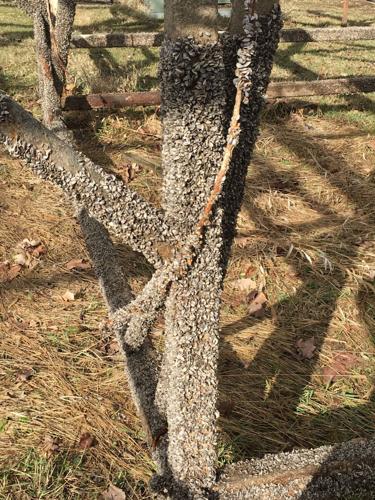
"They basically encrust everything that's in the water right now," said Mike Hawkins, an Iowa Department of Natural Resources fisheries management biologist who works out of the Spirit Lake Hatchery. "We're probably about one year behind on West Okoboji (Lake); and Big Spirit Lake we're yet to see any juveniles and adults there."
This small freshwater mussel is native to the lakes of southern Russia. Zebra mussels were first described by German zoologist Peter Simon Pallas in the Ural, Volga, and Dnieper rivers in 1769.
People are also reading…
How did they get to the Iowa Lakes region?
Hawkins said he's not sure. Either they came as larvae in water that was brought inside of a boat or as juveniles or adults attached to a boat or another structure such as a boat hoist that was bought, sold and transferred to the lake in a short amount of time. He thinks the latter scenario is a little more likely.
"The mussels can live out of the water. They close up and conserve water for a few days," he said. "If small juveniles or adults are transferred on a structure, they're already in close proximity to each other and so they can start reproducing right away."
Mike Lannoo, director of academics and research at Iowa Lakeside Laboratory, said zebra mussels will pile up on rocks, docks, swimming platforms and anything else in the water. He said pulling docks in the wintertime, somewhat prevents zebra mussels from colonizing.
"(Zebra mussels) are going to filter a lot of little floating microscopic plankton out of the water; and the water is gonna be a lot of clearer," he said. "The ecological impact will be great and negative. Probably the economic impact will be less so."
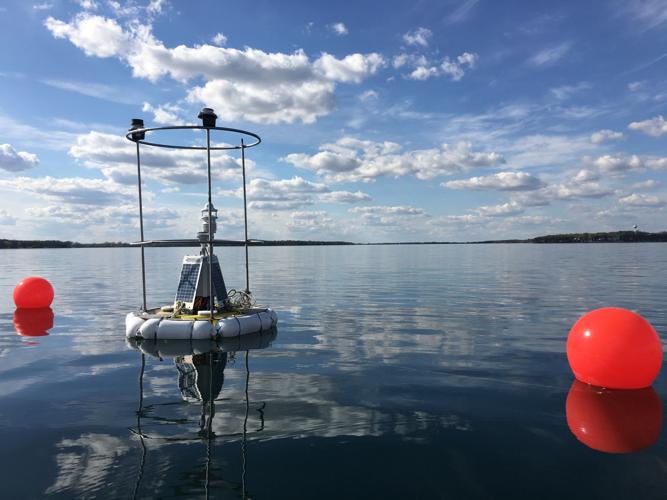
The Iowa Lakeside Laboratory deployed a hydrological buoy on West Lake Okoboji to collect data and to monitor water quality. Lannoo said the lab didn't encounter zebra mussels in the lake until the middle of summer 2015.
"Right now, we're just on the cusp of them being a real nuisance," he said.
HISTORIC INVASIONS
The introduction of invasive species to the Iowa Great Lakes dates back to the late 1800s when common carp, or European carp, arrived. Hawkins said the freshwater fish can cause high levels of ecological and water quality damage.
Curly leaf pondweed was first discovered in the region in the 1950s. The species of aquatic plant which is native to Eurasia, Hawkins said, still negatively affects East Lake Okoboji.
"Those are great examples of invasive species and non-native species that have become invasive that have been around a while and really give us an idea of how detrimental invasive species can be in general," he said.
Asian carp, including bighead and silver, invaded the Iowa Great Lakes in 2011. An electric barrier located at the bottom of Lower Gar Lake, the last lake in the Iowa Great Lakes chain, is keeping the current population in check and keeping additional Asian carp out.
"Their reproduction is occurring in the Missouri and Mississippi rivers. The only way for them to increase in numbers in the Iowa Great Lakes is to come in through the river system," he said. "We've kind of got that door closed. Although we do have a few remnants of them making that initial invasion, they probably are not going to grow in numbers."
More invasive species could be coming: Eurasian watermilfoil and hydrilla, aquatic plants; quagga mussel, a close relative of the zebra mussel; and snakeheads, predatory fish with long dorsal fins, large mouths and shiny teeth.
"The list goes on and on. It's pretty extensive and pretty spooky what's happening," Hawkins said.
STOPPING THE SPREAD
Once an invasive species arrives, Hawkins said, there isn't much you can do stop it. Asian carp are the exception.
Zebra mussels reproduce rapidly. Once present in a body of water, nothing can be done to completely eradicate them. Efforts focus on preventing their spread. The state of Iowa adopted new laws to do just that.
"It's aquatic plants. It's aquatic organisms, fish -- all of those things could be an invasive species or you may be transporting unknowingly an invasive species down the road," Hawkins said.
He said boaters must clean, drain and dry their vessels before moving them, to prevent the transfer of water from a lake down Iowa highways. He said the Iowa DNR has four seasonal employees who conduct boat inspections and interviews with people entering and leaving the Iowa Great Lakes. Interns learning and working at the Iowa Lakeside Laboratory also help the DNR educate boaters about invasive species and how to prevent them from spreading.
"Invasive species really get the best of our resources because they may be compromised," Hawkins said. "We need to continue to focus on maintaining the ecological and water quality health in our lakes and in our rivers because besides prevention, our best defense is having healthy plants and animals that are native to our system."