
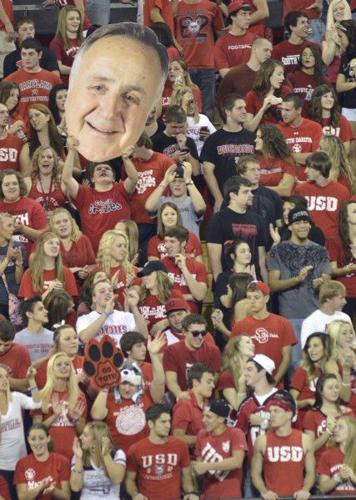
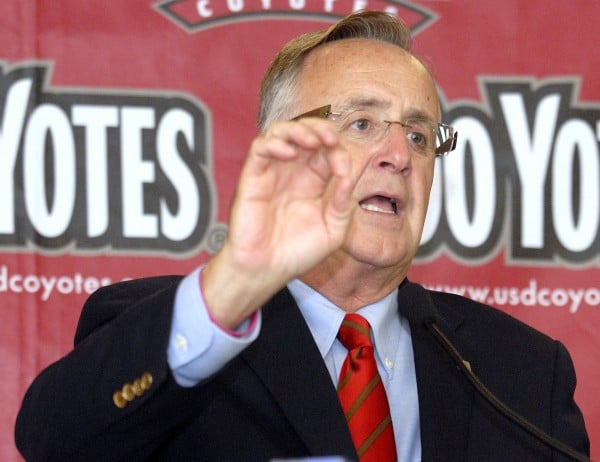
VERMILLION, S.D. | A political loss led to Jim Abbott's presidency at the University of South Dakota.
"Things collided at the right moment," says Abbott, referring to his setback in a 1996 primary election for the U.S. House of Representatives, a race he lost "handedly."
"I was with my wife (Collette) at dinner at Emma's in downtown Vermillion after the election," he remembers. "The USD student body president, Brendan Johnson, who is now a federal district attorney, came up to me and said, 'Our (USD) president just resigned. Why don't you apply?'"
Abbott mulled it over and threw his hat in the ring, or the pool of candidates, as it were.
He was hired and remains, some 17 years later. He has served much longer than the average college president, a position where terms often last five years or so.
People are also reading…
"At the time, our physical plant wasn't where it needed to be," Abbott says from his office. "So maybe I had a chance then as I felt we needed a rejuvenation and I felt I could fund-raise."
And how. Under his command, USD has built the Theodore R. and Karen K. Muenster University Center, the School of Business building, Coyote Village and a wellness center. A new athletic complex is coming. In just the past 12 or so years, The Belbas Center, the Al Neuharth Media Center, the Andrew E. Lee Medicine and Science Building, the Dakota Dome, Slagle Auditorium and the Churchill-Haines and Pardee science labs have been renovated.
In addition, Abbott captained a $133 million fund-raising effort, a record at the school in this arena, an area that boosts USD scholarships, undergraduate and faculty research, building renovations and more.
And in 2006, President Abbott announced the transition of its athletic programs from NCAA Division II to NCAA Division I.
"I try to listen," Abbott says in describing his management style. "I could be better at it."
To be surrounded by successful people from the start has played a key role in any successes Abbott has enjoyed. His loyalty shows in something you don't always find at the top of an organization: He took a brief leave in 2007 to donate a kidney to Bruce King, then USD's chief diversity officer.
Not only has Abbott worked with successful people, he's worked against them. He ran for lieutenant governor in 1994 and became good friends with the man at the top of the Republican ticket, Gov. Bill Janklow, who won.
"We had a good relationship; Gov. Janklow was one of my greatest boosters," Abbott says. "I borrow things from different people, people like (Sen. George) McGovern and Janklow. I admire them for different reasons."
Janklow, he says, could lead people, be it right, wrong or indifferent. He held his convictions; he directed with vision.
"McGovern? It was his absolute, unwavering commitment to the things in which he believed, whether it was stamping out poverty or the fact that every human being must be valued. He never, ever quit."
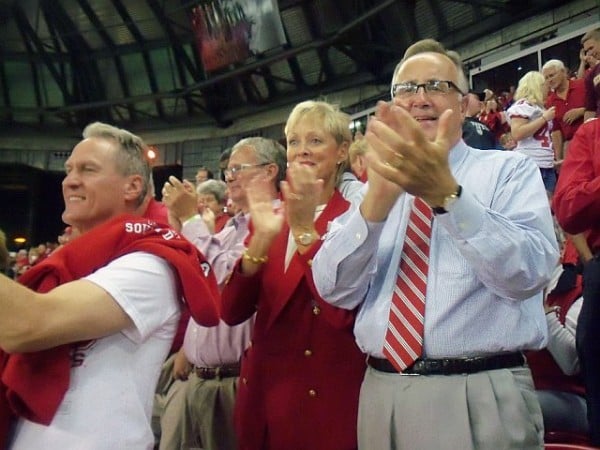
One month before McGovern's death, the former U.S. presidential candidate joined Abbott and the Coyote contingent as USD played at Northwestern University in Evanston, Ill.
"McGovern was 90 and still talking about things he wanted to do just a month before he died," says Abbott.
When you're in your mid-60s (Abbott is 65), you notice things like that. It can't help but fuel your optimism.
As a college president, that kind of outlook sustains Abbott. The best part of his job, after all, involves communicating with students who have the world opening before them.
It isn't uncommon for the president to take a seat with a table of students during lunch. While some don't know exactly how to address him, Abbott savors the interaction.
"Some call me 'president,' and some aren't sure what to say," he says with a laugh. "Some say 'Abbott' and I'll answer to that, as long as they're talking to me."
At the freshman convocation each fall, Abbott alerts incoming freshman they're about to embark on a great educational trek. But, he cautions, it's not a one-way ticket.
"This is a partnership," he says. "Students must do their part as well. The more heavily they're invested in their own eduction, the better off they are."
Even so, he adds, he wasn't a straight-A student in his USD days. In fact, he says, he was probably more social than he should have been.
That said, he returned to USD four years after earning his undergraduate degree to earn his law degree in 1974. After practicing law and working in management, he represented Yankton County in the South Dakota Legislature and became the Democratic nominee for lieutenant governor. He took a leave in 2002 to run for governor. Again, he lost.
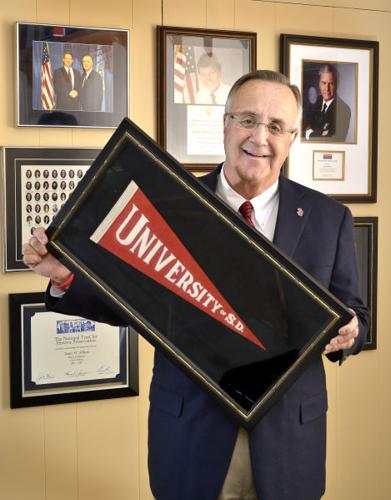
But, he came back and continues to serve, the university's 17th president and the only one who brought this to decorate the president's office: His own USD diploma.