



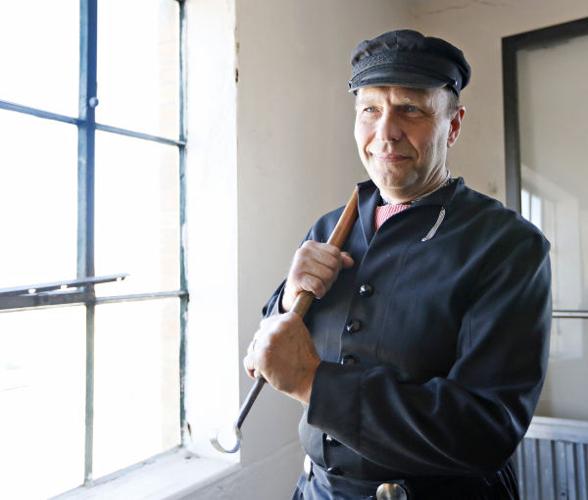
ORANGE CITY, Iowa | As a wide-eyed boy, William Van Marel Jr. enjoyed watching the town’s shoemaker skillfully craft clogs from blocks of wood. The Hollander and his family had moved next door to Van Marel’s grandma.
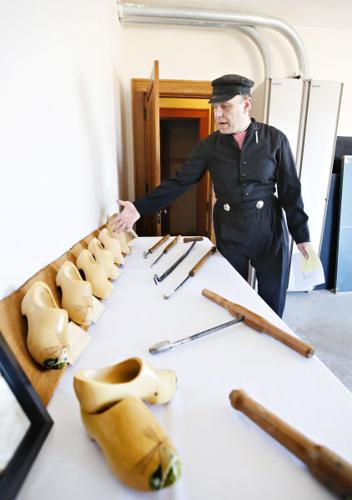
Eventually, Wilhelm Jansen would show him how to carve klompen, making Van Marel one of the few Dutchmen in Orange City to carry on the tradition.
He learned the trade in 1978, just six years before Jansen’s death.
They would go down in the woods, along river bottoms, and harvest trees. In turn, the craftsman would give Van Marel a couple blocks of basswood and the old sawhorse to take home. He tried to carve a shoe every night of the week, and he’d bring them to Jansen on Saturday for review.
“He could see what I did wrong,” Van Marel said. Undeterred, he kept practicing and soon got to be a part of the Tulip Festival. “At 19, that next year, I actually carved wooden shoes here in the basement of city hall.”
People are also reading…
Welkom to Orange City
In 1954, the Booster Club of Trinity Reformed Church took up the task of finding a wooden shoemaker for the community. Two years later, Jansen emigrated from the Netherlands to set up shop in The Old Factory, the original home of Diamond Vogel Paints.
From there, he’d ship those shoes all over the country. But he took care of his own, outfitting townspeople with proper footwear – including members of the local marching band, known as the Pride of the Dutchmen.
Jansen knew his way around a shoe.
Customers would come back to his shop, complaining of discomfort. He’d look at their feet and make a quick fix, carving the clogs to accommodate for everything from bunions to high arches. And off they went.
Van Marel observed instances like these for about three years, learning all that he could in the wooden shoemaking factory. It became a full-time hobby. His day job entailed working for Gary Cleveringa, a carpenter who would later pick up the klompen-carving tools and learn the skill, too.
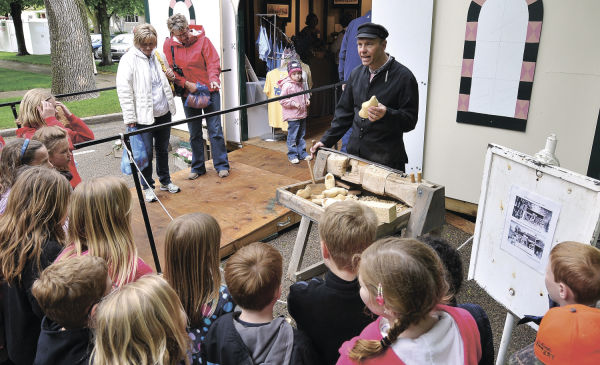
Both have become fixtures of the Tulip Festival’s Straatmarket.
The late shoemaker once told Van Marel, “If you can shave a piece of wood from the back of the shoe all the way to the front of the shoe – same thickness, without breaking it – then you’re a wooden shoe man.”
Decades later, his apprentice says, “I have not accomplished that yet.”
There’s not only a trick to making the wooden shoes but also wearing them.
The clogs suited rural folk living in the damp lowlands of Holland while they tended to gardens and livestock. Wood didn’t get sopping wet like leather.
But for the festival’s costumed characters, it’s an adjustment.
“I train my feet, maybe about a week ahead, and I just gradually get into it,” Van Marel said. “And actually, when you have a good, thick pair of wool socks on … you can walk and they’re very comfortable.”
Klompen ahead
For the festival, Van Marel doesn’t walk in his own shoes, which is to say he doesn’t wear a pair that he’s made. What he makes is usually a size 6. It can be whittled down faster for demonstrations.
The wooden shoes people wear now are imported from Holland.
Jansen passed away 30 years ago in June. His wife, Willemina, died in 2010 at the age of 91.
Van Marel made sure to save a pair of klompen from the time he worked alongside Jansen. Those are special since the factory has changed hands and no longer makes wearable wooden shoes.
The Old Factory has been turned into a coffee shop.
For a time, the Vogels owned the business and put on a klompen-carving demonstration during the Tulip Festival. However, last fall, Van Marel said the remaining manufacturing equipment was removed from the space adjoining the coffee shop.
The search is on, once again, to find a home for the machinery and klompen carvers to fill the post.
“I myself would hate to see this art die,” Van Marel said. “We need to keep it alive in Northwest Iowa. Tulip time is our Dutch heritage, and our Dutch heritage has a lot to do with wooden shoes.”


