

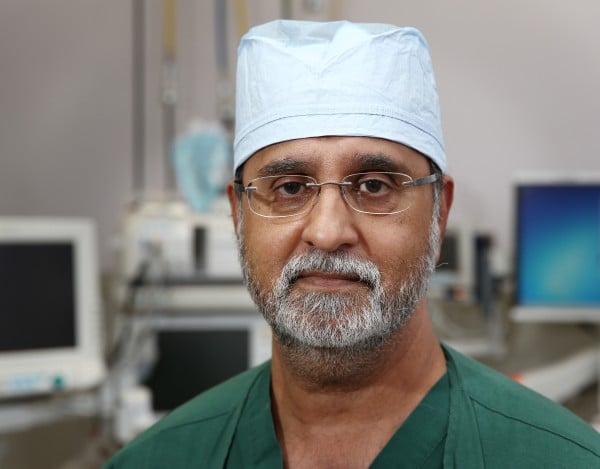
Dr. Ashok Kewalramani, medical director of anesthesia, Mercy Medical Center, talks with Nick Hytrek about his work in medicine.
1. How did you become interested in becoming an anesthesiologist?
I had done a family practice residency before and I was practicing family practice medicine in West Union, Iowa. A very good friend of mine was doing a residency in anesthesiology. She got me interested in it.
2. What type of education and training are required?
It is four years of college, then four years of medical school, then four years of anesthesia. Generally, it's 12 years.
3. What are the duties for an anesthesiologist?
Overall, what we do is provide anesthesia for surgery. That would include doing the preoperative evaluation, maintaining ideal operating conditions for the surgeons. If there is an emergency, we're there to help the surgeon. After everything is done, we take care of recovery after surgery and that would include pain control.
People are also reading…
4. Does all of your work take place in the operating room or are there other settings you work in?
Other settings would be doing obstetrics -- labor epidurals, also MRIs, CT scans, ICU and colonoscopies.
5. How many different drugs do anesthesiologists use?
Maybe five to 10 on a routine basis.
6. How do these drugs differ?
When a patient comes in we could give relaxants, then interoperatives -- induction agents and muscle relaxants and narcotics for pain.
7. Are researchers always developing new drugs or do you use many of the same ones that have always been used?
Pretty much we're using the same ones. There are three that are in trials right now, but overall, we use the same ones we've used for the last 10 years.
8. How do newer drugs compare with the older ones?
They keep improving. An ideal anesthetic is quick onset, quick offset and minimal side effects.
9. What's been the most significant development in anesthesiology in the past 10, 20 years?
There are a couple gases that are quick on-and-off-type gases. We are using many more epidurals for pain control now.
10. How far back in history does the use of anesthesia go?
You're talking about Sumerians to Indians to Egyptians, but modern times began in 1846 at Harvard with Dr. William Morton. (He used ether.)
11. What were some of the things first used to put people under?
Ether at first. I think that's when the modern era was ushered in.
12. Do you remember the first time you put someone under?
Absolutely -- Room 1, University of Iowa.
13. What was that experience like?
It was kind of funny. I was with my mentor. At that time, all I understood was put the tube in and my job is done. So I put the tube in and stepped back and he said your job hasn't even begun.
14. Are you present during the whole procedure when someone is under anesthesia?
Not around here. I do the induction, look at the initial numbers, and if everything is stable, the CRNA (certified registered nurse anesthetist) takes over and if anything happens, they give us a call.
15. Have you ever had someone begin to wake up during a procedure?
No, but I have talked to four or five people who have awakened.
16. What would you do in that situation?
My first thought would be to reassure them things are OK and at the same time I'm grabbing my syringe and putting them back to sleep.
17. Are there some people who are really hard to wake up?
Yes, there are a few classes of people. No. 1 would be the elderly and people with chronic diseases such as kidney failure and liver failure. I think a lot of neurosurgery patients are hard to wake up.
18. Do you encounter patients who are really frightened about being put under?
Yes, all the time.
19. How do you get them to feel at ease?
If the surgeon knows the patient is very apprehensive, what they need to do is send them over for a preoperative evaluation ahead of time and meet someone on the staff. I think meeting people two to three days ahead of time and having people explain what's going to happen ahead of time helps.
20. Can everyone be put under or are there some people on whom anesthesia doesn't work?
I really haven't encountered that problem. In appropriate doses, most people should be able to be put off to sleep.