

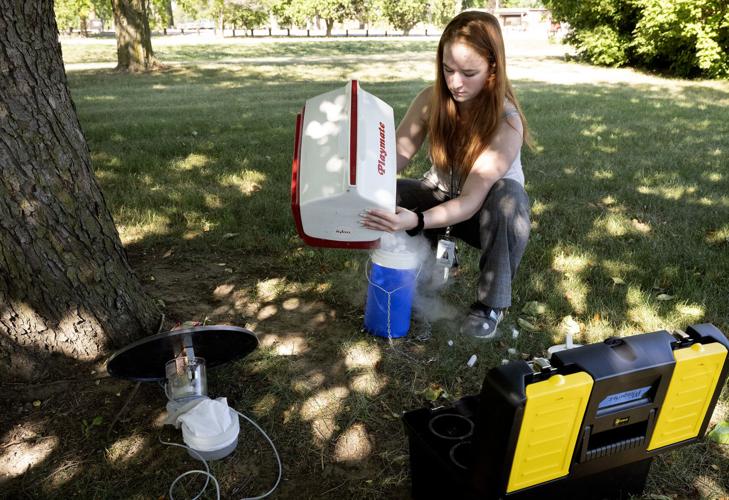
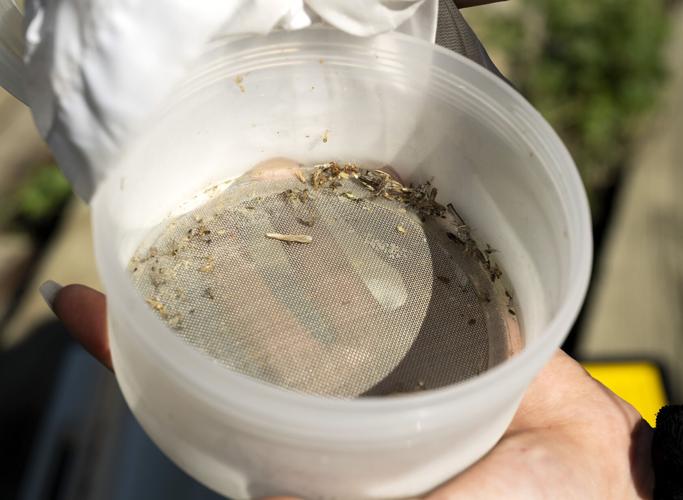
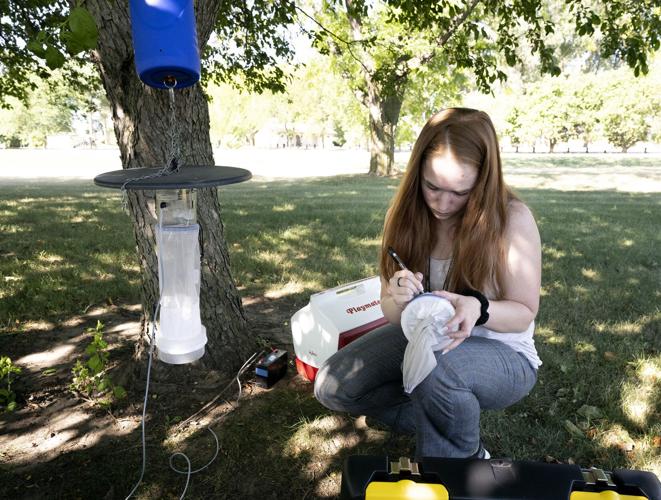

Jacque Laddusaw, an intern at Siouxland District Health Department, collects insects form a trap at Snyder Bend Park in rural Salix, Iowa. The insect collection is part of the district health department's efforts to track mosquitos that may carry the West Nile Virus.
SIOUX CITY -- Cookouts, camping and backyard games are synonymous with summer. But, so are warm-weather maladies.
Siouxland District Health Department Deputy Director Tyler Brock said mosquito and foodborne illnesses are common risks associated with gathering outdoors.

Brock
"We put our food on picnic tables and it sits outside," he said. "I'd say mosquitoes and probably the foodborne illnesses, just because food prep lapses a little bit when we're doing stuff outside some times."
West Nile virus
West Nile virus, a mosquito-borne illness, typically circulates in Iowa from late summer into early fall.
In 2021, just two cases of the virus were recorded in Woodbury County.
"The type of mosquitoes that typically carry the West Nile virus usually pop up later in the summer," Brock said. "We do see more West Nile virus late-summer, early fall."
People are also reading…
According to a study published in the journal Scientific Reports in April 2019, West Nile virus transmission is most common in the western part of Iowa, where the Culex tarsalis, the species of mosquito most often linked with West Nile virus transmission, is prevalent, especially in counties along the Missouri River.
Most cases of West Nile virus are mild and go unreported, according to Brock.
"West Nile virus, a lot of times goes undetected, because usually the only cases that actually get reported to us are the people who are quite sick," he said. "Most of the time, West Nile virus cases are mild and people don't even seek medical attention."
Those people who do develop symptoms may experience fever, stiff neck and headaches. In less than 1% of the people it infects, the virus causes serious neurological symptoms, including seizures and partial paralysis.
A mosquito repellent with DEET is going to be your primary weapon against mosquitoes.
Since mosquitoes lay their eggs in fresh or stagnant water that may be found in abandoned barrels, plastic swimming pools, bird baths and any other containers that can hold water, emptying these sources of standing water around your home are key to reducing mosquito numbers.
Wearing long sleeves and pants and avoiding the outdoors during prime mosquito feeding times, at dawn and dusk, will help protect you against West Nile.
Wear light-colored, long-sleeved shirts and long pants whenever you're outdoors for long periods of time or when mosquitoes are most active.
Lyme disease
Brock said Lyme disease is relatively rare in Siouxland, since the deer ticks that carry it aren't as prevalent in the region.
"They're more prominent in eastern Iowa, Minnesota, Wisconsin," he said. "We don't have a lot in our area, although we do have some. "
In 2021, Iowa tallied 356 confirmed and probable cases of Lyme disease, according to the Iowa Department of Public Health.
The most common early sign of Lyme disease is a skin rash with a bull's-eye appearance.
"The characteristic rash is kind of what you're looking for," Brock said. "All the rest of the symptoms with Lyme disease are really vague and just very general."
While a wet summer favors mosquitoes, ticks flourish in humid environments in low-lying vegetation. If you find a tick attached to your skin, use a tweezers to grab a hold of it and then pull upward.
Foodborne illness
The Centers for Disease Control and Prevention estimates that 48 million cases of foodborne illness occur in the United States every year. At least 128,000 Americans are hospitalized and 3,000 die from eating contaminated food.
Salmonella causes diarrhea, fever and abdominal cramps within 12 to 72 hours of infection. The illness lasts four to seven days. Most people recover without treatment.
"With salmonella risk, it really comes down to cooking your food to the proper temperatures. Cold things need to stay cold. Hot things need to stay hot," Brock said.
Practicing good handwashing is key to avoiding foodborne illness, as is avoiding cross-contamination with raw foods and ready-to-eat foods, according to Brock. He stressed that if you're feeling sick, you shouldn't be preparing food for other people.
The most likely cause of the "stomach flu" is norovirus, a highly contagious illness transmitted directly from person to person or indirectly through contaminated food and water.
"If you've got some diarrheal symptoms, you really shouldn't be preparing food for other people, because norovirus isn't on a food, it's on a person. So, we contaminate the food with food prep," Brock said.