

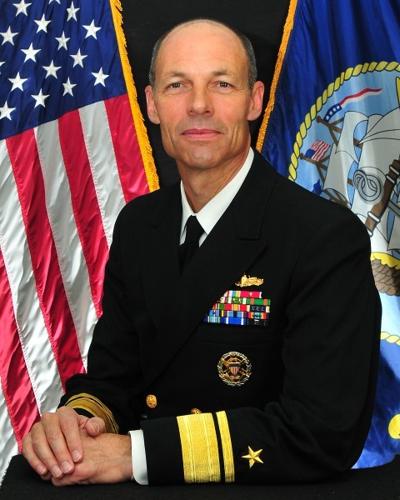
A life in the military? Nick Hytrek discovers what it's like when he talks with Rear Admiral Michael Franken, a Sioux Center, Iowa, native, who graduated from Sioux Center High School in 1976.
1. How long have you been in the Navy?
I am in my 32nd year of service.
2. How did you get interested in military service?
I was a biochemistry major at Morningside College, intending to go to medical school as many of my family members had. By chance I had a talk with my brother, who was a pilot in the Navy. He said rather than go straight to med school, why don't you join the military and goof off for three years and see the world? So I went to (the University of) Nebraska and looked around and joined the ROTC.
3. Why the Navy?
People are also reading…
I applied to the Air Force first, but it was too late for them to take me. So I went to the Navy and they accepted me.
4. Does military service run in the family?
My father served during World War II (in the Navy). My brother did 34 years in the Navy. I have a brother-in-law who was an Army surgeon. I have another brother-in-law who is an Air Force retired colonel pilot. And I have a third brother-in-law who was a Marine infantryman in Vietnam.
5. Have you served in the conflicts in Iraq or Afghanistan?
I have.
6. In what capacity?
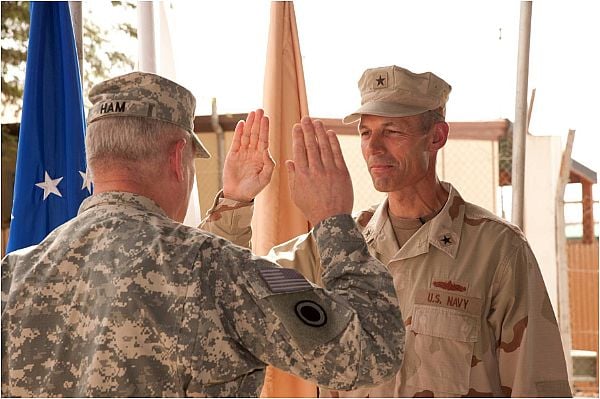
Right after 911, I went to a staff in the Navy called Deep Blue, and we worked on early operations in Afghanistan and planning for Iraq. I had jobs that were either there or tangential (to the wars) since 2002. Recently, I did a year as commander in Djibouti and was responsible for actions in the southwest Middle East and the Horn of Africa.
7. When did you get promoted to admiral?
In July 2008. I was promoted to two-star in February.
8. Was becoming an admiral a goal of yours?
No, never. It couldn't be farther from what my intention was. It's a typical Midwestern thing, you join and you don't stop. You keep carrying forward.
9. Where are you stationed now and what are your duties?
I'm in the Pentagon and live in Alexandria, Va. I represent the Secretary of the Navy on Capitol Hill. I ensure that our nation's legislators are well-versed in all things maritime. I am, by all other descriptions, a man of the legislative process.
10. Do you get any kidding about being an admiral who grew up about as far away from the ocean as you can get?
No. It's unbelievably common. We had a chief of naval operations who was born in Sioux City. There's, I believe, five or six one- or two-star admirals from the University of Nebraska.
11. From your biography, it looks like you've been all over the world. How many countries have you visited?
Something over 80. Some of them a dozen times or more.
12. What are your favorites?
The northern half of Italy is notable. Western Great Britain in the moor area is phenomenal. The mountains of Ethiopia. The Rift Valley of Tanzania. The Seychelles in the Indian Ocean. The northern reaches of Norway.
13. Are there any places you haven't visited yet that you'd like to?
I would like to spend time in Madagascar. I would like to live for a year in Nepal. I think I would appreciate living in the hill country of Southeast Asia, say Cambodia or Thailand.
14. How much of your Navy career has been spent on a ship in the middle of the ocean?
That would be an indeterminate question. I have about 12 years of sea service. In essence, I spent the '80s at sea.
15. How's that compare to being surrounded by the green corn and bean fields of Northwest Iowa?
There are some visuals which are the same. As the corn and beans wax and wane in the breeze is like waves. The expanse is kind of the same.
16. What does Veterans Day mean to you?
I've never really needed to be thanked for my service. I chose this lifestyle. The right outlook on it ought to be a high degree of humility. We shouldn't seek preferential treatment.
17. Do you think the way the country views its veterans has changed since the wars in Iraq and Afghanistan?
The nation should be thankful our military members answered the call of our civilian leadership. People signed up for the military knowing they were going to war. That's worth a tip of the cap. The nation should treat us like any person who's in a service-related field like teachers or social workers or police officers.
18. How do you personally honor veterans?
I honor my elders. I have a soft spot for World War II, Korea and Vietnam veterans. There's no honoring other than treating them with respect.
19. Can you describe the bond shared by veterans who have served together?
You have to really have an understanding of what the person did during their service. Before I show any emotion, I try to understand what that person did in their service.
20. What's been your proudest moment as a member of the military?
Standing on the bridge after you know your ship did really well. When you're the CO (commanding officer) of a ship, you're really alone at the top.