

Heart and renal failure can result in fluid overload, a medical condition where there is too much fluid in the blood.
Patients become bloated, their skin tightens and they have trouble breathing.
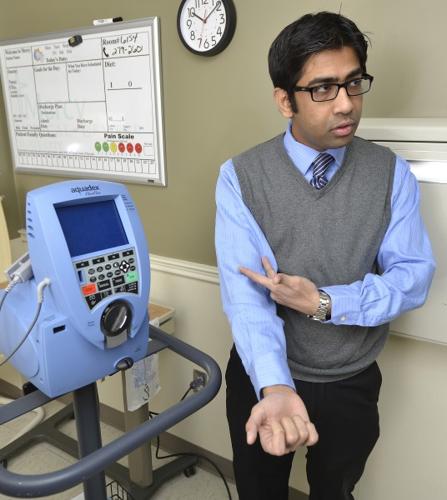
Diuretics or water pills are used to rid the body of excess water through urine, but they don't always work well, according to Ashar Luqman. That's when the nephrology specialist with Renal Associates in Sioux City said he turns to an aquapheresis machine.
"The advantage of this machine over the diuretics is with this machine we can save and protect the kidneys a little bit better because the kidneys are not being used to get rid of all the additional fluid," he explained.
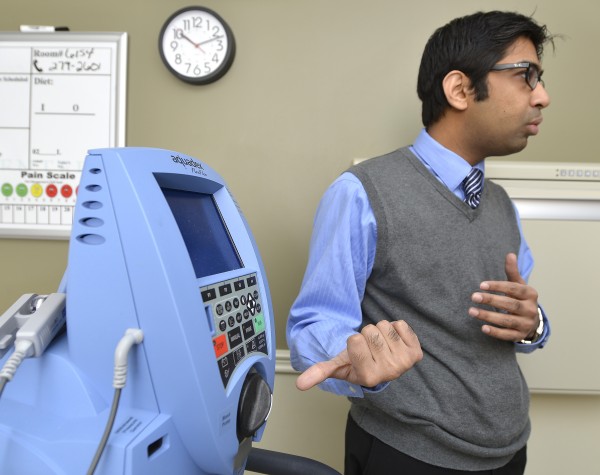
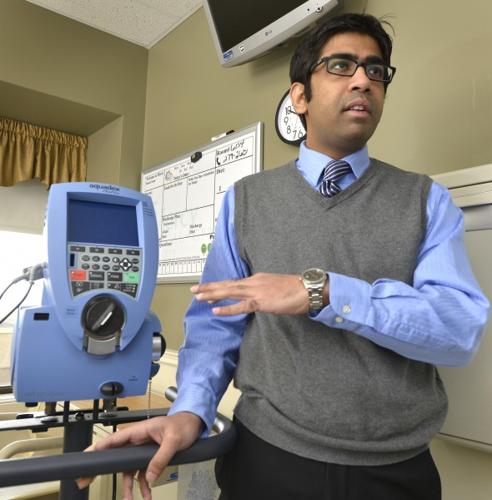
Mercy Medical Center obtained the Aquadex FlexFlow system about eight months ago. The portable blue machine, Luqman said, has been used successfully on a handful of patients.
People are also reading…
"We have used this machine in at least three or four patients so far with very good results," he said. "We're trying to expand the program."
A patient with congestive heart failure suffering from fluid overload, who has normal kidney function, Luqman said, would be a candidate for aquapheresis.
"With the help of this machine we usually get the fluid off," he said. "The difference between this machine and a dialysis machine is that with this machine only the fluid is removed. We don't clean the blood with this one."
A small catheter is inserted into a vein in the patient's arm. A small pump connected to the catheter removes the blood and and transports it through a filter in the machine, which removes water before transporting the blood back to the body. A small sensor in the machine tells the physician how the patient's body is responding to the treatment.
"There is an internal safety mechanism which helps to protect against removing a lot of fluid, which will make the patient dehydrated, hypertensive or have them drop their blood pressures or increase their heart rates quite a bit," Luqman said.
If the patient is doing well, he said up to up to 4 liters or 8 pounds of fluid can be removed from their body within a 24 hour period via aquapheresis.
"When we remove the additional fluid your heart gets into better hemodynamics because it has less fluid to play with," he said. "It's just like a pump, if that pump has to handle 20 liters of fluid versus 10 liters of fluid, the pump will work better and more efficiently."
At total of 5 to 10 liters or 10 to 20 pounds may be removed from the body at the end of the treatment, which Luqman said, lasts two to three days on average.
After a stint on the Aquadex FlexFlow, Luqman said patients usually resume taking water pills.
"While the patient is getting the aquapheresis done, we usually stop the diuretics about a day or so before we initiate this treatment," he said. "
In terms of mortality, Luqman said their is no difference between diuretics and aquapheresis. However, he said the machine has been shown to reduce the length of time a patient will stay in the intensive care unit and the hospital overall.