
SIOUX CITY -- Bridget Breyfogle said it smelled like Play-Doh while Mackenzie Tott said it was squishy when she cut it in half.
"It was not only squishy, but it also left plenty of brain juice behind," Mackenzie said, scrunching up her nose. "Sheep brains are gross!"
Mackenzie and Bridget, both Blessed Sacrament Catholic School sixth-graders, were participating in the four-day CNOS Foundation Science Classic, in which middle school kids were allowed to experience chemistry, physics and anatomy in a hands-on way.
And by hands-on, yes, we do mean actual sheep brains were dissected.
"Super gross," Bridget said, shaking her head.
Held this year at Bishop Heelan Catholic High School, the specialized camp regularly attracts science-minded students from school districts in Siouxland and beyond, according to CNOS Foundation's Beth Noel.
People are also reading…
"The Science Classic is dedicated in the memory of my late husband Dr. Stephen Noel," she said. "Steve wanted to create a summer program in which students could experience science in a way that wouldn't be feasible during the school year."
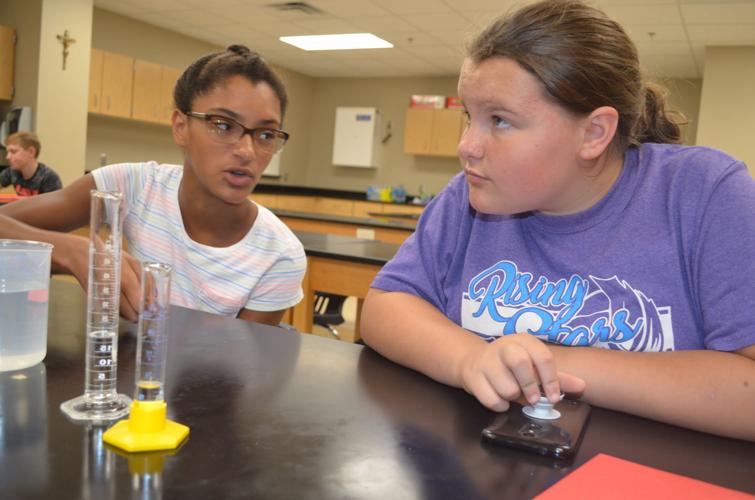
For instance, a physics unit let students measure liquids in a test tube, while a chemistry class demonstrated how copper oxidizes when combined with different chemical agents.
Plus the units are taught by area physics, chemistry and biology teachers, respectively.

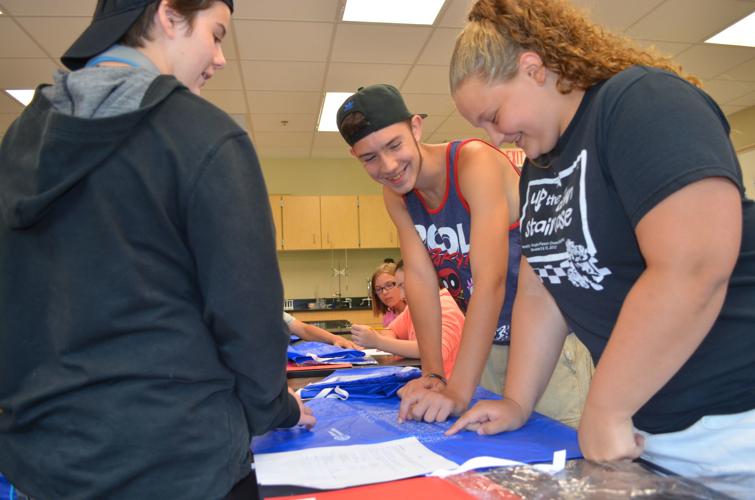
Eighth graders DaniKa Burrell, Alexander Cowell and Olivia Stevens look at a periodic chart for a chemistry unit taught during a CNOS Foundation Science Challenge summer camp. The annual camp gives students hands-on training i chemistry, physics and anatomy.
So, is this some sort of camp for future doctors? Not according to Noel.
"The science field isn't just about medicine," she said. "On our last day of class, the students will go on different field trips. One of the sites students may be visiting is the city's water treatment facilities.
"We want the science classic to expose kids to every aspect of science."
During the regular school year, West High School biology teacher Kent Martin works with older children. With the science classic, he's teaching sixth-graders who never have been taught anything about dissection.
"When you're teaching younger children, you're stressing things like showing respect toward something that was once a living creature," he said. "By the sixth grade, I think kids get it."

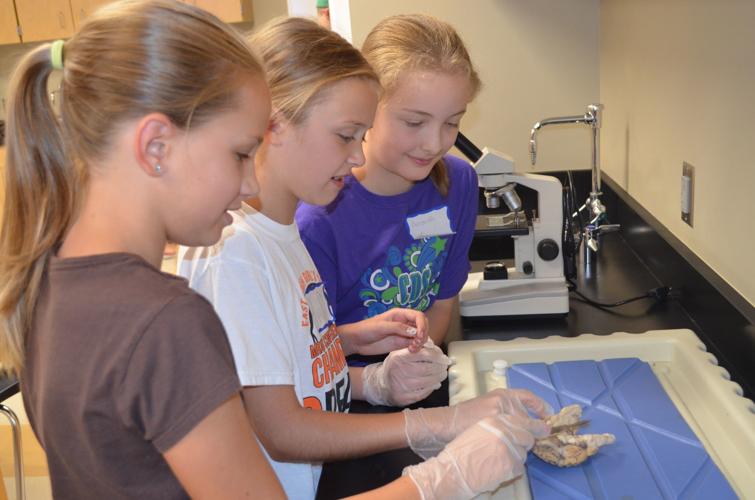
Budding sixth grade scientists Olivia Munchrath, Ava Downing and Aniah Croft tackle anatomy by dissecting the brain of a sheep during a CNOS Foundation Science Challenge summer camp, held in July. Biology teacher Kent Martin said such hands-on learning experiences are important since kids are naturally curious.
Olivia Munchrath gets how anatomy is best taught through dissection. However, neither she nor her sixth-grade lab partner Ava Downing is happy about examining the brain of a sheep.
"It is more springy than I thought it would be," Olivia said.
"I thought it would be soft," Ava added, shaking her head. "Parts of the brain were quite hard."
These are the types of observations Martin wants students to get from his class.
"Kids are naturally curious and they like to see how things really work," he said. "Science is all about discovery."
Despite their initial objection, Bridget Breyfogle and Mackenzie Tott seem to have recovered from their bad "sheep brain" experience.
"I don't know if I want to be a scientist when I grow up," Bridget said. "But this week has been interesting."
Mackenzie nodded her head in agreement.
"I like these classes because they're different than the ones taught during the school year," she said. "That makes it challenging."
Copyright 2018 The Sioux City Journal. All rights reserved. This material may not be published, broadcast, rewritten or redistributed.

Earl Horlyk
Food and Lifestyles reporter