

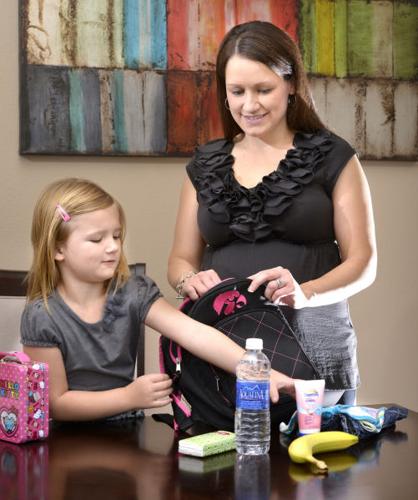
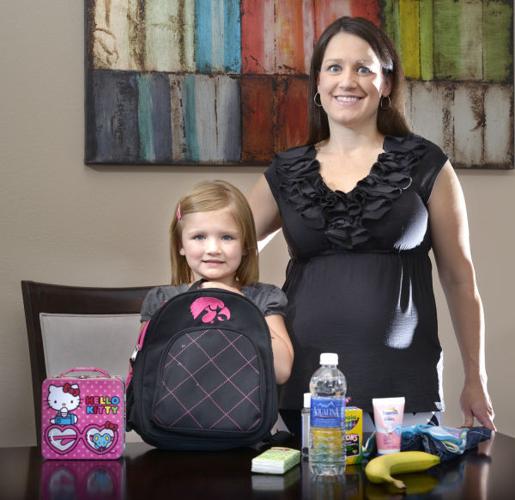
There's no magic pill or product that will keep your child safe and disease-free this school year, but local doctors, who also hold the title of mom and dad, offered some tips that might help keep kids healthier.
Amanda Dannenbring, a family practice physician at Family Health Care of Siouxland Dakota Dunes Clinic, is already seeing cases of strep throat that causes fever, swollen glands and headache in addition to sore throat. Hand-foot-and-mouth disease, a viral infection that causes sores in the mouth and on the hands and feet, was another illness sickening Dannenbring's young patients during the summer.
Dannenbring, who will send her 5-year-old daughter to pre-kindergarten this month, said students missed the first day of school because of strep throat, a contagious bacterial infection.
"I had a little guy the other day who was so upset. He wanted to go to science class; and he wasn't able to go to science class," she said. "I felt really bad, but he had a pretty good fever."
People are also reading…
Dannenbring said children need to be fever-free for at least 24 hours before returning to school to prevent the spread of the illness.
Parents, Dannenbring said, should be sure to schedule a back-to-school physical if they haven't with their child's doctor to take care of any chronic conditions such as asthma and catch up on immunizations. Inoculations to protect against influenza, diphtheria, pertussis and tetanus are a must.
According to Steven Joyce, a physician with Mercy Medical Center Internal Medicine & Pediatrics, practicing good hand-washing in school is of utmost importance.
"That's how kids get sick. They're around a whole bunch of other kids more than they are in the summertime. They are exposed to lots more germs, so they need to wash their hands with soap and water and good technique," he said. "It seems like kids get sick a lot more at the beginning of school because they do."
Joyce has a daughter going off to college this fall for the first time. College students, he said, should have a Meningococcal vaccine to protect against meningitis, a rare but potentially deadly bacterial infection that poses a greater risk to students living in close quarters.
"The meningitis vaccine is probably the most important one because in college you're exposed to a lot of people in a close vicinity.," he said. "You're living with them. Those are the risk factors."
Aimee Lorenz, a pediatrician at Prairie Pediatrics in Sioux City, echoes Joyce's hand-washing advice. She's equipping her 11-year-old son and 8-year-old daughter with a bottle of hand sanitizer.
While wiping down desks and tables with wet wipes is a good way to reduce bacteria and virus transmission from surfaces, Lorenz said following good handwashing with a little hand sanitizer also reduces the spread of diseases.
Getting an adequate amount of sleep (her kids aim for 9.5 hours), Lorenz said is key to keep students of all ages healthy. Teens trying to balance school with extracurricular activities and part-time jobs, she said, struggle to get enough sleep. Lorenz recommends they to shoot for around 10 hours a night.
"Poor sleeping habits will decrease their ability to fight off infections," she said. "Falling asleep at school is a sign they're not getting enough sleep."
Red eyes, dark circles under the eyes and irritable behavior, she said, also indicate the need for an earlier bedtime.
"I think they won't go to bed nearly as early when they're exhausted," Lorenz said of her kids. "They'll still try to push the limit to stay up late."