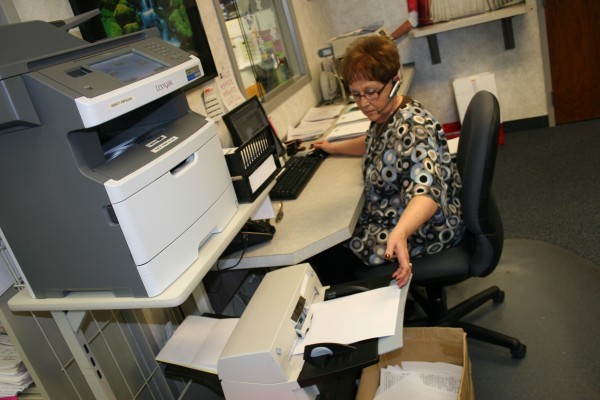
Linda Mulder, a customer relations representative, feeds medical documents through a scanner at Family Health Care of Siouxland Indian Hills Clinic. After it is scanned, the information can be placed directly into a patient's electronic medical record.
When Family Health Care of Siouxland Indian Hills Clinic switched from paper medical records to electronic ones in 2006, some office jobs dramatically changed, while others were eliminated altogether.
Manager Barb Held said the clinic, located at 2600 Outer Drive North, once employed two full-time transcriptionists to transcribe physician dictation.
Since physicians now type information on a laptop directly into a patient's electronic record, there is almost no need for medical transcriptionists, although Held said the clinic still does employ one on an on-call basis to transcribe form letters and occasional dictation.
Office personnel once tasked with filing paper medical records, today scan a variety of paper medical documents into the clinic's computer system. Once the information is into the system, it can be routed to the patient's medical record with a click of a mouse.
Even faxes go directly into the clinic's computer system, although Held said employees still needs to file them appropriately.
Linda Mulder, who has worked as a customer relations representative at the clinic for 15 years, had to make the transition from paper to electronic medical documents.
She feeds paper pathology reports, living wills, hospital records and other medical documents through a small scanner adjacent to her desk and then puts them in the proper places in the patient's electronic medical record.
"It's definitely lots more computer work," she said. "It's probably faster and a little more efficient."
Held said an advantage of electronic medical records is knowing where every patient's record is. A paper chart, she said, would often float through the office.
"There's no losing paper," she said. "If you're very proficient on the computer and you like looking up stuff that way, then it's easier."
According to Held, physicians have said that scanned documents are also easier for them to read.
Patients have had to adjust to the change as well. Physicians, Held said, can't make as much eye contact in the exam room because they're typing.
Held said she only expects more office jobs to be lost and hours slashed as technology advances.
"The more electronic you go, the less jobs there are or at least less hours," she said.
Linda Mulder, a customer relations representative, feeds medical documents through a scanner at Family Health Care of Siouxland Indian Hills Clinic. After it is scanned, the information can be placed directly into a patient's electronic medical record.