

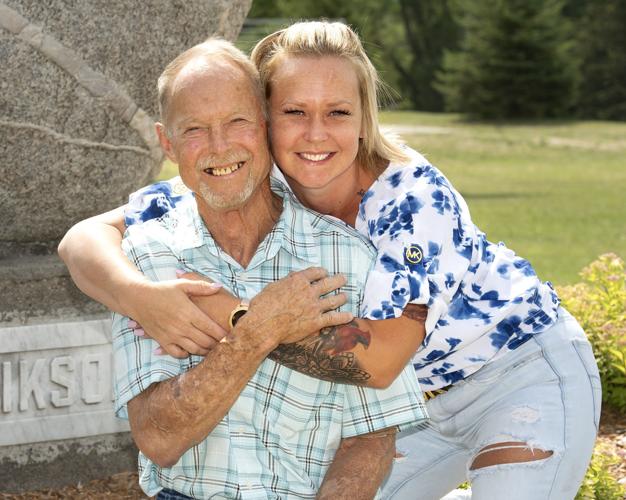
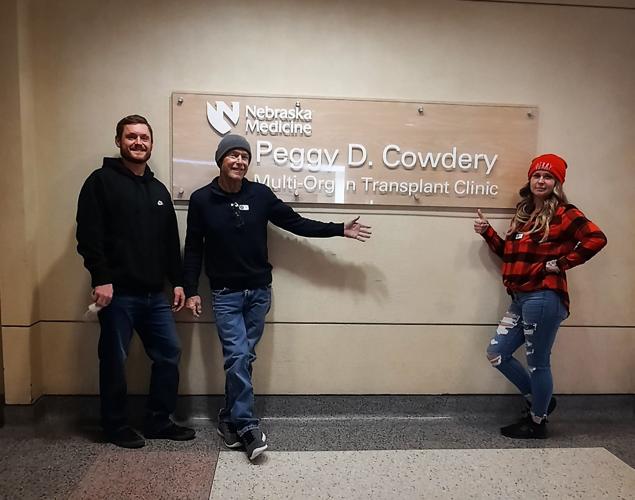
SIOUX CITY -- Last year, Cora and Phil Haefs had a surgery scheduled to transplant one of her kidneys to him. It was cancelled. Then they made another appointment. It also was cancelled. Then another. And another.
One of the appointments, at Nebraska Medicine in Omaha, was called off due to a fatal automobile accident -- the doctors and staff were suddenly diverted to the urgent, time-sensitive task of removing organs and tissues from a donor who was killed. The others were cancelled for various reasons, including staffing difficulties and the ever-present pandemic.
But finally, on Dec. 17, it happened. Over the course of roughly 2 1/2 hours, Drs. Arika Hoffman and Alexander Maskin removed one of Cora's kidneys and put it in the body of Phil, her father. Almost instantaneously, like the lights in a room after a blown fuse is replaced, the healthy kidney got to work.
People are also reading…
"It started pumping fluid right out of the bladder immediately, which is perfect -- you can't get any better than that," Phil said. "Sometimes a kidney will 'sleep' for a day or two before it starts (functioning.) It started working right away, it was the best you could ask for."
Cora was able to go home after a few days, while Phil had to stay in Omaha into part of January for observation and to be in close proximity to the medical team, and for follow-up exams, educational classes and physical therapy.
Within days of the transplant, he was already looking markedly healthier; while on dialysis his skin had developed the mottled, thin, scabbed appearance typical of a far older person.
After he got back on his feet and back in Sioux City, Phil, 64, had big plans. He wants to build up his strength -- dialysis left him weakened. "He was thinner than paper," said Cora, 38.
And he intends to get back to work, liberated from the dialysis equipment that kept him a prisoner at home much of the day. Free of the fear that dialysis won't go well today, and the near-certainty of serious illness that follows. Confident that his rehabilitated renal system is doing what it's supposed to, on autopilot and without any complicated mechanical intervention, so that he doesn't need to worry about it.
"I'm 64, I'm almost at the age to retire, but I'm not that kind of guy, I just don't think I'm going to do that yet," he said.
Lone kidney
Phil Haefs grew up with only one working kidney. Its faulty counterpart wasn't discovered until after he turned 18, when a physical exam revealed high blood pressure -- the kidneys govern blood pressure and fluid balance -- and doctors found a kidney problem. A procedure the following year put things back in order, at least for the next 40 years or so, but he still had only one kidney.
He acknowledged that, for a time in his younger years -- when illness and old age were still in the distant future -- he wasn't as careful with his kidney as he could've been, describing himself as "rambunctious" and a "construction worker, drinker, smoking guy." Still, the kidney soldiered on and he remained in good health until time took its toll.
Around the time he turned 60, Phil's solo kidney began to weaken. After a cardiovascular procedure that didn't go well, the kidney shut down and he went on dialysis. The kidney recovered and he got off dialysis, but within two years the kidney failed again. It was permanent this time.
Kidney failure usually manifests itself as a noticeable fluid buildup, called edema, along with a host of other distressing symptoms. These are the result of the renal system failing to exchange fluids, eliminate waste and maintain the proper balance of water, salts, bodily chemicals and blood pressure. In the era before dialysis or transplants, when the condition was termed "Bright's disease," kidney failure typically resulted in death unless the patient's kidney function made an (unlikely) comeback.
For many kidney failure sufferers, fluid builds up in the lower extremities -- typically the legs and feet -- giving them a very puffy appearance, a visual hallmark of the condition.
"For me, the fluid buildup is in my face, of course," Phil Haefs said last summer, before the transplant.
He went on dialysis, but it often didn't go well and served as a constant source of distress. Though dialysis technology has made major advances in recent decades -- dialysis can be done from the comfort of home now -- it remains one of the most intensely disliked and dreaded medical interventions. Even the advanced machines of today can't always be relied on to correctly perform delicate bodily functions that healthy organs manage flawlessly.
"I mean a lot of people just deny doing (dialysis), they don't want to live that way," Phil Haefs said. "And they pass away. They'd just rather pass away than do it. Not me, though."
It took quite a while, but Cora eventually prevailed on her father to accept a transplant. Parental resistance to receiving a transplant from children is not uncommon among those who have that option, but Cora wasn't going to take no for an answer.
"A whole year before I finally gave in. I didn't want to do that to my daughter -- I mean I've lived 64 years with one kidney," he said.
The organ transplant list is notoriously long, and the wait often ends when the patient dies without having received a transplant. Prospective recipients have to be ready, always, at a moment's notice to make a mad dash to the hospital should an organ suddenly come available -- time is of the essence. But that abrupt, get-here-now call may never come.
Testing revealed Cora to be a perfect match, and she was in good health. Phil took solace in the hope that renal treatment or replacement technology will make significant advances in the coming decades, so that even if Cora's kidney falters one day, she won't have to struggle the way he did.
Whatever the long-term risks, real or perceived, Cora paid them little mind. She only wanted her father to feel better.
"If I had a million (kidneys), they could've taken them all out but one," Cora said. "I hope other people that are on dialysis get that chance."
Caring for a new kidney
Phil and Cora are determined to keep their shared renal systems alive and well for a long, long time -- ideally for as long as they themselves are around.
"The saying that they have is, 'The way to pay back a kidney transplant is to treat that kidney with respect,'" Phil said. "That's a good thing to keep in mind and that's kind of the way I've got to live life now."
Transplant recipients have to go on immunosuppressant drugs for the remainder of their lives -- the immune system can become spooked at encountering an unfamiliar person's organ and attack it, killing the organ and putting the recipient back at square one. So the immune system has to be calmed down with drugs.
"It's a lifelong commitment," Phil said.
An immune system restrained by medication leaves Phil at increased risk of infection, so he has to be careful. Fresh fruits and vegetables -- or any food item that was touched by somebody else -- has to be washed thoroughly to keep foodborne pathogens at bay. Rare or undercooked meat isn't a good idea. Vaccines are a good idea.
"I used to, I still do, like medium-rare meat, and that's out of the question because medium-rare meat can hold bacteria," Phil said.
Cora, on the other hand, has relatively few restrictions to her lifestyle, except for minor things like drinking generous portions of water every day and avoidance of certain over-the-counter pain relievers. Activities that could put stress on a kidney -- excessive drinking, smoking -- are probably better avoided. She already didn't do those things, so that's not a problem.